
Millstone Township in Monmouth County, New Jersey — The American Northeast (Mid-Atlantic)
Woodville
“Little Africa”
Photographed by Richard Peterson, August 25, 2026
1. Woodville Marker, Side One
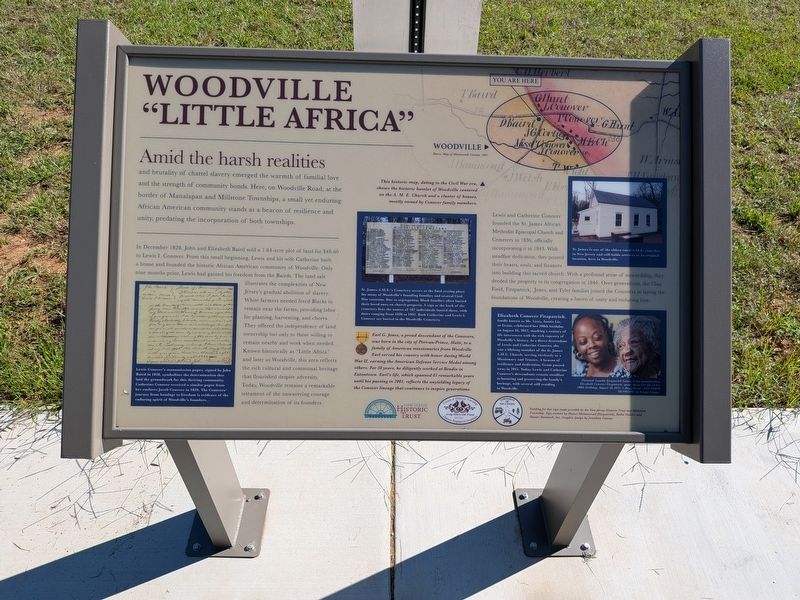
Amid the harsh realities and brutality of chattel slavery emerged the warmth of familial love and the strength of community bonds. Here, on Woodville Road, at the border of Manalapan and Millstone Townships, a small yet enduring African American community stands as a beacon of resilience and unity, predating the incorporation of both townships.
In December 1828, John and Elizabeth Baird sold a 1.64-acre plot of land for $48.60 to Lewis I. Conover. From this small beginning, Lewis and his wife Catherine built a house and founded the historic African American community of Woodville. Only nine months prior, Lewis had gained his freedom from the Bairds. The land sale illustrates the complexities of New Jersey’s gradual abolition of slavery. White farmers needed freed Blacks to remain near the farms, providing labor for planting, harvesting, and chores. They offered the independence of land ownership but only to those willing to remain nearby and work when needed. Known historically as “Little Africa” and later as Woodville, this area reflects the rich cultural and communal heritage that flourished despite adversity. Today,
this page online
Lewis and Catherine Conover founded the St. James African Methodist Episcopal Church and Cemetery in 1836, officially incorporating it in 1843. With steadfast dedication, they poured their hearts, souls, and finances into building this sacred church. With a profound sense of stewardship, they deeded the property to its congregation in 1846. Over generations, the Clay, Field, Fitzpatrick, Jones, and Tyler families joined the Conovers in laying the foundations of Woodville, creating a haven of unity and enduring love.
Earl G. Jones, a proud descendant of the Conovers, was born in the city of Port-au-Prince, Haiti, to a family of American missionaries from Woodville. Earl served his country with honor during World War II, earning the American Defense Service Medal among others. For 38 years, he diligently worked at Bendix in Eatontown. Earl’s life, which spanned 83 remarkable years until his passing in 2001, reflects the unyielding legacy of the Conover lineage that continues to inspire generations.
Elizabeth Conover Fitzpatrick,
Photographed by Richard Peterson, August 25, 2026
2. Woodville Marker
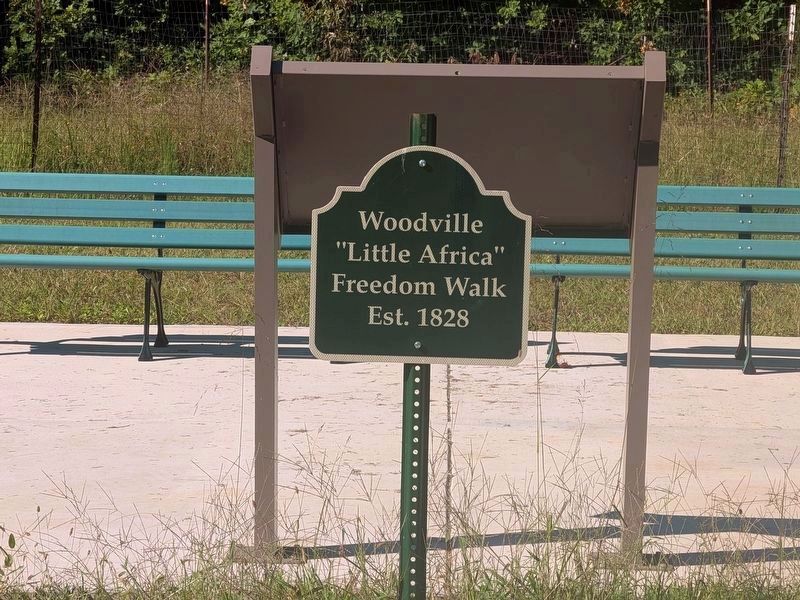
“Little Africa”
Freedom walk
Est. 1828
Pictured: Lanette Fitzpatrick listens to her grandmother, Elizabeth Conover Fitzpatrick, speak about her life on her 100th birthday, August 10, 2012. (c) Doug Hood — USA Today Network via Imagn Images
( image captions )
— Lewis Conover’s manumission paper, signed by John Baird in 1828, symbolizes the determination that laid the groundwork for this thriving community. Catherine Conover received a similar paper from her enslaver Jacob Conover in 1829. The Conovers’ journey from bondage to freedom is evidence of the enduring spirit of Woodville’s founders.
— St. James A.M.E.'s Cemetery serves as the final resting place for many of Woodville’s founding families and several Civil War veterans. Due to segregation, Black families often buried their loved ones on church property. A sign at the back of the cemetery lists the names of 107 individuals buried there, with dates ranging from 1830 to 1992. Both Catherine and Lewis I. Conover are buried in the Woodville Cemetery.
— St. James is one of the oldest A.M.E churches in New Jersey and still holds services at its original location, here in Woodville.
Funding for this sign made possible by the New Jersey Historic Trust
and Millstone Township. Sign content by Shazel Muhammad (Fitzpatrick), Retha Onitiri, and
Hunter Research, Inc. Graphic design by Jonathan Conner.
Topics. This historical marker is listed in these topic lists: African Americans • Religion & Religious Structures • Settlements & Settlers. A significant historical year for this entry is 1828.
Location. 40° 14.517′ N, 74° 23.05′ W. Marker is in Millstone Township, New Jersey, in Monmouth County. It is at the intersection of Smithburg Road and Roberts Road, on the right when traveling south on Smithburg Road. Touch for map. Marker is in this post office area: Millstone Township NJ 08535, United States of America. Touch for directions.

Regionally, this marker is in Central Jersey and in the New York City Metropolitan Area. It is also in the American Northeast, in the Mid-Atlantic, and on the Eastern Seaboard. Globally, it is in the North Atlantic Region, North America, the Western Hemisphere, the Western World, and the Anglosphere. Historically, it finds itself in what was once New Netherland and also one of the original Thirteen Colonies.
Other nearby markers. At least 8 other markers are within 4 miles of this marker, measured as the crow flies: Welcome to Baird Homestead (approx. 0.4 miles away); Mary Hays, nicknamed “Molly Pitcher" (approx. 3.6 miles away); Combs Hill Cannonade (approx. 3.7 miles away); Monmouth Battlefield (approx. 3.7 miles away); General von Steuben (approx. 3.7 miles away); D’Annae: A French, Swedish-Style 4-pounder (approx. 3.7 miles away); Monmouth Battlefield State Park (approx. 3.7 miles away); Molly Pitcher (approx. 3.7 miles away).
Credits. This page was last revised on August 31, 2026. It was originally submitted on August 25, 2026, by Richard Peterson of East Windsor, New Jersey. This page has been viewed 10 times since then. Photos: 1, 2. submitted on August 25, 2026, by Richard Peterson of East Windsor, New Jersey. • Michael Herrick was the editor who published this page.
