Memorial Park in Ruston in Lincoln Parish, Louisiana — The American South (West South Central)
Captain Gerald McCallum
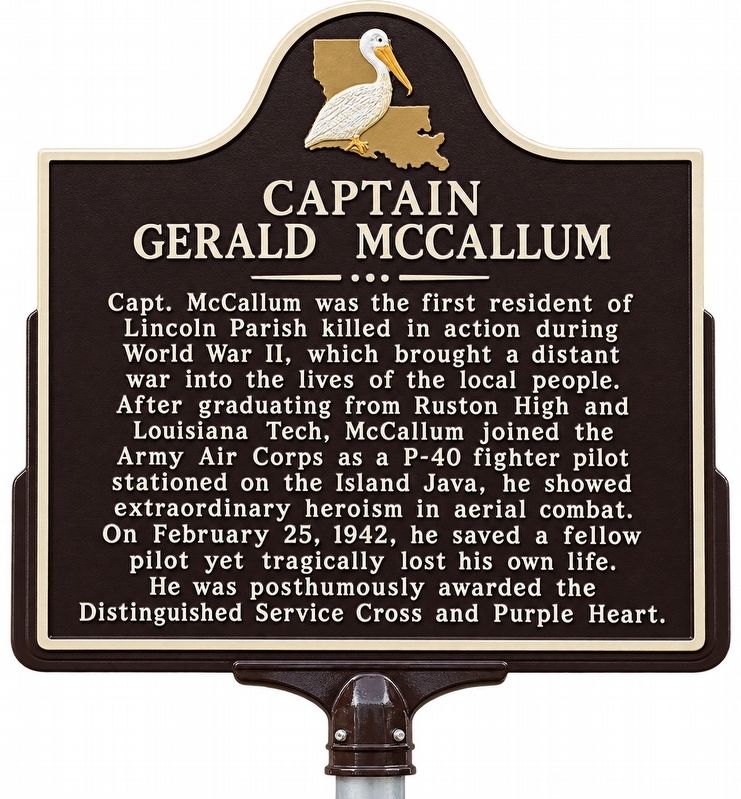
Photographed by Wesley Harris
1. Captain Gerald McCallum Marker
Capt. McCallum was the first resident of Lincoln Parish killed in action during World War II, which brought a distant war into the lives of the local people. After graduating from Ruston High and Louisiana Tech, McCallum joined the Army Air Corps as a P-40 fighter pilot stationed on the Island Java, he showed extraordinary heroism in aerial combat. On February 25, 1942, he saved a fellow pilot yet tragically lost his own life. He was posthumously awarded the Distinguished Service Cross and Purple Heart.
Erected 2026 by McFarland-McCallum American Legion Post No. 2.
Topics. This historical marker is listed in this topic list: War, World II. A significant historical date for this entry is February 25, 1942.
Location. 32° 31.831′ N, 92° 37.979′ W. Marker is in Ruston, Louisiana, in Lincoln Parish. It is in Memorial Park. It is on Memorial Drive 0 miles south of East Georgia Avenue (U.S. 80), on the left when traveling south. the marker is at roadside between the North Louisiana Military Museum and the VFW Hall across the street. Touch for map. Marker is at or near this postal address: 200 Memorial Dr, Ruston LA 71270, United States
this page online

Regionally, this marker is in North Louisiana. It is also in the American South, specifically in the Deep South, and in the Piney Woods. Globally, it is in North America, a Gulf of Mexico state, the Western Hemisphere, the Western World, and the Anglosphere. Historically, it finds itself in what was once the territory of the Mississippian Culture, the Louisiana Purchase, one of the Confederate States of America, and the Antebellum South.
Other nearby markers. At least 8 other markers are within 2 miles of this marker, measured as the crow flies: First Presbyterian Church (approx. 0.2 miles away); Old Post Office (approx. 0.3 miles away); Lincoln Parish musicians / Honors Lincoln Parish Music Venues (approx. 0.3 miles away); V. S. & P. Railroad Depot (approx. 0.3 miles away); The Pierian Rose Garden (approx. 0.4 miles away); Kidd-Davis House (approx. 0.4 miles away); West Hill (approx. half a mile away); Lincoln High School (approx. 1.6 miles away). Touch for a list and map of all markers in Ruston.
Regarding Captain Gerald McCallum. Harris on History: Ruston Hero's Last Mission
by
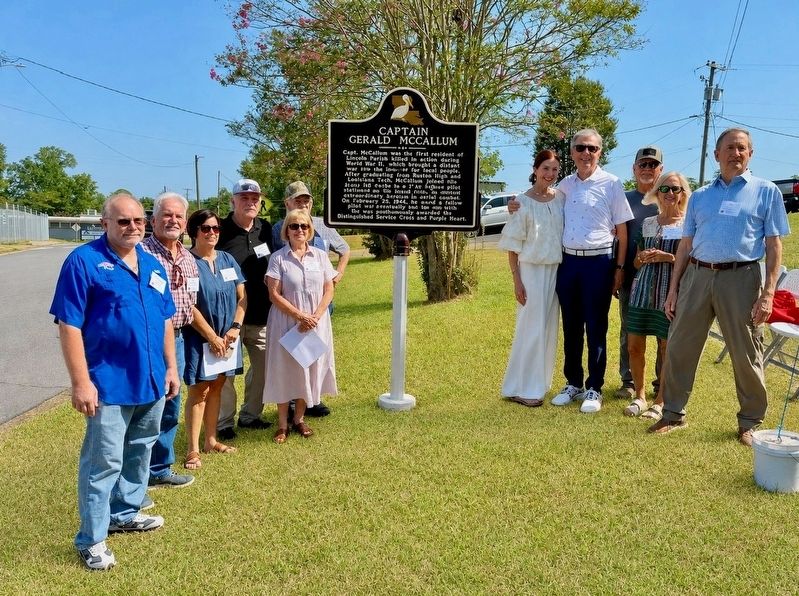
Photographed by Malcolm Butler, August 26, 2026
2. Member of McCallum's family gather around his new marker.
(Lincoln Parish Journal, Aug 27, 2026)
On August 26, more than 84 years after Gerald McCallum gave his life in the skies over Java, his sacrifice was formally memorialized in his hometown.
With dignitaries and members of McCallum’s family present, a historical marker honoring the World War II fighter pilot was dedicated at Ruston’s Memorial Park.
Mounted between the North Louisiana Military Museum and the Veterans of Foreign Wars hall, the new marker commemorates McCallum, the first man from Lincoln Parish killed in World War II. For his actions during his final mission, he was posthumously awarded the Distinguished Service Cross, America’s second-highest award for valor.
McCallum was 25 years old.
Born in Ruston on January 31, 1917, McCallum was the son of Mr. and Mrs. E. D. McCallum. He graduated from Ruston High School in 1932 and later earned a B.A. in engineering from Louisiana Tech before entering the Army Air Corps in 1939.
After training, Second Lieutenant McCallum, nicknamed “Bo,” shipped out to the Philippines in 1940. American troops there were wary of the Japanese who had been fighting the Chinese since
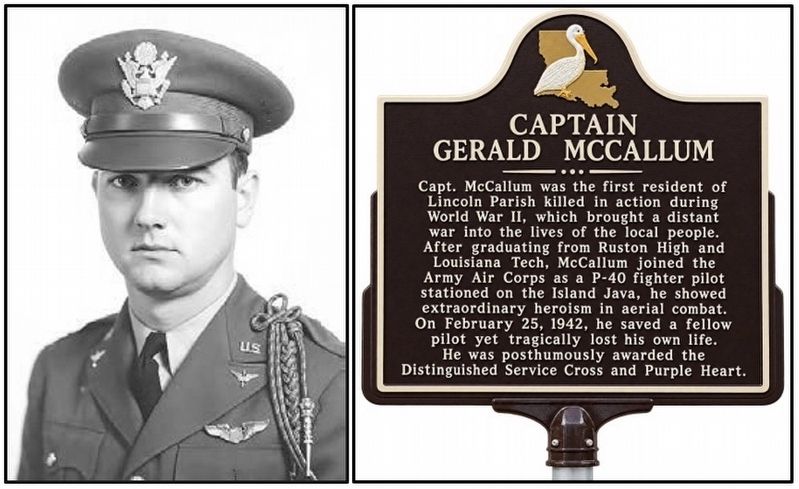
Photographed by Wesley Harris, August 26, 2026
3. Captain Gerald McCallum Marker
In late 1941, First Lieutenant McCallum was sent to the southwest Pacific on a special mission. Troops and planes would be coming into Australia and men like McCallum would have to ready them when the U.S. joined the war. When the Japanese attacked the Philippines and Pearl Harbor on December 7, McCallum found himself fighting on one of the most desperate fronts of the war.
Japan moved quickly. Its forces swept south through the Pacific, capturing airfields, ports, and islands as Allied defenses crumbled before them. Australia was becoming a vital base for American and Allied forces, providing airfields, ports, supplies, and a place from which eventually to strike back. It could not be allowed to fall.
But until that strike could be organized, McCallum and others formed a thin and badly outnumbered Allied defense line between the Japanese advance and Australia. American pilots were sent into the Netherlands East Indies to help hold that barrier and slow the enemy while men, aircraft, and supplies poured into Australia for the fight to come.
McCallum’s 17th Pursuit Squadron was a provisional outfit hastily assembled in Australia from available pilots and aircraft, including veterans who had already fought the Japanese in the Philippines. In January 1942, its pilots flew their P-40 Warhawks roughly 2,000 miles across Australia to begin the hazardous journey north across the Timor Sea and through the islands to Java. Of the original 17 P-40s, only 13 reached Soerabaja.
There they faced an enemy advancing faster than the Allies could reinforce the squadron.
When Japanese aircraft attacked Soerabaja, Java on February 3, the 17th stood virtually alone. The nearest other American fighter planes were 1,300 miles away.
The 17th was not simply waiting for the Japanese to come. Its pilots intercepted enemy bombers and fighters and carried bombs beneath their P-40s to strike Japanese ships and landing forces. On February 17, eight of the squadron’s fighters flew hundreds of miles to attack Japanese shipping and aircraft near Palembang. Japanese fighters tried to stop them, but three American planes broke through to attack the enemy landing force, and all eight P-40s made it home.
But the Japanese continued closing the ring around Java. Singapore fell February 15. Japanese forces seized strategic positions across Borneo and Celebes, landed on Bali, and cut the air route through which American fighters had been reaching Java. Reinforcements trickled in, but aircraft were being lost to combat, crashes, weather, and the long journey north from Australia. Even at the height of its strength, the official Army Air Forces history described the 17th as “far from equal to the task confronting it.”
The squadron was losing pilots, too.
Its commander, Major Charles Sprague, was killed in aerial combat on February 20. Two more pilots, George Hynes and Wallace Hoskyn, were lost the following day. After Sprague’s successor was ordered away, command of the battered squadron fell to McCallum, its engineering officer.
The 25-year-old from Ruston was now leading what remained of the 17th Pursuit Squadron.
The next day, February 25, with only twelve planes available, McCallum led his pilots into battle over Soerabaja.
They climbed to intercept an approaching Japanese force and found themselves facing 54 enemy bombers protected by 36 fighters. The Japanese held not only a crushing numerical advantage but also the advantage in altitude.
McCallum attacked anyway.
During the battle, he saw one of his pilots being pressed by a Japanese fighter and in serious danger. With his own life already at risk, McCallum turned his P-40 toward the enemy aircraft.
He went to help.
McCallum drove off the Japanese fighter pursuing his fellow pilot, but his own P-40 was hit. With his engine smoking, McCallum bailed out, and his parachute opened.
The Japanese fighters did not let him escape. They followed the helpless pilot down, firing their machine guns into his parachute as he fell.
Gerald McCallum was dead before he reached the ground.
His Distinguished Service Cross citation later described his actions as demonstrating “unquestionable valor in aerial combat.” The decoration was awarded posthumously for his extraordinary heroism that day.
Gerald McCallum became Lincoln Parish’s first serviceman killed in action in World War II.
He died saving someone else.
The 17th Pursuit Squadron continued fighting as Java collapsed around it. Between February 21 and 26 alone, its pilots claimed 10 Japanese aircraft destroyed while losing McCallum and two other pilots. The official history described the unit as approaching the end of its “brief and tragic history.”
The news of McCallum’s death devastated Ruston. He would be the first among other local young men to perish in the global conflict. But for a time, he represented the worst fears of local families of what was yet to come.
The Ruston Chamber of Commerce formally proposed naming Ruston’s airport under construction at the time McCallum Field. His father received Gerald’s Distinguished Service Cross and Purple Heart in an elaborate ceremony on the tarmac at Barksdale Field.
The young pilot was later honored with 121 other fallen Louisiana Tech students when Memorial Gymnasium was constructed in their memory. His name appears with the others on a large bronze plaque in the gym.
His name was also added to Ruston’s American Legion post, which became McFarland-McCallum American Legion Post No. 2.
More than eight decades after that deadly dogfight, McCallum’s actions remain remarkable. Now, a marker in Memorial Park ensures the story of what happened in the skies over Java on February 25, 1942, remains part of the history of the community he called home.
Credits. This page was last revised on August 27, 2026. It was originally submitted on August 27, 2026, by Wesley Harris of Ruston, Louisiana. This page has been viewed 18 times since then. Photos: 1, 2, 3. submitted on August 27, 2026, by Wesley Harris of Ruston, Louisiana. • James Hulse was the editor who published this page.
