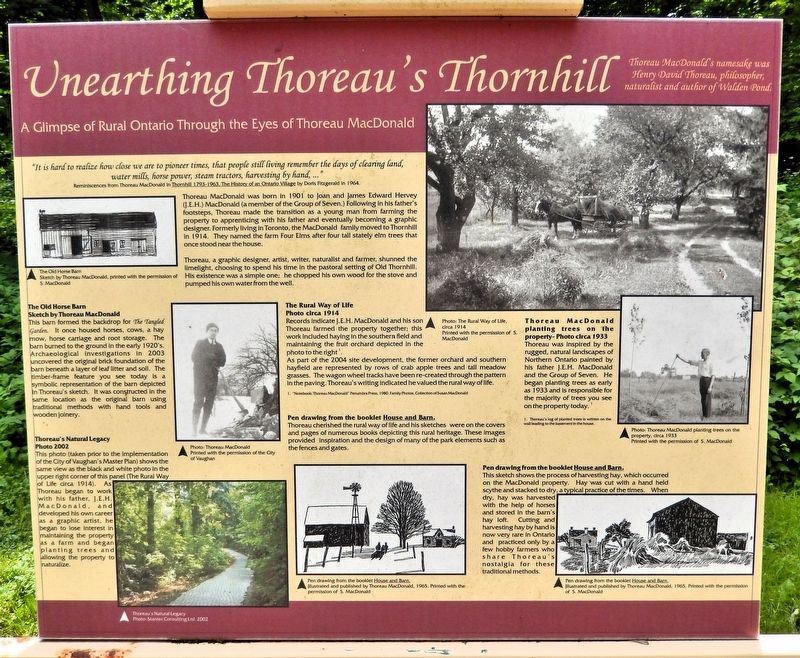
Unearthing Thoreau's Thornhill
A Glimpse of Rural Ontario Through the Eyes of Thoreau MacDonald
Thoreau MacDonald’s namesake was Henry David Thoreau, philosopher, naturalist and author of Walden Pond.
“It is hard to realize how close we are to pioneer times, that people still living remember the days of clearing land; water mills, horse power, steam tractors, harvesting by hand, ...”
Reminiscences from Thoreau MacDonald in Thornhill 1793-1963, The History of an Ontario Village by Doris Fitzgerald in 1964.
Thoreau MacDonald was born in 1901 to Joan and James Edward Hervey (J.E.H.) MacDonald (a member of the Group of Seven.) Following in his father's footsteps, Thoreau made the transition as a young man from farming the property to apprenticing with his father and eventually becoming a graphic designer. Formerly living in Toronto, the MacDonald family moved to Thornhill in 1914. They named the farm Four Elms after four tall stately elm trees that once stood near the house.
Thoreau, a graphic designer, artist, writer, naturalist and farmer, shunned the limelight, choosing to spend his time in the pastoral setting of Old Thornhill. His existence was a simple one; he chopped his own wood for the stove and pumped his
this page online
The Old Horse Barn
Sketch by Thoreau MacDonald
This barn formed the backdrop for The Tangled Garden. It once housed horses, cows, a hay mow, horse carriage and root storage. The barn burned to the ground in the early 1920's. Archaeological investigations in 2003 uncovered the original brick foundation of the barn beneath a layer of leaf litter and soil. The timber-frame feature you see today is a symbolic representation of the barn depicted in Thoreau's sketch. It was constructed in the same location as the original barn using traditional methods with hand tools and wooden joinery.
Thoreau's Natural Legacy
Photo 2002
This photo (taken prior to the implementation of the City of Vaughan's Master Plan) shows the same view as the black and white photo in the upper right corner of this panel (The Rural Way of Life circa 1914). As Thoreau began to work with his father, J.E.H. MacDonald, and developed his own career as a graphic artist, he began to lose interest in maintaining the property as a farm and began planting trees and allowing the property to naturalize.
The Rural Way of Life
Photo circa 1914
Records indicate J.E.H.
1. "Notebook: Thoreau MacDonald" Penumbra Press, 1980. Family Photos, Collection of Susan MacDonald
As part of the 2004 site development, the former orchard and southern hayfield are represented by rows of crab apple trees and tall meadow grasses. The wagon wheel tracks have been re-created through the pattern in the paving. Thoreau's writing indicated he valued the rural way of life.
Pen drawing from the booklet House and Barn.
Thoreau cherished the rural way of life and his sketches were on the covers and pages of numerous books depicting this rural heritage. These images provided inspiration and the design of many of the park elements such as the fences and gates.
Thoreau MacDonald planting trees on the property
Photo circa 1933
Thoreau was inspired by the rugged, natural landscapes of Northern Ontario painted by his father J.E.H. MacDonald and the Group of Seven. He began planting trees as early as 1933 and is responsible for the majority of trees you see on the property today.1
1. Thoreau's log of planted trees is written on the wall leading to the basement in the house.
Pen drawing from the booklet House and Barn.
This sketch shows the process of harvesting hay, which occurred on the MacDonald property. Hay was cut with a hand held scythe and stacked to dry, a typical practice of the times. When dry, hay was harvested with the help of horses and stored in the barn's hay loft. Cutting and harvesting hay by hand is now very rare in Ontario and practiced only by a few hobby farmers who share Thoreau's nostalgia for these traditional methods.
[photo & drawing captions]
• The Old Horse Barn [Sketch by Thoreau MacDonald, printed with permission of S. MacDonald]
• Thoreau MacDonald [Printed with the permission of the City of Vaughan]
• Thoreau’s Natural Legacy [Photo: Stantec Consulting Ltd. 2002]
• The Rural Way of Life, circa 1914 [Printed with the permission of S. MacDonald]
• Pen Drawing from the booklet House and Barn. [Illustrated and published by Thoreau MacDonald, 1965. Printed with the permission of S. Macdonald]
• Thoreau MacDonald planting trees on the property, circa 1933 [Printed with the permission of S. MacDonald]
• Pen drawing from the booklet House and Barn. [Illustrated and published by Thoreau MacDonald, 1965. Printed with permission of S. MacDonald]
Topics. This historical marker is listed in this topic list: Arts, Letters, Music.
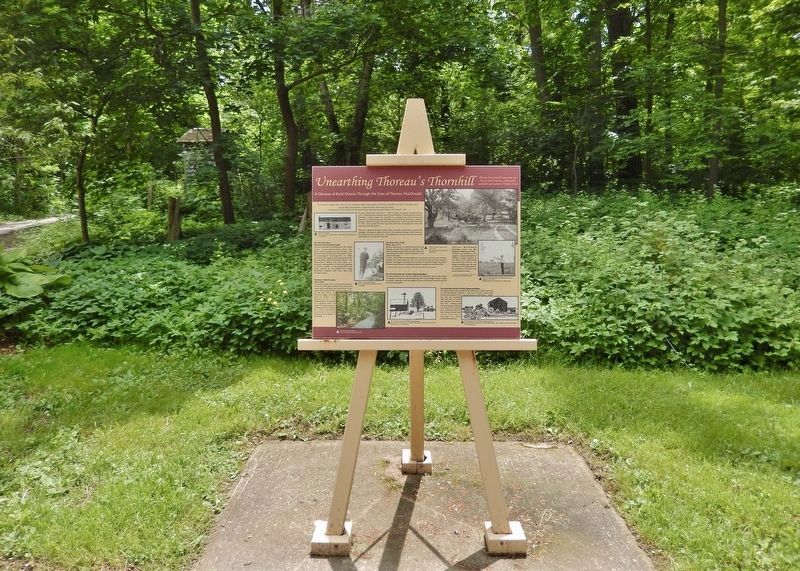
Location. 43° 48.884′ N, 79° 25.706′ W. Marker is in Vaughan, Ontario, in York Region. It is in Thornhill. It can be reached from the intersection of Centre Street and Thornbank Road, on the right when traveling east. The marker is on the garden walkway at the MacDonald House heritage site. Touch for map. Marker is at or near this postal address: 121 Centre Street, Vaughan ON L4J 1G3, Canada. Touch for directions.

Regionally, this marker is in Greater Toronto, specifically on the Golden Horseshoe, in the York, Durham and Headwaters Area, and in the Toronto Metropolitan Area. It is also in Central Canada. Globally, it is in North America, the Western Hemisphere, the Western World, and the Anglosphere. Historically, it finds itself in what was once a British colony, the Viceroyalty of New France, the Haudenosaunee (Iroquois) Confederacy, and Rupert’s Land.
Other nearby markers. At least 8 other markers are within 8 kilometers of this marker, measured as the crow flies: J.E.H. MacDonald 1873-1932 (within shouting distance of this marker); Holy Trinity Church (about 90 meters away, measured in a direct line); Yonge Street Hill (approx. 0.3 kilometers away); Mason Cogswell's Wagon Yard (approx. 0.4 kilometers away); The Founding of Thornhill (approx. 0.4 kilometers away); Zion Evangelical Lutheran Church (approx. 6.3 kilometers away); The Founding of Richmond Hill (approx. 7.1 kilometers away); St. Andrew’s Church (approx. 7.8 kilometers away). Touch for a list and map of all markers in Vaughan.
Also see . . . Thoreau MacDonald (1901-1989) (Wikipedia).
Excerpt: Canadian illustrator, graphic and book designer, and artist. MacDonald was the son of Group of Seven member J. E. H. MacDonald. He was self-taught, but had worked on commercial art with his father, who was famous for his work in design. Thoreau MacDonald was colour blind and as a result he worked primarily in black and white.(Submitted on August 27, 2026, by Cosmos Mariner of Cape Canaveral, Florida.)MacDonald's contribution was mainly to the history of the area of graphic art in Canada and the United States. As an illustrator, MacDonald worked for Ryerson Press; Dartmouth College in Hanover, New Hampshire; the Canadian Forum magazine for which he designed many covers; and on books in general, including those from his private press — Woodchuck Press. His work is found in the National Gallery of Canada in Ottawa, Hart House at the University of Toronto, the Art Gallery of Ontario, and the McMichael Canadian Art Collection among other collections. In 1972, he was made an Honorary Life member of the Society of Ontario Naturalists whose cause he considered he had served life-long.
His former home and 4-acre garden in Vaughan, Ontario, which he inherited from his father, was donated to the City of Vaughan in 1974. The building and grounds have been restored and are open to the public.
Credits. This page was last revised on August 27, 2026. It was originally submitted on August 27, 2026, by Cosmos Mariner of Cape Canaveral, Florida. This page has been viewed 10 times since then. Photos: 1, 2. submitted on August 27, 2026, by Cosmos Mariner of Cape Canaveral, Florida.
