Olympia in Thurston County, Washington — The American West (Northwest)
Early Olympia Fire Department

Photographed by Shirley A Stirling, September 9, 2026
1. Early Olympia Fire Department Marker
In the Beginning
In early days, communities used bucket brigades to deliver water, ladders to reach higher floors, and hooks on poles to create fire breaks.
Alert Hook & Ladder
After a series of suspicious fires, thought to be set by hobos, citizens organized at the district schoolhouse in late 1859 and, in January 1860, chartered a fire company at the first annual meeting of Alert Hook & Ladder. (In early days, fire companies were exclusive clubs with dues, but over time they transitioned to government.) Early on, officers tried to buy a fire engine with city funding (taxes), but no luck. In the “social season of 1864–65,” Foreman Charles E. Williams saw an ad in a fireman’s journal, resolving to buy a 2nd-hand Button hand-engine. Williams followed the lead of local women who had raised money through benefit balls to fund Long Bridge and the Westside Wharf, a busy landing serving ocean steamers. He gave a grand ball ($10 per ticket, about $200 in 2025 dollars) in Olympic Hall, which he owned... and it succeeded!
1865 Button Engine
The engine arrived in 1865 by ship, around the horn. It was inscribed Columbia Engine No. 1 and they kept the name. They later nicknamed it Old Reliable. It was, “a splendid machine, with 9-in. cylinders and 8-in. stroke, calculated to be manned, at full capacity, by 60 men, 30 per shift.” Williams decided to keep the engine privately but relented when firefighters built a mock engine, Squilgees, and set a fire in front of Williams’ business and only pretended to extinguish
this page online
Columbia Hall
Built in 1869 at 210 Fourth Avenue East, Columbia Hall was a symbol of Olympia’s growing community spirit. The first floor housed the Olympia Fire Department, while the second served as City Hall—together forming the city’s first true seat of government.
1870 Barnes
After a fire destroyed his and other downtown buildings, George Barnes organized a hook-and-ladder company, buying uniforms and equipment and continuing the fund-raising-ball tradition. Organization and community spirit were essential. The firemen were community leaders, not only fighting fires but also appearing at fairs and parades in uniform and with their engine.
Speaking Trumpets
Large crowds often pressed in at fire scenes, adding to the commotion. In the days before electronic speakers or even megaphones, officers relied on speaking trumpets, sometimes engraved as honorary gifts.
1882 Modern Silsby
In October 1882, after the Great Olympia Fire, the city bought a coal-fired rotary steam engine, a Silsby, 5th size, plus a lot at 407 Columbia St. SW, to house it. They named the engine Columbia Engine No. 1—so both Olympia’s engines shared the same name, upsetting the Button supporters. It almost caused a riot!
The Great Seattle Fire
In 1889, the OFD sent the Silsby north by ship to assist in battling the Great Seattle Fire. When Seattle’s water supply failed and water had to be

Photographed by Shirley A Stirling, September 9, 2026
2. Wide shot of Early Olympia Fire Department Marker
The storyboard marker is between garage bay one and garage bay two.
Those Who Run With the Machines
In 1890, Olympia City Council (finally) decided to purchase horses. Firefighters had “run with the machines,” as the saying goes, over the years pulling both “Old Reliable” and the 4,800-pound Silsby to fires.
1st Fire Chief
Longtime member George Smith Allen was the first fire chief, serving in 1887, 1897, and 1898. The Columbia Engine Co. serenaded Allen and his wife Annie Furquhar on their wedding evening, December 1, 1877.
Jesse Mars
Jesse Mars, Olympia’s earliest known African American firefighter, joined the OFD at age 13. He died in 1891 at age 21 of tuberculosis and was honored with a firefighter’s funeral.
Horses Prove Their Worth (1907)
For 25 years, Olympia’s fire engines were pulled by hand, then for 15 years by horses—until motorized vehicles came under consideration. A lively contest was held to see which could reach a fire faster. The horses reportedly won, but progress prevailed: a Seagrave motorized fire truck was delivered in 1911.
Cisterns
In 1859 and over the next 35+ years, a dozen plus cisterns were built, sized to collect 1,000–144,000 gallons of rain and sea water. (The first two cisterns were built and filled
1885
3. Fire fighters with engine in front of Columbia Hall.
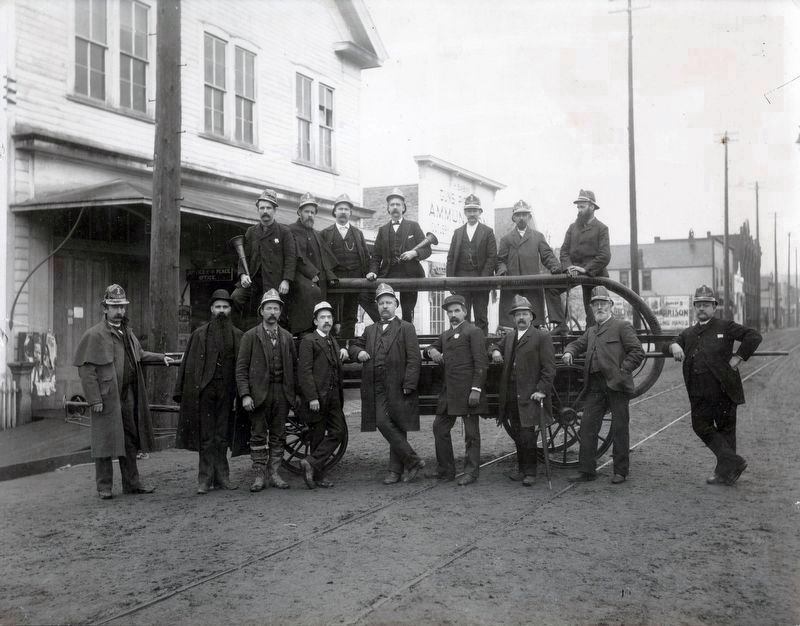
Image shows sixteen men in front of the Columbia No. 1 Engine at Columbia Hall, 210 E 4th Ave., Olympia, WA. Some men wear Columbia Engine Company No. 1 hats.
Standing on ground, left to right: Tom Ford, Clem Johnson, William Scofield, Joe Raisbach, John Miller Murphy, Sam McClelland, Bob Forst, Dick Wood, and E.T. Young. Standing on the pumper: John McClelland, "Dud" Henry, W.J. Craig, George Allen (Chief), Charley Talcott, Edwin O. Robbins, and Joe Chilberg. SW-540-3-6-ph000023 Olympia Fire Department Photograph Collection, 1885-1980, Washington State Archives, Digital Archives, http://www.digitalarchives.wa.gov, [date accessed 8-30-2026].
Standing on ground, left to right: Tom Ford, Clem Johnson, William Scofield, Joe Raisbach, John Miller Murphy, Sam McClelland, Bob Forst, Dick Wood, and E.T. Young. Standing on the pumper: John McClelland, "Dud" Henry, W.J. Craig, George Allen (Chief), Charley Talcott, Edwin O. Robbins, and Joe Chilberg. SW-540-3-6-ph000023 Olympia Fire Department Photograph Collection, 1885-1980, Washington State Archives, Digital Archives, http://www.digitalarchives.wa.gov, [date accessed 8-30-2026].
Hydrants & Alarms
In 1890, 20 fire hydrants were supplied by the city’s first water system, which was completed in 1889. Statehood, water mains, and fire hydrants—that’s progress worth celebrating! Then, in the year 1891, came the amazing telegraph alarm system—street boxes with levers were installed. Pull a lever if you see a fire! With good water pressure and many hydrants, by 1899 a third hose company, the 5th Ward, added valuable city coverage.
Engine No. 2
Engine No. 2, a 1924 Seagrave fire engine, is an early motorized pumper that replaced horse-drawn engines. It served the OFD for over 20 years before moving to reserve status. Now, at 102, it is still operational and is driven in parades and local events. Housed at Firehouse 5, it celebrates the firefighting heritage. WSSDAC members were inspired to create this panel after riding aboard the engine in local parades.
City Hall & Fire Dpt.
Of the three historic fire buildings in Olympia, only the one at 108 State Avenue NW remains intact as of 2026. Built in 1912, it replaced Columbia Hall at 210 Fourth Avenue East. (The additional station at 407 Columbia Street SW, which housed the Silsby steamer, went out of use when the Silsby was retired and Company No. 2 disbanded.)
For 80 years (1912-1992), the above pictured station served as the Olympia Fire Department, and for more than 50 years, it also housed City Hall. At various times, the building also accommodated the public library, the police department, and the Chamber

Photographed by Shirley A Stirling
4. Philatelic cover
(credits on lower right)
Washington State Society Daughters of the American Colonists. State Regent Shirley Sterling 2024-2027 • Winsor Fireform Signs and Markers • Text by Frank Spickelmire, Shirley Stirling, & Diane Smith. • Dedicated on September 12, 2026, by the Olympia Fire Department (OFD), Fire Fighters Local 468, and the Washington State Society Daughters of the American Colonists (WSSDAC) • Panel design by Shirley Stirling.
Erected 2026 by Washington State Society Daughters of the American Colonists, IAFF Local 468, Olympia Fire Department.
Topics. This historical marker is listed in this topic list: Charity & Public Work. A significant historical month for this entry is January 1860.
Location. 47° 2.736′ N, 122° 53.502′ W. Marker is in Olympia, Washington, in Thurston County. It is on Eastside Street. The Olympia Fire Department 1 HQ station occupies the entire city block with the front door official address on Eastside Street. The marker is on the garage bay side, back, of the building, which faces Puget Street. Touch for map. Marker is at or near this postal address: 100 Eastside Street NE, Olympia WA 98506, United States of America. Touch for directions.

Regionally, this marker is in the Puget Sound Region and in Greater Seattle. It is also on the American Pacific Coast, in the Pacific Northwest, and in the Lewis & Clark Corridor. Globally, it is in North America, in the Inside Passage, on the Ring of Fire, on the Pacific Rim, in the Western Hemisphere, in the Western World, and in the Anglosphere.

5. Olympia Fire Department horse drawn engine #2
Olympia Hose Company #2 which served the City of Olympia from the 1870's until the early 1900's when motorized fire engines became the standard of the industry. Ed Ulrich is on the back step. Circa 1900
Other nearby markers. At least 8 other markers are within walking distance of this marker: Bell History (approx. 0.2 miles away); Billy the man (approx. ¼ mile away); Howard Point - An Olympia Black History Landmark (approx. ¼ mile away); Susan B. Anthony Visits Bigelow House (approx. 0.3 miles away); Daniel R. Bigelow House (1854) (approx. 0.3 miles away); Historic Bigelow House (approx. 0.3 miles away); 1903 Washington State Legislative Meeting Site (approx. 0.3 miles away); Former Olympia Library (approx. 0.4 miles away). Touch for a list and map of all markers in Olympia.
More about this marker. This interpretive panel shows the logos of the IAFF Local 468 and the Olympia Fire Department flanking the title, and those of the Daughters of the American Colonists in Washington State and Winsor Fireform (the manufacturer of the panel) on the lower right.
Illustrations and their captions:
- Columbia Hall 1943.42.1400 – Washington State Historical Society, Tacoma (Wash.)
- Firefighters with engine in front of Columbia Hall, 1885–1895. Olympia Fire Department Photograph Collection, 1885–1980. Washington State Archives, Digital Archives. Retrieved Nov. 21, 2025, from http://www.digitalarchives.wa.gov
- Back inscription: “Fire Company, Olympia, Washington Territory, approximately 1885.” — University of Washington Libraries, Special Collections, L. Wilson Clark, photographer, WAS1281 (negative number UW37511)
- Line drawing of the Modern Silsby coal-fired steam rotary engine. — The American Fire Engine Co., Illustrated Catalog, Seneca Falls
NY p. 17, fig. 10, 1893, Public domainNovember 7, 20256. Early Olympia Fire DepartmentThis photo is in the Olympia Fire Department archives.- George Smith Allen, 1st Fire Chief — Cropped from: Firefighters with engine in front of Columbia Hall, 1885–1895
- 1907 OFD with Ed Ulerich on back step — Courtesy of David and Marcy Belles.
- Old Fire Department Station C1982.18.29.16 – Washington State Historical Society, Tacoma (Wash.)
- The uncaptioned trumpet and OFD helmet are from the Olympia Fire Department archives.

Also see . . . History of Olympia Fire Department - The Beginning. City of Olympia saved Pages By Olympia Historical Society March 20, 2022 [Captured from Wayback machine that archived deleted City of Olympia pages]
The Beginning Olympia’s first fire fighting unit, Barnes’ Hook and Ladder Brigade, was organized in the early 1850’s. Columbia…(Submitted on September 1, 2026, by Shirley A Stirling of Lacey, Washington.)
Additional commentary.
1. Columbia Engine Company
The City of Olympia, 1866-1899. By transcribing, in summary form, the minutes of the Columbia Engine Company, Olympia’s first official fire department, 1866-1899, Roger Easton extracted names of the firemen, and some additional information.
In earlier days, it was considered an honor to belong to this company, and members had to pay dues, attend weekly practice musters, and be ready to help maintain equipment. Though the city gave it space in the lower quarters of Columbia Hall, and helped with expenses, the most popular form of fundraising was holding balls. Much of the minutes of the early company were taken up by planning for these events. Proceeds helped with purchasing hoses, uniforms, and other equipment. Helmets and badges were supplied, and members were always eager to march through town with their engines, which in earlier days were pulled by men, not horses. —By Roger Easton – Washington State Archives
— Submitted September 1, 2026, by Shirley A Stirling of Lacey, Washington.
Credits. This page was last revised on September 10, 2026. It was originally submitted on August 29, 2026, by Shirley A Stirling of Lacey, Washington. This page has been viewed 62 times since then. Photos: 1, 2. submitted on September 9, 2026, by Shirley A Stirling of Lacey, Washington. 3. submitted on August 30, 2026, by Shirley A Stirling of Lacey, Washington. 4, 5, 6. submitted on September 1, 2026, by Shirley A Stirling of Lacey, Washington. • J. J. Prats was the editor who published this page.
