
Hill City in Pennington County, South Dakota — The American Midwest (Upper Plains)
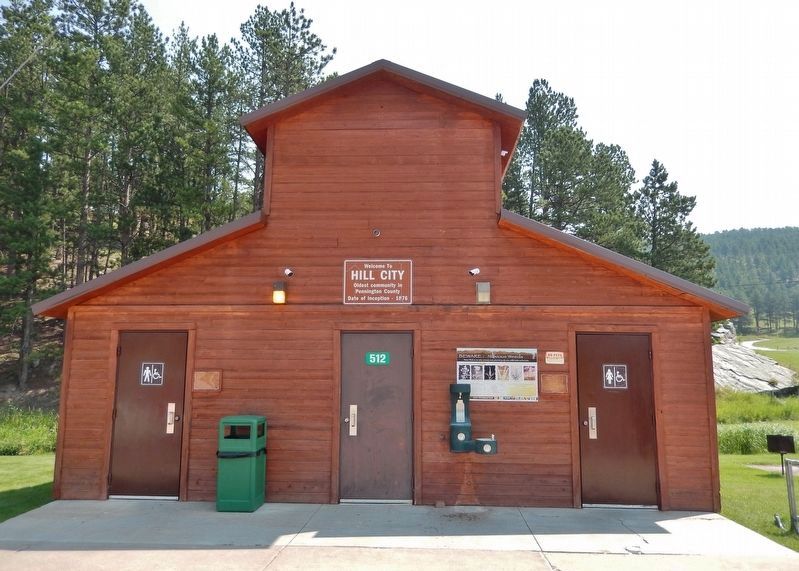
Welcome To Hill City

Photographed by Cosmos Mariner, August 17, 2023
1. Welcome To Hill City Marker
Date of inception — 1876
Topics. This historical marker is listed in this topic list: Settlements & Settlers. A significant historical year for this entry is 1876.
Location. 43° 55.667′ N, 103° 34.432′ W. Marker is in Hill City, South Dakota, in Pennington County. It is on South Newton Avenue just south of Poplar Street, on the left when traveling south. The marker is in Tracy Park, at the Burlington Northern Hill City Trailhead on the George S. Mickelson Rail Trail. Touch for map. Marker is at or near this postal address: 512 South Newton Avenue, Hill City SD 57745, United States of America. Touch for directions.

Regionally, this marker is in South Dakota’s West River, in the Badlands, and in Greater Rapid City. It is also in the American Black Hills, in the Lewis & Clark Corridor, on the prairies, and on the Northern Plains. Globally, it is in North America, the Western Hemisphere, the Western World, and the Anglosphere. Historically, it finds itself in what was once Rupert’s Land and also the Louisiana Purchase.
Other nearby markers. At least 8 other markers are
this page online
Also see . . . Hill City, South Dakota (Wikipedia).
Excerpt: Hill City is the oldest existing city in Pennington County, South Dakota. Human history in the area that became Hill City, and the greater Black Hills in particular, started by at least 7000 BC. The Arikara arrived by 1500 AD, followed by the Cheyenne, Crow, Kiowa and Pawnee. In the 19th century, the Lakota Sioux claimed the land, calling it Paha Sapa. In 1874, Major General George Armstrong Custer led an expedition into the Black Hills, during which gold was discovered in French Creek, 13 miles south of Hill City. The discovery of gold opened the Black(Submitted on September 2, 2026, by Cosmos Mariner of Cape Canaveral, Florida.)Hills, and the Hill City area, to mining. Hill City was first settled by miners in 1876, who referred to the area as Hillyo. A post office was constructed and opened on November 26, 1877.Photographed by Cosmos Mariner, August 17, 20232. Welcome To Hill City MarkerThe marker is mounted high on the west/front side of the Burlington Northern Hill City Trailhead Comfort Station of the George S. Mickelson Rail Trail in Tracy Park.
Credits. This page was last revised on September 2, 2026. It was originally submitted on August 30, 2026, by Cosmos Mariner of Cape Canaveral, Florida. This page has been viewed 12 times since then. Photos: 1, 2. submitted on September 1, 2026, by Cosmos Mariner of Cape Canaveral, Florida.
