Central Business District in Melbourne, Victoria, Australia — Oceania
Market Football
| — | Queen Victoria Market | — |

Photographed by Dean Barton-Ancliffe, July 16, 2026
1. Market Football Marker
The Market football team, as the Queen Victoria Market team was known, joined the Wednesday Football League with games being held every Wednesday afternoon during the football season. Market competed against teams drawn from local civic organisations including Fire Brigade, Police, Post & Telegraph, Press, Telephone Exchange, Yellow Cabs and Waterside Workers.
The opening match for 1931 gave Market a narrow win against Yellow Cabs. In the next game, Market was victorious over the Waterside Workers, but only after a protest found that the Waterside team had played ineligible players. More wins were registered against Fire Brigade and Telephone Exchange. Yet another win against the Press, played at the Richmond football ground saw a narrow victory for Market, by four points. The Market team committee reported in the Market Times Newspaper, "The Victoria Market Football Club, playing its part in the social and civic development of the market community is doing real good service and is earning appreciation."
this page online
In addition, another football league ran during the 1920s and 1930s, made up of teams representing Melbourne's charitable associations. Queen Victoria Market formed another social club to raise money for local charities and a football club was also formed from among its members. Few details have survived about the participating clubs, they did include at least, the Young Chinese Club, Tattersalls and Market. We do know that the opening game of the 1924 season between Market and the Young Chinese Club, saw Market the victors by two points at a match held at the Albert Park ground. The Young Chinese Club was particularly competitive with many talented players who were supported by the Queen Victoria Market Chinese fruit merchants. These social club football teams not only consisted of Queen Victoria Market footballers but often recruited players from more skilled outside clubs who were keen to earn some extra money during the Depression.
Erected by Queen Victoria Market.
Topics. This historical marker is listed in these topic lists:
Photographed by Dean Barton-Ancliffe, July 16, 2026
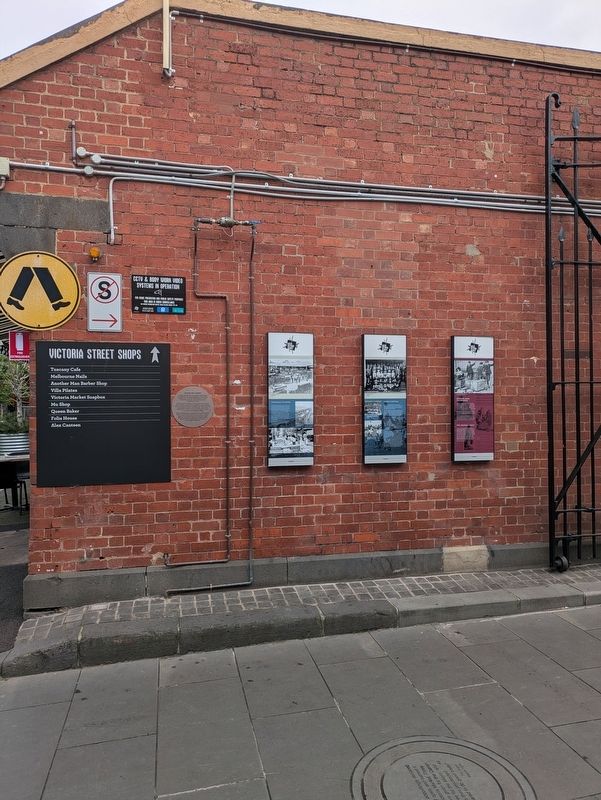
2. Market Football Marker in the Northern Entrance to the Market
Location. 37° 48.37′ S, 144° 57.433′ E. Marker is in Melbourne, Victoria. It is in the Central Business District. It is at the intersection of Victoria Street (Victoria Route 32) and Cobden Street, on the left when traveling west on Victoria Street. Touch for map. Marker is at or near this postal address: 133 Victoria Street, Melbourne VIC 3000, Australia. Touch for directions.

Regionally, it is in Oceania, in Australasia, in the Pacific Ocean, in South Pacific, on the Pacific Rim, in the Western World, and in the Anglosphere. Historically, it finds itself in what was once a British colony.
Other nearby markers. At least 8 other markers are within walking distance of this marker: Bringing home the Shopping (here, next to this marker); Market Opening - Floor Plaque (here, next to this marker); Wholesale to Retail (here, next to this marker); Saving the Market (here, next to this marker); The Market Gates (here, next to this marker); Tombstone Territory / The People Prevail (within shouting distance of this marker); Queen Victoria Market Timeline (within shouting distance of this marker); Victoria Street Shops / Instant and Delicious (within shouting distance of this marker). Touch for a list and map of all markers in Melbourne.
Also see . . . Queen Victoria Market Football Team 1924. City of Melbourne Libraries
Photograph of the Queen Victoria Market Football Team dated 4 September 1924. The only person noted is Charlie Johnson, brother of George Johnson, sons of Peter Johnson. He is in the standing in the back row of players, in a suit with no hat. The photograph was donated by June M Webb, his cousin, and according to her notes, his birth name was Carl Johan Harry Johansson and he was born 28 January in Sweden. He arrived in Melbourne 30 October 1886 with his mother and two brothers per Hohenstaufen. He died 10 October 1951. He lived in Capel, Cobden and Queen Streets, and was a fruit merchant at the market.(Submitted on September 1, 2026, by Dean Barton-Ancliffe of Rowville, Victoria.)
Credits. This page was last revised on September 1, 2026. It was originally submitted on September 1, 2026, by Dean Barton-Ancliffe of Rowville, Victoria. This page has been viewed 12 times since then. Photos: 1, 2. submitted on September 1, 2026, by Dean Barton-Ancliffe of Rowville, Victoria. • Andrew Ruppenstein was the editor who published this page.
