Central Business District in Melbourne, Victoria, Australia — Oceania
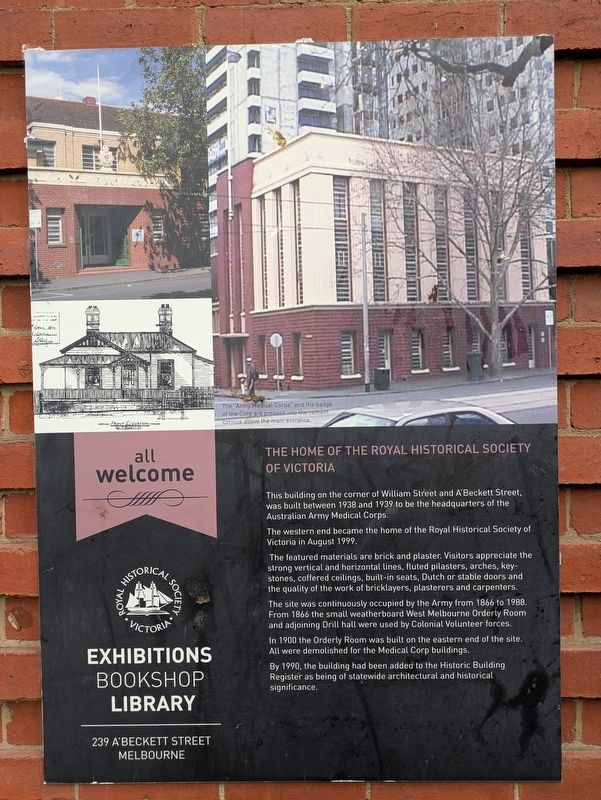
The Home of the Historical Society of Victoria
| — | Royal Historical Society - Victoria | — |
Photographed by Dean Barton-Ancliffe, July 20, 2026
1. The Home of the Historical Society of Victoria Marker
The western end became the home of the Royal Historical Society of Victoria in August 1999.
The featured materials are brick and plaster. Visitors appreciate the strong vertical and horizontal lines, fluted pilasters, arches, key-stones, coffered ceilings, built-in seats, Dutch or stable doors and the quality of the work of bricklayers, plasterers and carpenters.
The site was continuously occupied by the Army from 1866 to 1988. From 1866 the small weatherboard West Melbourne Orderly Room and adjoining Drill hall were used by Colonial Volunteer forces.
In 1900 the Orderly Room was built on the eastern end of the site. All were demolished for the Medical Corp buildings.
By 1990, the building had been added to the Historic Building Register as being of statewide architectural and historical significance.
Erected by Royal Historical Society - Victoria.
Topics. This historical marker is listed in these topic lists: Architecture • Military. A significant historical year for this entry is 1938.
Location. 37° 48.634′ S,
this page online

Regionally, it is in Oceania, in Australasia, in the Pacific Ocean, in South Pacific, on the Pacific Rim, in the Western World, and in the Anglosphere. Historically, it finds itself in what was once a British colony.
Other nearby markers. At least 8 other markers are within walking distance of this marker: Panoramic View of Melbourne (a few steps from this marker); Melbourne 1880 (a few steps from this marker); First Princes Bridge, Melbourne (within shouting distance of this marker); Melbourne (Bird's Eye View) 1882 (within shouting distance of this marker); The Flagstaff Gardens (within shouting distance of this marker); Federal Coffee Palace (within shouting distance of this marker); Exhibition Building - William Street (within shouting distance of this marker); The Gill (within shouting
Photographed by Dean Barton-Ancliffe, July 20, 2026
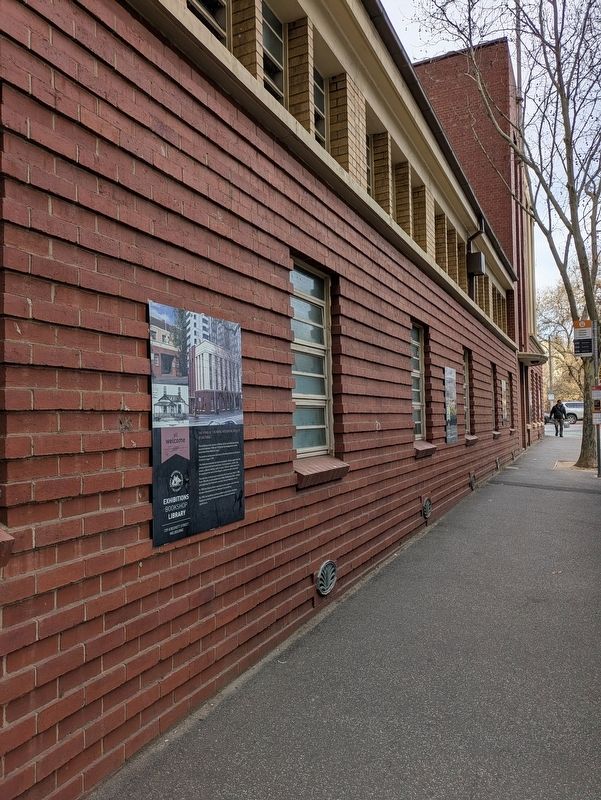
2. The Home of the Historical Society of Victoria Marker along A'Beckett Street
Also see . . . The Royal Historical Society, 239 A'Beckett Street Melbourne. Royal Historical Society Victoria
The functional and utilitarian building has two large drill halls with offices along their northern side. The drill halls are separated by a public entrance foyer which leads off A’Beckett Street. Messes are placed at the centre – for sergeants – and at the east and west ends of the building – for ‘other ranks’ and officers respectively.(Submitted on September 2, 2026, by Dean Barton-Ancliffe of Rowville, Victoria.)
The principal entrance is in A’Beckett Street, and it is here that the words Army Medical Corps and the badge of the Corps are pressed into the cement cornice. Of the numerous additional entrances to the east and west, one on Williams Street leads to the Officers’ Mess.
The building was the result of both the defence build-up just prior to World War II and the end of the 1930s Depression when government sponsored construction was used to employ tradespeople. Many government offices were built in Canberra and throughout Australia, including those for the Commonwealth Bank, post offices and telephone exchanges. A great many buildings were also constructed for the Army, Navy and Air Force.
The Army Medical Corps’ new building was purposely designed to provide a centrally located building for the administration, organisation and implementation of training, research and advice in medical, hygiene and hospital procedures, the provision of services and the issuing of stores and payroll.
Prior to mobilisation for World War II the Army had only three permanent medical officers. The militia organisations during World War I were the backbone of the Corps. These were backed up by civilian medical personnel who could be called up but most had no military or field training whatsoever and even the militia had had no on-going training since 1918. The Australian Army Medical Corps numbered 35 in 1938-1939 and increased to 49 during the following 12 months. By 1943-1944 the total number was 32,100 – 2,500 doctors, 3,500 nurses, 900 non-medical officers (scientists and technicians) and 25,300 other ranks. Women were not admitted to the Australian Army Medical Corps until September 1940.
The drill hall had a number of functions: as an indoor parade ground for marching and equipment drill; as a gymnasium and for physical training; as a social centre offering activities such as dances, film nights etc. and for displays. The mezanine (the ceiling of a row of offices) allows for observation of the activities on the floor of the hall. The design of the ceiling of the drill hall is reminiscent of suburban cinemas of the time.
Credits. This page was last revised on September 4, 2026. It was originally submitted on September 2, 2026, by Dean Barton-Ancliffe of Rowville, Victoria. This page has been viewed 10 times since then. Photos: 1, 2. submitted on September 2, 2026, by Dean Barton-Ancliffe of Rowville, Victoria. • Andrew Ruppenstein was the editor who published this page.
