
The Shevlin Wood Yard
| — | Discover Fort Frances | — |
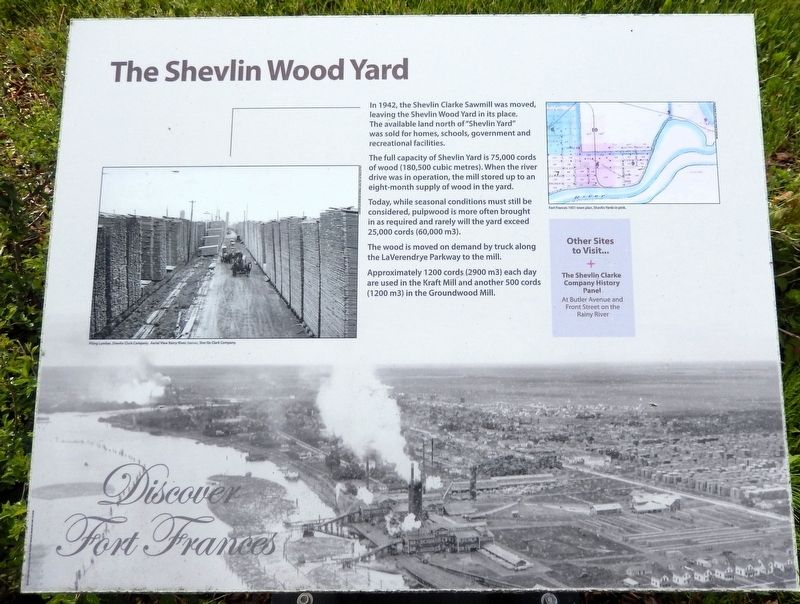
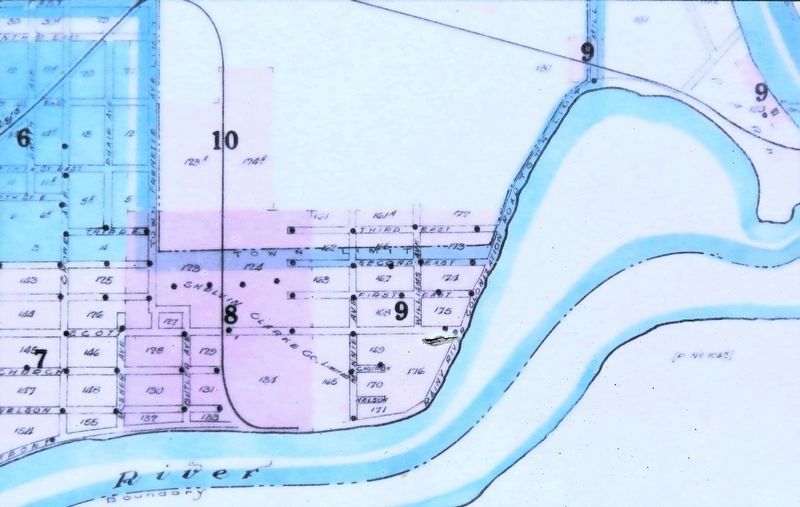
In 1942, the Shevlin Clarke Sawmill was moved, leaving the Shevlin Wood Yard in its place. The available land north of “Shevlin Yard” was sold for homes, schools, government and recreational facilities.
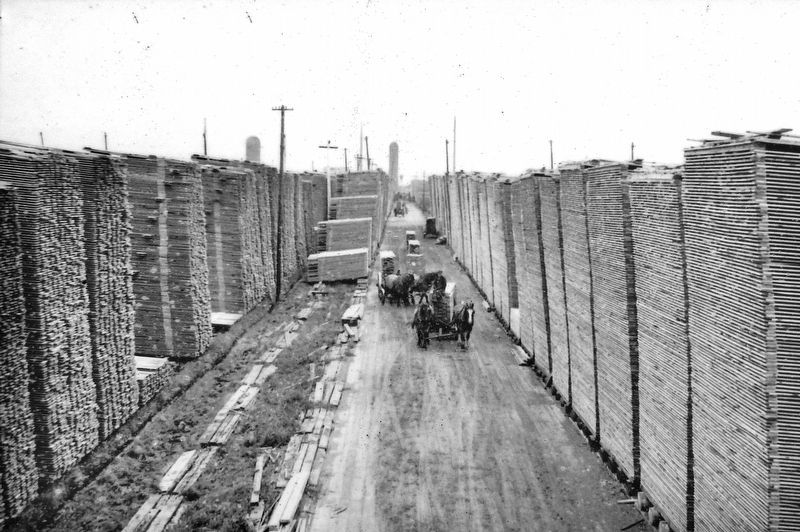
The full capacity of Shevlin Yard is 75,000 cords of wood (180,500 cubic metres). When the river drive was in operation, the mill stored up to an eight-month supply of wood in the yard.
Today, while seasonal conditions must still be considered, pulpwood is more often brought in as required and rarely will the yard exceed 25,000 cords (60000 m3).
The wood is moved on demand by truck along the LaVerendrye Parkway to the mill.
Approximately 1200 cords (2900 m3) each day are used in the Kraft Mill and another 500 cords (1200 m3) in the Groundwood Mill.
[background image caption] Aerial View Rainy River, Shevlin Clark Company
Other Sites to Visit…
The Shevlin Clarke Company History Panel at Butler Avenue and Front Street on the Rainy River
Topics. This historical marker is listed in this topic list: Industry & Commerce. A significant historical year for this entry is 1942.
Location. 48° 36.429′ N, 93° 22.566′ W. Marker is in Fort
this page online

Regionally, this marker is in Northern Ontario and specifically in Northwest Ontario. It is also in Central Canada. Globally, it is in North America, the Great North Woods, the Western Hemisphere, the Western World, and the Anglosphere. Historically, it finds itself in what was once a British colony, the Viceroyalty of New France, the Haudenosaunee (Iroquois) Confederacy, and Rupert’s Land.
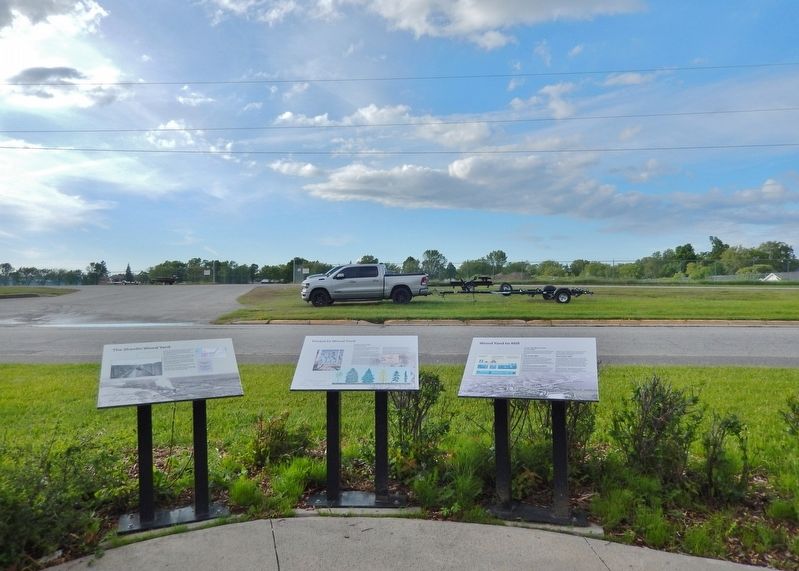
Other nearby markers. At least 8 other markers are within walking distance of this marker: Forest to Wood Yard (here, next to this marker); The North West Mounted Police on the Dawson Route (here, next to this marker); History of the Lookout Tower (within shouting distance of this marker); La Verendrye Parkway (approx. 0.3 kilometers away); Explore Fort Frances West (approx. 0.3 kilometers
Also see . . . Shevlin-Clarke Co. Ends 32 Years of Lumbering Operations in Fort Frances (Fort Frances Times).
(Fort Frances Times and Rainy Lake Herald 23 April 1942) Excerpt: Although the Shevlin-Clarke did not begin logging operations in the Rainy River Watershed until the winter of 1910, another subsidiary of the Shevlin Carpenter & Clarke Co. of Minneapolis, the parent company, had cut over parts of this area, especially in the north arm of Rainy Lake and north of the Cascades. This was the Rainy River Lumber Co. Ltd., with mills at Rainy River, which began operating about 1904 and continued until 1913. The company operated a third plant at Spooner, Minnesota, the Shevlin-Mathieu Co. which began its operation about 1906 and continued until 1913 when it was sold to the Backus-Brooks Co.(Submitted on September 3, 2026, by Cosmos Mariner of Cape Canaveral, Florida.)The erection of the first unit of the Shevlin-Clarke Co. Ltd. in Fort Frances in 1911 did away with
the necessity of driving the Rainy River. The erection of Mill No. 2 in Fort Frances coincided with the of Shevlin’s operations in Rainy River and Spooner.Fort Frances Museum Collection3. Marker detail: Fort Frances 1931 Town PlanDuring the 32 years Shevlin-Clarke Co. Ltd. operated in Fort Frances, the annual production averaged better than 50 million feet of lumber and its payroll averaged $645,000 per year, David P. Larsen, vice-president of the firm, revealed Wednesday morning while discussing operations here. The sawmills were able to turn out 500,000 feet of lumber daily, while the immense yards usually carried a stock of from 50 to 55 million feet.
“During the period it was operating here Shevlin’s payroll totaled $20 million,” Mr. Larsen revealed. To this must be added the huge amounts spent locally for its camps which averaged between eight and ten each winter, with each camp consuming 125,000 lbs. of foodstuffs during the logging operations.
Credits. This page was last revised on September 3, 2026. It was originally submitted on September 2, 2026, by Cosmos Mariner of Cape Canaveral, Florida. This page has been viewed 6 times since then. Photos: 1, 2, 3, 4. submitted on September 3, 2026, by Cosmos Mariner of Cape Canaveral, Florida.
