Watsonia in Banyule, Victoria, Australia — Oceania
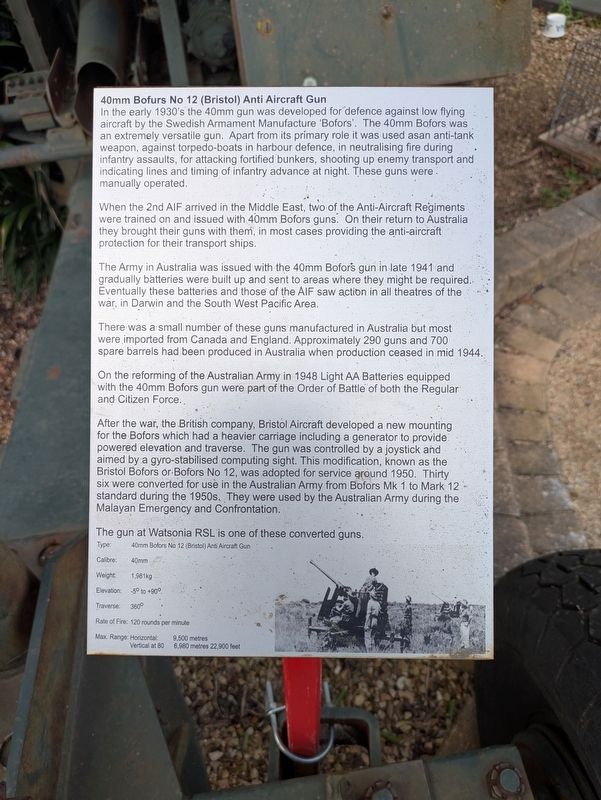
40mm Bofurs No 12 (Bristol) Anti Aircraft Gun
Photographed by Dean Barton-Ancliffe, July 20, 2026
1. 40mm Gun Marker
When the 2nd AIF arrived in the Middle East, two of the Anti-Aircraft Regiments were trained on and issued with 40mm Bofors guns. On their return to Australia they brought their guns with them, in most cases providing the anti-aircraft protection for their transport ships.
The Army in Australia was issued with the 40mm Bofors gun in late 1941 and gradually batteries were built up and sent to areas where they might be required. Eventually these batteries and those of the AIF saw action in all theatres of the war, in Darwin and the South West Pacific Area.
There was a small number of these guns manufactured in Australia but most were
this page online
On the reforming of the Australian Army in 1948 Light AA Batteries equipped with the 40mm Bofors gun were part of the Order of Battle of both the Regular and Citizen Force.
After the war, the British company, Bristol Aircraft developed a new mounting for the Bofors which had a heavier carriage including a generator to provide powered elevation and traverse. The gun was controlled by a joystick and aimed by a gyro-stabilised computing sight. This modification, known as the Bristol Bofors or Bofors No 12, was adopted for service around 1950. Thirty six were converted for use in the Australian Army from Bofors Mk 1 to Mark 12 standard during the 1950s. They were used by the Australian Army during the Malayan Emergency and Confrontation.
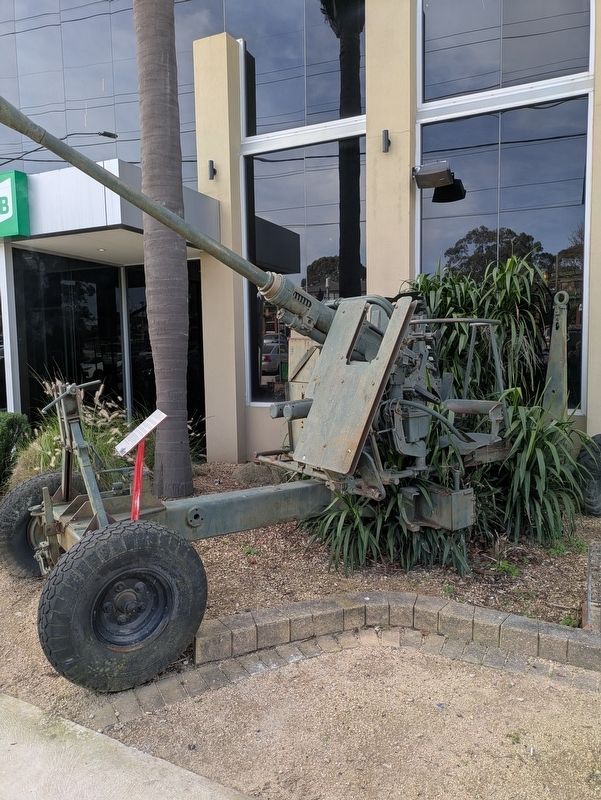
The gun at Watsonia RSL is one of these converted guns.
Topics. This memorial is listed in these topic lists: Military • War, World II.
Location. 37° 42.569′ S, 145° 4.924′ E. Memorial is in Watsonia,
Photographed by Dean Barton-Ancliffe, July 20, 2026
2. 40mm Bofurs No 12 Gun and the Marker

Regionally, it is in Oceania, in Australasia, in the Pacific Ocean, in South Pacific, on the Pacific Rim, in the Western World, and in the Anglosphere. Historically, it finds itself in what was once a British colony.
Other nearby markers. At least 8 other markers are within 6 kilometers of this marker, measured as the crow flies: Citizens of Diamond Valley and Watsonia R.S.L. War Memorial (here, next to this marker); 25 Pounder Mark 2 on Carriage 25 Pounder Mark I/L (a few steps from this marker); Greenwood Reserve (approx. 0.8 kilometers away); Gresswell Forest Nature Conservation Reserves (approx. 0.8 kilometers away); Quirk's the Tailor and Mrs Quirk's Tea Rooms (approx. 2.3 kilometers away); Swimming Pool on the Plenty River (approx. 2.4 kilometers away); Eltham Avenue of Honour (North) (approx. 5.8 kilometers away); The Barak Bushlands (approx. 5.8 kilometers away). Touch for a list and map of all markers in Watsonia.
Also see . . . 40 mm Bofors Anti Aircraft Gun. Oz at War
The 40mm Bofors light anti-aircraft automatic gun was used extensively by the military in Australia during WW2. It was developed by A.B. Bofors of Sweden in 1929. It was adopted by the British Army in 1938 and by the U.S. Army in 1941. The German Army captured and used a number of Bofors guns captured from France and Poland.(Submitted on September 2, 2026, by Dean Barton-Ancliffe of Rowville, Victoria.)
It was used to defend airfields, and other military establishments against low level enemy attack. It fired a 2lbs (1kg) high explosive shell at 2,800 ft/sec (848m/sec) at 120 rounds per minute. The Bofors maximum ceiling was 7, 151 metres but the most effective ceiling was 3,787 meters.
The standard mounting for Bofors gun was a four-wheeled trailer unit. Two wheeled versions were produced for airborne units in the United Kingdom and USA. Self-propelled mountings were also produced for the protection of mobile columns.
Credits. This page was last revised on September 3, 2026. It was originally submitted on September 2, 2026, by Dean Barton-Ancliffe of Rowville, Victoria. This page has been viewed 12 times since then. Photos: 1, 2. submitted on September 2, 2026, by Dean Barton-Ancliffe of Rowville, Victoria. • Andrew Ruppenstein was the editor who published this page.
