Watsonia in Banyule, Victoria, Australia — Oceania
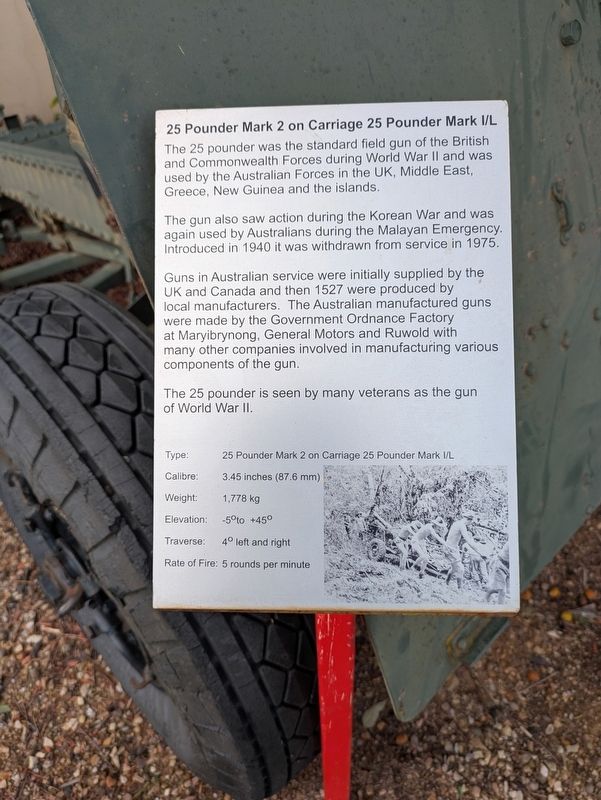
25 Pounder Mark 2 on Carriage 25 Pounder Mark I/L
Photographed by Dean Barton-Ancliffe, July 20, 2026
1. 25 pounder Marker
The gun also saw action during the Korean War and was again used by Australians during the Malayan Emergency. Introduced in 1940 it was withdrawn from service in 1975.
Guns in Australian service were initially supplied by the UK and Canada and then 1527 were produced by local manufacturers. The Australian manufactured guns were made by the Government Ordnance Factory at Maryibrynong, General Motors and Ruwold with many other companies involved in manufacturing various components of the gun.
The 25 pounder is seen by many veterans as the gun of World War II.
Topics. This memorial is listed in these topic lists: War, Korean • War, World II.
Location. 37° 42.573′ S, 145° 4.928′ E. Memorial is in Watsonia, Victoria, in Banyule. It is on Morwell Avenue 0.1 kilometers north of Grace Street, on the left when traveling east. Touch for map. Memorial is at or near this
this page online

Regionally, it is in Oceania, in Australasia, in the Pacific Ocean, in South Pacific, on the Pacific Rim, in the Western World, and in the Anglosphere. Historically, it finds itself in what was once a British colony.
Other nearby markers. At least 8 other markers are within 6 kilometers of this marker, measured as the crow flies: Citizens of Diamond Valley and Watsonia R.S.L. War Memorial (here, next to this marker); 40mm Bofurs No 12 (Bristol) Anti Aircraft Gun (a few steps from this marker); Greenwood Reserve (approx. 0.8 kilometers away); Gresswell Forest Nature Conservation Reserves (approx. 0.9 kilometers away); Quirk's the Tailor and Mrs Quirk's Tea Rooms (approx. 2.3 kilometers away); Swimming Pool on the Plenty River (approx. 2.4 kilometers away); Eltham Avenue of Honour (North) (approx. 5.7 kilometers away); The Barak Bushlands (approx. 5.8 kilometers away). Touch for a list and map of all markers in Watsonia.
Also see . . . 25 pounder Field Gun Mk 2 gun, Q.F. Australian War Memorial
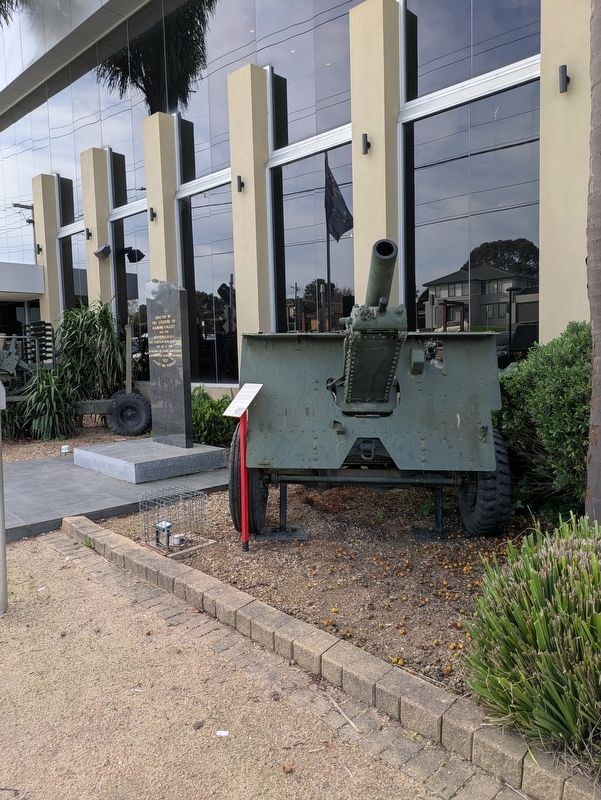
The Mk 2 gun fitted to the Mk 1 carriage(Submitted on September 2, 2026, by Dean Barton-Ancliffe of Rowville, Victoria.)was the standard British and Commonwealth artillery piece during the Second World War.Photographed by Dean Barton-Ancliffe, July 20, 20262. 25 Pounder Mark 2 Marker in front of Watsonia RSL
The first Australian unit to be issued with the 25-pounder guns was the 2/3rd Field Regiment who were training in England in 1940. They were equipped with British and Canadian made guns. Other Australian Regiments serving in the Middle East were also initially equipped with the British made guns.
Production of the 25-pounder guns in Australia did not get underway until the latter stages of 1940 in both government and commercial factories. The first Australian built 25-pounder was completed in May 1941 and the Australian made guns were soon being shipped overseas to Australian regiments on active service. At the end of production in Australia in 1943 over 1500 units had been built.
The 25-pounder acquitted itself well in action in the Middle East, North Africa and in the South West Pacific theatres of operation. It performed well in the wide variety of conditions it encountered in these theatres and was very popular with the gun crews due to its ease of handling, its accuracy and adaptability.
The 25-pounder remained the standard gun in Australian field artillery regiments until replaced in the early 1960s by the American built M2A2 105mm Howitzer. It did remain in use with Reserve regiments until 1975 when it was finally withdrawn from service.
Credits. This page was last revised on September 3, 2026. It was originally submitted on September 2, 2026, by Dean Barton-Ancliffe of Rowville, Victoria. This page has been viewed 8 times since then. Photos: 1, 2. submitted on September 2, 2026, by Dean Barton-Ancliffe of Rowville, Victoria. • Andrew Ruppenstein was the editor who published this page.
