Belfast, Prince Edward Island — The Atlantic Provinces (North America)
Arrival and Legacy
Photographed by Jay Noble, August 22, 2026
1. Arrival and Legacy Marker

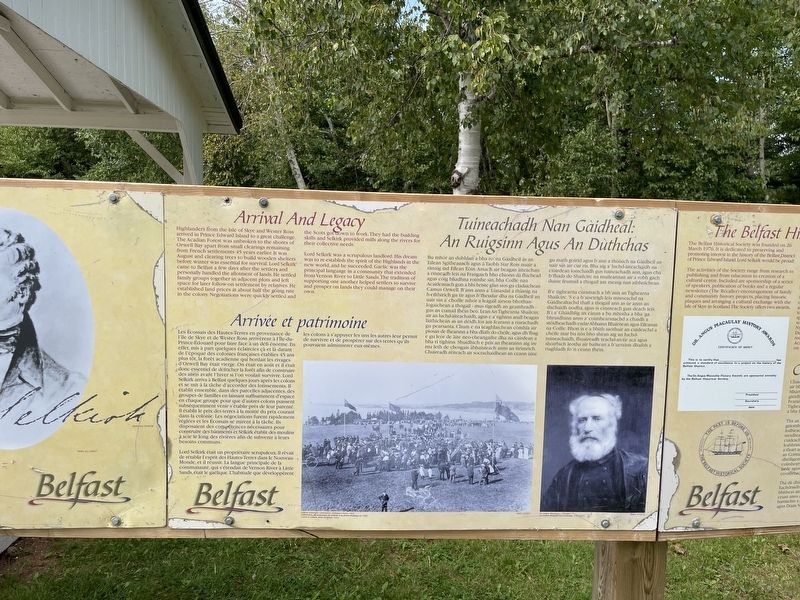
Highlanders from the Isle of Skye and Wester Ross arrived in Prince Edward Island to a great challenge. The Acadian Forest was unbroken to the shores of Orwell Bay apart from small clearings remaining from French settlements 45 years earlier. It was August and clearing trees to build wooden shelters before winter was essential for survival. Lord Selkirk came to Belfast a few days after the settlers and personally handled the allotment of lands. He settled family groups together in adjacent plots and left space for later follow-on settlement by relatives. He established land prices at about half the going rate in the colony. Negotiations were quickly settled and the Scots got down to work. They had the building skills and Selkirk provided mills along the rivers for their collective needs.
Lord Selkirk was a scrupulous landlord. His dream was to re-establish the spirit of the Highlands in the new world, and he succeeded. Gaelic was the principal language in a community that extended from Vernon River to Little Sands. The tradition of supporting one another helped settlers to survive and prosper
this page online
Les Écossais des Hautes-Terres en provenance de l'île de Skye et de Wester Ross arrivèrent à l'Île-du- Prince-Édouard pour faire face à un défi énorme. En effet, mis à part quelques éclaircies çà et là datant de l'époque des colonies françaises établies 45 ans plus tôt, la forêt acadienne qui bordait les rivages d'Orwell Bay était vierge. On était en août et il était donc essentiel de défricher la forêt afin de construire des abris avant l'hiver si l'on voulait survivre. Lord Selkirk arriva à Belfast quelques jours après les colons et se mit à la tâche d'accorder des lotissements. Il établit ensemble, dans des parcelles adjacentes, des groupes de familles en laissant suffisamment d'espace en chaque groupe pour que d'autres colons puissent subséquemment venir s'établir près de leur parenté. Il établit le prix des terres à la moitié du prix courant dans la colonie. Les négociations furent rapidement réglées et les Écossais se mirent à la tâche. Ils disposaient des compétences nécessaires pour -construire des bâtiments et Selkirk établit des moulins à scie le long des rivières
Photographed by Jay Noble, August 22, 2026
2. Arrival and Legacy Marker
Lord Selkirk était un propriétaire scrupuleux. Il rêvait de rétablir l'esprit des Hautes-Terres dans le Nouveau- Monde, et il réussit. La langue principale de la communauté, qui s'étendait de Vernon River à Little Sands, était le gaélique. L'habitude que développèrent les colons à s'appuyer les uns les autres leur permit de survivre et de prospérer sur des terres qu'ils pouvaient administrer eux-mêmes.
Bu mhór an dubhlan a bha ro'na Gàidheil ás an Eilean Sgitheanach agus á Taobh Siar Rois nuair a rànaig iad Eilean Eòin. Amach air beagan àiteachais a rinneadh leis na Frangaich bho chionn dà fhichead agus cóig bliadhna roimhe sin, bha Coille nan Acaideanach gun a bhi briste glan sios gu cladaichean Camus Orwell. B'ann anns a' Lùnasdal a thàinig na h-eilthirich gu tìr agus b'fheudar dha na Gàidheil an uair sin a' choille mhór a leagail airson bhothan- logaichean a thogail - mus tigeadh an geamhradh - gus an cumail fhéin beò. Lean An Tighearna Shailcirc air an luchd-àiteachaidh, agus e a' tighinn anall beagan làithichean as an déidh los am fearann a riarachadh gu pearsanta. Chum e na teaghlaichean còmhla air pìosan de fhearann a bha dlùth do chéile, agus dh'fhag e gu leòr de àite neo-cheangailte dha na càirdean a bha ri tighinn. Shuidhich e pris an fhearainn aig ìre mu leth de chosgais àbhaisteach anns an tìrimrich. Chuireadh réiteach air socrachaidhean an ceann ùine gu math goirid agus b'ann a thòisich na Gàidheil an uair sin air cur ris. Bha aig a' luchd-àiteachaidh na ciùirdean iomchaidh gus tuineachadh ann, agus cha b'fhada do Shailcirc na muileannan air a robh gach duine feumail a thogail am measg nan aibhnichean.
B'e tighearna cùramach a bh'ann an Tighearna Shailcirc. 'S e a b'aiseirigh leis misneachd na Gàidhealtachd thall a thogail ann as ùr anns an dachaidh nodha, agus is cinnteach gun deach leis. B'i a' Ghàidhlig an cànan a bu mhotha a bha 'ga bhruidhinn anns a' coimhearsnachd a chaidh a stéidheachadh eadar Abhainn Bhairnean agus Eileanan na Coille. Bhon is e a bhith saothair an cuideachd a chéile mar bu nòs bho shean aig an luchd- tuineachaidh, fhuaireadh teachd-an-tìr aca agus shoirbich leotha air bailtean a b'urrainn dhaibh a riaghladh fo 'n ceann fhéin.
Topics. This historical marker is listed in this topic list: Settlements & Settlers.
Location. 46° 5.627′ N, 62° 54.688′ W. Marker is in Belfast, Prince Edward Island. It is on Selkirk Park Road. Touch for map. Marker is at or near this postal address: 112 Selkirk Park Road, Belfast PE C0A 1A0, Canada. Touch for directions.

Regionally, this marker is in the Maritimes and in Atlantic Canada. Globally, it is in the North Atlantic Region, North America, the Western Hemisphere, the Western World, and the Anglosphere. Historically, it finds itself in what was once a British colony and also the Viceroyalty of New France.
Other nearby markers. At least 8 other markers are within walking distance of this marker: The Croft House (here, next to this marker); Scottish Settlement (a few steps from this marker); The Belfast Historical Society (a few steps from this marker); The Honourable J. Angus MacLean (within shouting distance of this marker); To Commemorate the Honourable J. Angus MacLean P.C, O.C., D.F.C. 1914-2000 (within shouting distance of this marker); Acadian Departure / Départ des Acadiens (about 90 meters away, measured in a direct line); Saint-Paul a la Pointe-Prim 1752-1758 (about 90 meters away); Acadian Settlement / Établissement acadien (about 90 meters away). Touch for a list and map of all markers in Belfast.
Credits. This page was last revised on September 16, 2026. It was originally submitted on September 2, 2026, by Jay Noble of Charlottetown, Prince Edward Island. This page has been viewed 11 times since then. Photos: 1, 2. submitted on September 2, 2026, by Jay Noble of Charlottetown, Prince Edward Island. • Andrew Ruppenstein was the editor who published this page.
