DeKalb in DeKalb County, Illinois — The American Midwest (Great Lakes)
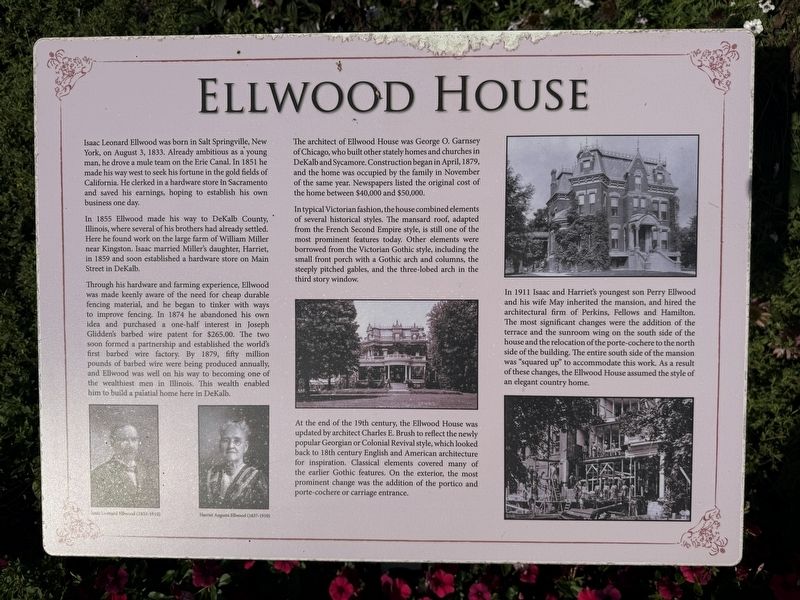
Ellwood House
Photographed by Matthew Stevens, September 10, 2026
1. Ellwood House Marker
Isaac Leonard Ellwood was born in Salt Springville, New York, on August 3, 1833. Already ambitious as a young man, he drove a mule team on the Erie Canal. In 1851 he made his way west to seek his fortune in the gold fields of California. He clerked in a hardware store in Sacramento and saved his earnings, hoping to establish his own business one day.
In 1855 Ellwood made his way to DeKalb County, Illinois, where several of his brothers had already settled. Here he found work on the large farm of William Miller near Kingston. Isaac married Miller's daughter, Harriet, in 1859 and soon established a hardware store on Main Street in DeKalb.
Through his hardware and farming experience, Ellwood was made keenly aware of the need for cheap durable fencing material, and he began to tinker with ways to improve fencing. In 1874 he abandoned his own idea and purchased a one-half interest in Joseph Glidden's barbed wire patent for $265.00. The two soon formed a partnership and established the world's first barbed wire factory. By 1870, fifty million pounds of barbed wire were being produced annually, and Ellwood was well on his
this page online
The architect of Ellwood House was George O. Garnsey of Chicago, who built other stately homes and churches in DeKalb and Sycamore. Construction began in April, 1879, and the home was occupied by the family in November of the same year. Newspapers listed the original cost of the home between $40,000 and $50,000.
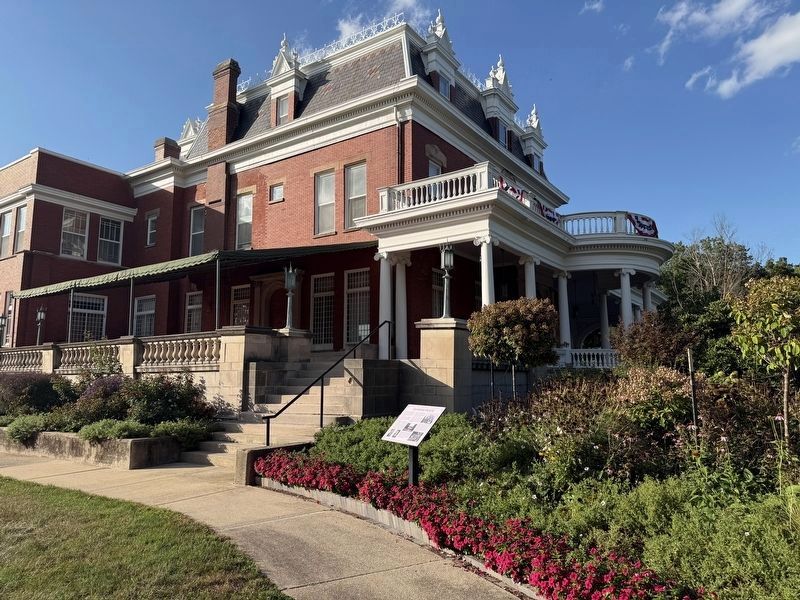
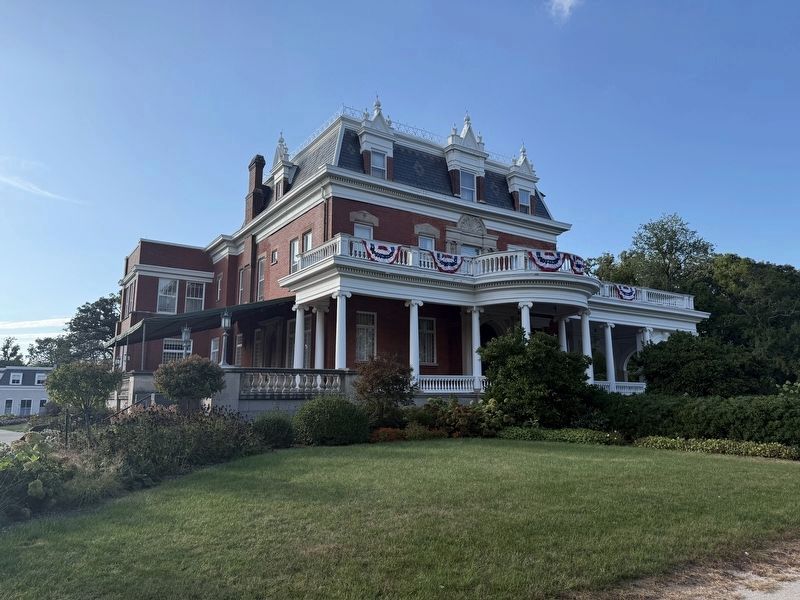
In typical Victorian fashion, the house combined elements of several historical styles. The mansard roof, adapted from the French Second Empire style, is still one of the most prominent features today. Other elements were borrowed from the Victorian Gothic style, including the small front porch with a Gothic arch and columns, the steeply pitched gables, and the three-lobed arch in the third story window.
At the end of the 19th century, the Ellwood House was updated by architect Charles E. Brush to reflect the newly popular Georgian or Colonial Revival style, which looked back to 18th century English and American architecture for inspiration. Classical elements covered many of the earlier Gothic features.
Photographed by Matthew Stevens, September 10, 2026
2. Ellwood House & Marker
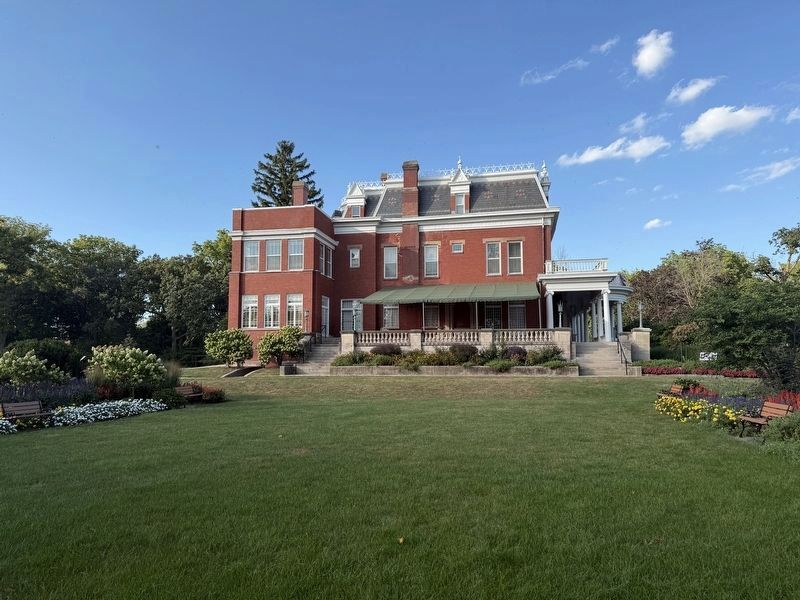
In 1911 Isaac and Harriet's youngest son Perry Ellwood and his wife May inhered the mansion, and hired the architectural firm of Perkins, Fellows and Hamilton. The most significant changes were the addition of the terrace and the sunroom wing on the south side of the house and the relocation of the porte-cochere to the north side of the building. The entire south side of the mansion was "squared up" to accommodate this work. As a result of these changes, the Ellwood House assumed the style of an elegant country home.
Isaac Leonard Ellwood (1833-1919)
Harriet Augusta Ellwood (1837-1910)
Erected by the Ellwood House Museum.
Topics. This historical marker is listed in these topic lists: Architecture • Industry & Commerce • Notable Buildings. A significant historical month for this entry is April 1879.
Location. 41° 56.108′ N, 88° 45.149′ W. Marker is in DeKalb, Illinois, in DeKalb County. It is on North 1st Street. This marker is located southeast of the Ellwood House in DeKalb. Touch for map. Marker is at or
Photographed by Matthew Stevens, September 10, 2026
3. Ellwood House

Regionally, this marker is in Northern Illinois. It is also in the American Midwest and in the Corn Belt. Globally, it is in North America, the Western Hemisphere, the Western World, and the Anglosphere. Historically, it finds itself in what was once the territory of the Mississippian Culture and also the Northwest Territory.
Other nearby markers. At least 8 other markers are within walking distance of this marker: A different marker also named Ellwood House (a few steps from this marker); Ellwood Mansion (a few steps from this marker); Rooted in Tradition (within shouting distance of this marker); Mrs. Ellwood’s Museum (within shouting distance of this marker); The Little House (about 300 feet away, measured in a direct line); Ellwood Green (about 300 feet away); Major General Johann De Kalb White Oak (about 300 feet away); Jacob Haish (approx. ¼ mile away). Touch for a list and map of all markers in DeKalb.
Photographed by Matthew Stevens, September 10, 2026
4. Ellwood House South Side
Credits. This page was last revised on September 16, 2026. It was originally submitted on September 10, 2026, by Matthew Stevens of Washington, Illinois. This page has been viewed 13 times since then. Photos: 1, 2, 3, 4. submitted on September 10, 2026, by Matthew Stevens of Washington, Illinois. • Andrew Ruppenstein was the editor who published this page.
