Berliner Innenstadt in Friedrichshain-Kreuzberg, Germany — Northeast German Plain (The European Plain)
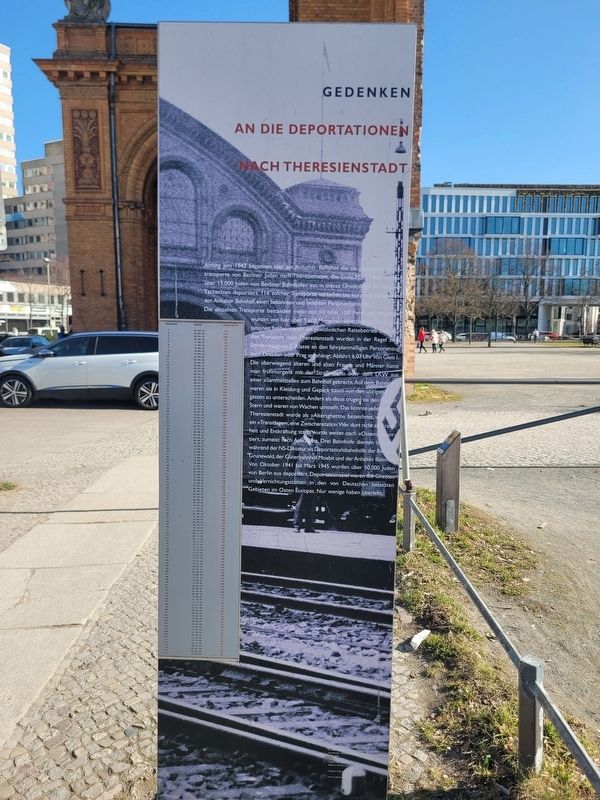
Gedenken an die Deportationen nach Theresienstadt
⎯⎯⎯
Commemoration of the Deportations to Theresienst
Photographed by James Hulse, March 6, 2026
1. Gedenken an die Deportationen nach Theresienstadt / Commemoration of the Deportations to Theresienst

Anfang Juni 1942 begannen hier am Anhalter Bahnhof die so genannten »Alterstransporte« von Berliner Juden nach Theresienstadt. Bis Ende März 1945 wurden über 15.000 Juden von Berliner Bahnhöfen aus in dieses Ghettolager im heutigen Tschechien deportiert. 116 solcher Transporte verließen bis kurz vor Kriegsende den Anhalter Bahnhof, einen bekannten und belebten Personenbahnhof.
Die einzelnen Transporte bestanden meist aus 50 oder 100 Personen; insgesamt wurden von hier über 9.600 Menschen verschleppt. Die Deportationen fanden mitten im gewöhnlichen Reisebetrieb statt. Für den Transport nach Theresienstadt wurden in der Regel zwei Sonderwaggons 3. Klasse an den fahrplanmäßigen Personenzug nach Dresden oder Prag angehängt; Abfahrt 6.07 Uhr von Gleis 1.
Die überwiegend älteren und alten Frauen und Männer hatte man frühmorgens mit der Straßenbahn oder dem LKW aus einer »Sammelstelle« zum Bahnhof gebracht. Auf dem Bahnsteig waren sie in Kleidung und Gepäck kaum von den übrigen Fahrgästen zu unterscheiden. Anders als diese trugen sie den Gelben Stern und waren
this page online
Theresienstadt wurde als »Altersghetto« bezeichnet, war aber ein »Transitlager«, eine Zwischenstation: Wer dort nicht an Krankheit und Entkräftung starb, wurde weiter nach »Osten« deportiert, zumeist nach Auschwitz. Drei Bahnhöfe dienten in Berlin während der NS-Diktatur als Deportationsbahnhöfe: der Bahnhof Grunewald, der Güterbahnhof Moabit und der Anhalter Bahnhof. Von Oktober 1941 bis März 1945 wurden über 50.000 Juden von Berlin aus deportiert. Deportationsziel waren die Ghettos und Vernichtungsstätten in den von Deutschen besetzten Gebieten im Osten Europas. Nur wenige haben überlebt.
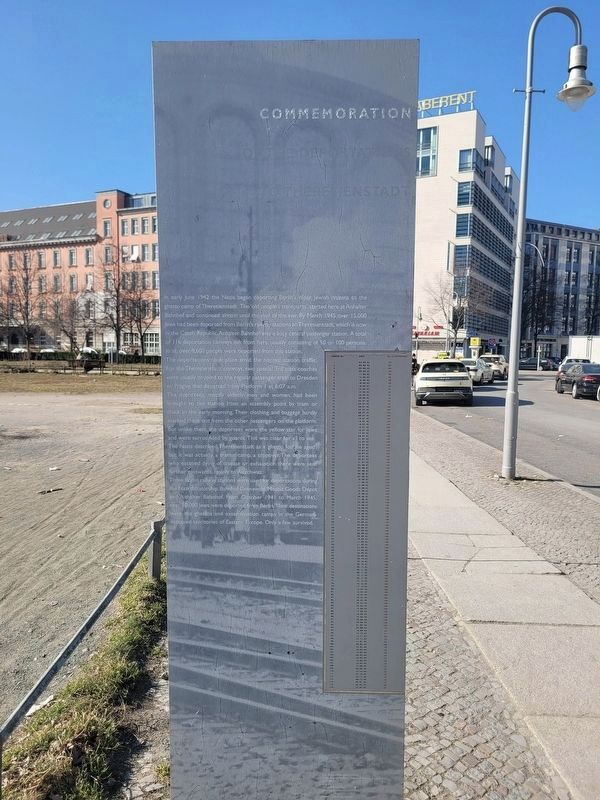
In early June 1942 the Nazis began deporting Berlin’s older Jewish citizens to the ghetto camp of Theresienstadt. The ‘old people’s transports’ started here at Anhalter Bahnhof and continued almost until the end of the war. By March 1945 over 15,000 Jews had been deported from Berlin’s railway stations to Theresienstadt, which is now in the Czech Republic. Anhalter Bahnhof was a busy central passenger station. A total of 116 deportation convoys
Photographed by James Hulse
2. Gedenken an die Deportationen nach Theresienstadt / Commemoration of the Deportations to Theresienst
Reverse Side in English text.
The deportations took place amid the normal station traffic. For the Theresienstadt convoys, two special 3rd class coaches were usually coupled to the regular passenger train to Dresden or Prague that departed from Platform 1 at 6:07 a.m.
The deportees, mostly elderly men and women, had been brought to the station from an assembly point by tram or truck in the early morning. Their clothing and baggage hardly marked them out from the other passengers on the platform. But unlike them, the deportees wore the yellow star for Jews and were surrounded by guards. This was clear for all to see.
The Nazis described Theresienstadt as a ‘ghetto for the aged’, but it was actually a transit camp, a stopover. The deportees who escaped dying of disease or exhaustion there were sent further eastwards, mainly to Auschwitz.
Three Berlin railway stations were used for deportations during the Nazi dictatorship: Bahnhof Grunewald, Moabit Goods Depot and Anhalter Bahnhof. From October 1941 to March 1945, over 50,000 Jews were
Photographed by James Hulse
3. Gedenken an die Deportationen nach Theresienstadt / Commemoration of the Deportations to Theresienst
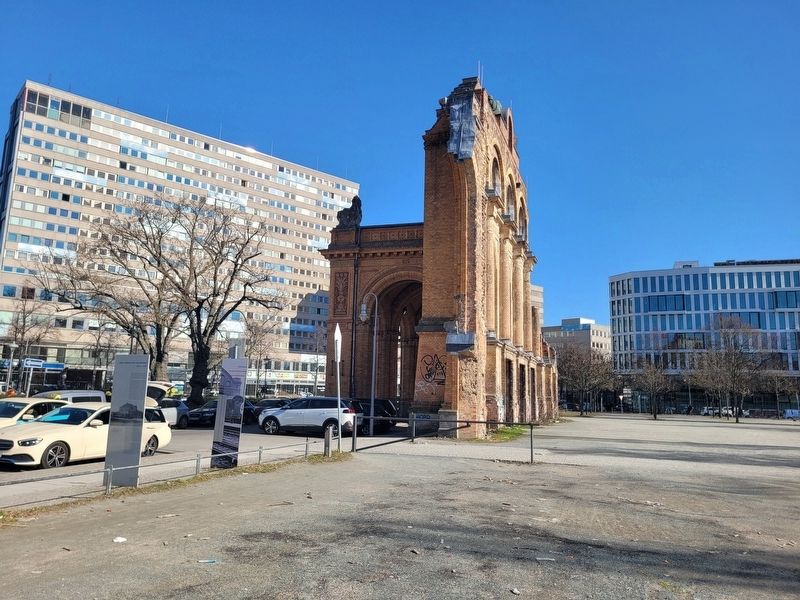
The view of the marker from the train station ruins.
Erected 2008 by Bezirksamt Friedrichshain-Kreuzberg von Berlin, in collaboration with the Governing Mayor of Berlin, Senate Chancellery – Cultural Affairs – Art in Urban Space. Text: Dr. Dietlinde Peters, English translation: Karen Margolis, Design and organization: Helga Lieser and Photograph: Landesarchiv Berlin.
Topics. This historical marker is listed in these topic lists: Railroads & Streetcars • War, World II. A significant historical month for this entry is March 1945.
Location. 52° 30.225′ N, 13° 22.928′ E. Marker is in Berlin, in Friedrichshain-Kreuzberg. It is in Berliner Innenstadt. It is at the intersection of Askanischer Pl. and Schöneberger Straße, on the left when traveling west on Askanischer Pl.. Touch for map. Marker is at or near this postal address: Askanischer Pl 6, Berlin 10963, Germany. Touch for directions.

Regionally, it is in Europe, the European Union, Atlantic Europe, Central Europe, the Schengen Area, Western Europe, and the Western World.
Photographed by James Hulse, March 6, 2026
4. Gedenken an die Deportationen nach Theresienstadt / Commemoration of the Deportations to Theresienst
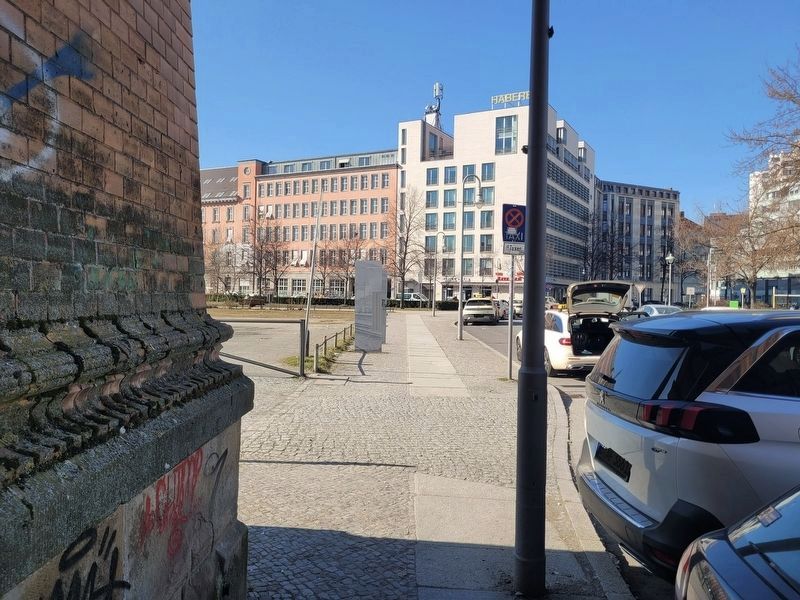
The marker is the closest marker of the two markers to the train station ruins.
Other nearby markers. At least 8 other markers are within walking distance of this marker: Der Anhalter Bahnhof / Anhalter Railway Station (here, next to this marker); Lilli Henoch Sportplatz (within shouting distance of this marker); Das Europahaus (about 210 meters away, measured in a direct line); Die Geschichte des Ministeriums / History of the Ministry (about 210 meters away); Europahaus-Komplex / Europahaus Complex (approx. 0.3 kilometers away); Das „Hausgefängnis“ der Gestapo-Zentrale / The “House Prison” at Gestapo Headquarters (approx. 0.3 kilometers away); NS-Luftschutzbauten / Nazi Air Raid Protection Structures (approx. 0.3 kilometers away); Verpflegungsbaracke der SS / SS Mess Hut (approx. 0.3 kilometers away). Touch for a list and map of all markers in Berlin.
Additional keywords. Holocaust
Credits. This page was last revised on September 14, 2026. It was originally submitted on September 13, 2026, by James Hulse of Medina, Texas. This page has been viewed 11 times since then. Photos: 1, 2, 3, 4. submitted on September 14, 2026, by James Hulse of Medina, Texas.
