Berliner Innenstadt in Friedrichshain-Kreuzberg, Germany — Northeast German Plain (The European Plain)
Der Anhalter Bahnhof
⎯⎯⎯
Anhalter Railway Station
1841–1959
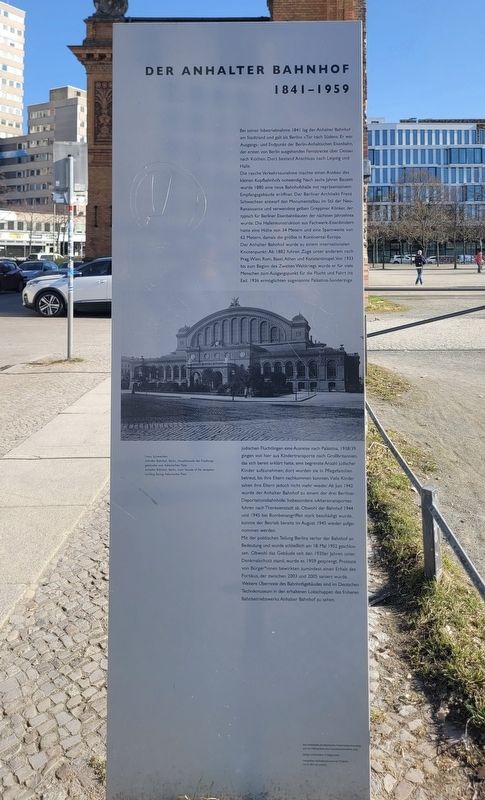
Photographed by James Hulse, March 6, 2026
1. Der Anhalter Bahnhof / Anhalter Railway Station Marker

Die rasche Verkehrszunahme machte einen Ausbau des kleinen Kopfbahnhofs notwendig: Nach sechs Jahren Bauzeit wurde 1880 eine neue Bahnhofshalle mit repräsentativem Empfangsgebäude eröffnet. Der Berliner Architekt Franz Schwechten entwarf den Monumentalbau im Stil der Neo-Renaissance und verwendete gelben Greppiner Klinker, der typisch für Berliner Eisenbahnbauten der nächsten Jahrzehnte wurde. Die Hallenkonstruktion aus Fachwerk-Eisenbindern hatte eine Höhe von 34 Metern und eine Spannweite von 62 Metern, damals die größte in Kontinental-Europa.
Der Anhalter Bahnhof wurde zu einem internationalen Knotenpunkt: Ab 1882 fuhren Züge unter anderem nach Prag, Wien, Rom, Basel, Athen und Konstantinopel. Von 1933 bis zum Beginn des Zweiten Weltkriegs wurde er für viele Menschen zum Ausgangspunkt für die Flucht und Fahrt ins Exil. 1936 ermöglichten sogenannte Palästina-Sonderzüge jüdischen Flüchtlingen eine Ausreise nach Palästina. 1938/39 gingen von hier aus Kindertransporte nach Großbritannien, das sich bereit erklärt hatte, eine begrenzte Anzahl jüdischer Kinder aufzunehmen; dort wurden sie in Pflegefamilien betreut, bis ihre Eltern nachkommen konnten. Viele Kinder sahen ihre Eltern jedoch nicht mehr wieder. Ab Juni 1942 wurde der Anhalter Bahnhof zu einem der drei Berliner Deportationsbahnhöfe: Insbesondere »Alterstransporte« fuhren nach Theresienstadt ab. Obwohl der Bahnhof 1944 und 1945 bei Bombenangriffen stark beschädigt wurde, konnte der Betrieb bereits im August 1945 wieder aufgenommen werden.
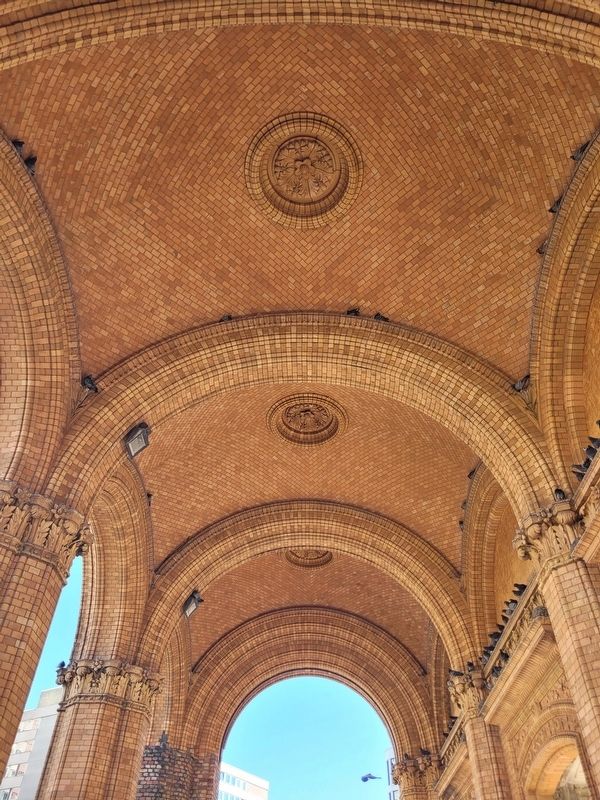
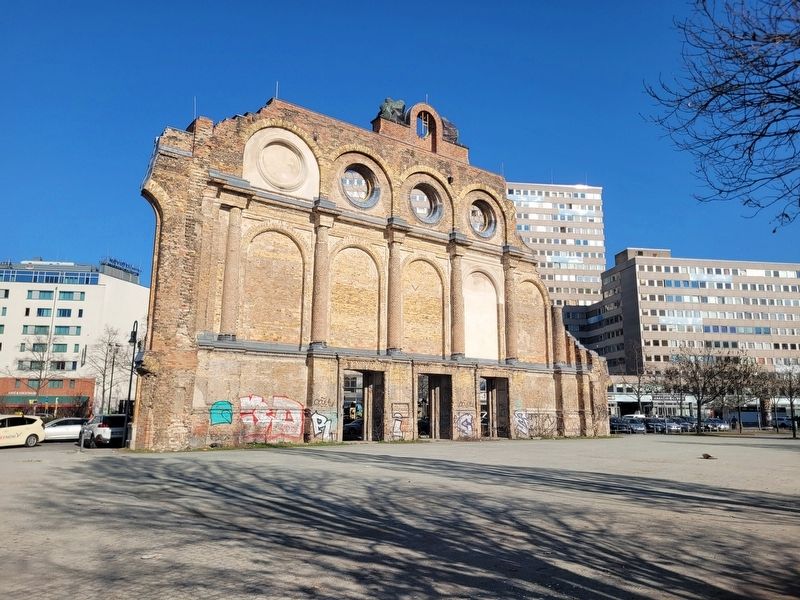
Mit der politischen Teilung Berlins verlor der Bahnhof an Bedeutung und wurde schließlich am 18. Mai 1952 geschlossen. Obwohl das Gebäude seit den 1930er Jahren unter Denkmalschutz stand, wurde es 1959 gesprengt. Proteste von Bürger*innen bewirkten zumindest einen Erhalt des Portikus, der zwischen 2003 und 2005 saniert wurde. Weitere Überreste des Bahnhofsgebäudes sind im Deutschen Technikmuseum in den erhaltenen Lokschuppen des früheren Bahnbetriebswerks Anhalter Bahnhof zu sehen.
Franz Schwechten, Anhalter Bahnhof, Berlin, Hauptfassade des Empfangsgebäudes zum Askanischen Platz
this page online
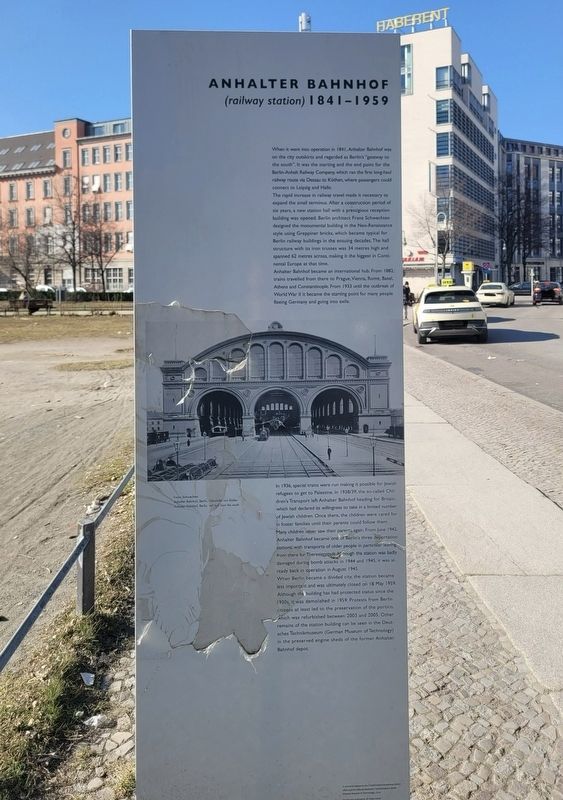
The rapid increase in railway travel made it necessary to expand the small terminus. After a construction period of six years, a new station hall with a prestigious reception building was opened. Berlin architect Franz Schwechten designed the monumental building in the Neo-Renaissance style using Greppiner bricks, which became typical for Berlin railway buildings in the ensuing decades. The hall structure with its iron trusses was 34 metres high and spanned 62 metres across, making it the biggest in Continental Europe at that time.
Anhalter Bahnhof became an international hub. From 1882, trains travelled from there to Prague, Vienna, Rome, Basel, Athens and Constantinople. From 1933 until the outbreak of World War II it became the starting point for many people fleeing Germany and going into exile.
In 1936, special trains were run making it possible for Jewish refugees to get to Palestine. In 1938/39, the so-called Children’s Transport left Anhalter Bahnhof heading for Britain, which had declared its willingness to take in a limited number of Jewish children. Once there, the children were cared for in foster families until their parents could follow them. Many children never saw their parents again. From June 1942, Anhalter Bahnhof became one of Berlin’s three deportation stations, with transports
Photographed by James Hulse
2. Der Anhalter Bahnhof / Anhalter Railway Station Marker
Reverse Side with the English Text.
When Berlin became a divided city, the station became less important and was ultimately closed on 18 May 1959. Although the building has had protected status since the 1930s, it was demolished in 1959. Protests from Berlin citizens at least led to the preservation of the portico, which was refurbished between 2003 and 2005. Other remains of the station building can be seen in the Deutsches Technikmuseum (German Museum of Technology) in the preserved engine sheds of the former Anhalter Bahnhof depot.
Franz Schwechten, Anhalter Bahnhof, Berlin, main facade of the reception building facing Askanischer Platz
Erected 2019 by Friedrichshain-Kreuzberg district office and the Stiftung Deutsches Technikmuseum Berlin (German Museum of Technology), Design and realization: © Helga Lieser and Photographs: TU Berlin architecture museum, Inv. no.: BZ-F 08, 016/017.
Topics. This historical marker is listed in this topic list: Railroads & Streetcars. A significant historical date for this entry is May 18, 1959.
Location. 52° 30.226′ N, 13° 22.925′ E. Marker is in Berlin, in Friedrichshain-Kreuzberg. It is in Berliner Innenstadt. It is at the intersection of Askanischer Pl. and Schöneberger Str., on the left when traveling west on Askanischer Pl.. Touch for map. Marker is at or near this postal address: Askanischer Pl 6, Berlin 10963, Germany. Touch for directions.

Regionally, it is in Europe, the European Union, Atlantic Europe, Central
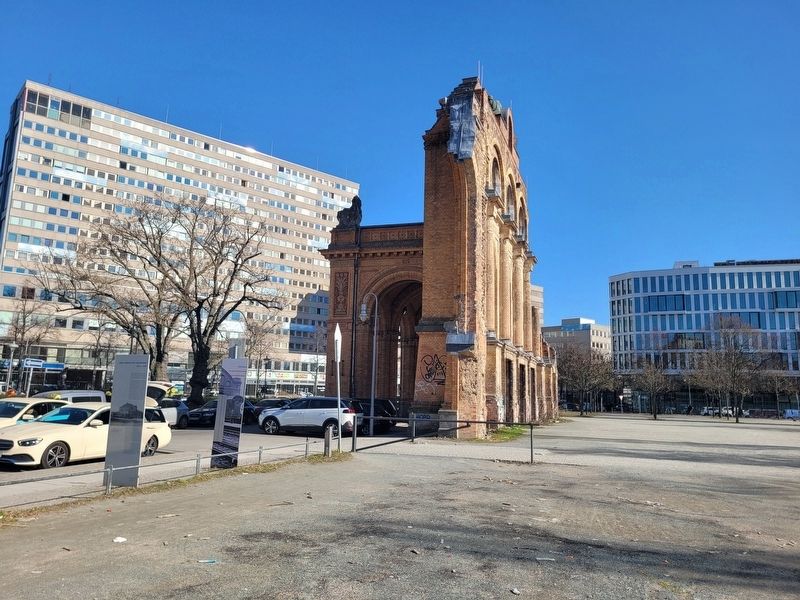
Photographed by James Hulse, March 6, 2026
3. Der Anhalter Bahnhof / Anhalter Railway Station Marker
The marker is the first marker from the left of the two markers.
Other nearby markers. At least 8 other markers are within walking distance of this marker: Gedenken an die Deportationen nach Theresienstadt / Commemoration of the Deportations to Theresienst (here, next to this marker); Lilli Henoch Sportplatz (within shouting distance of this marker); Das Europahaus (about 210 meters away, measured in a direct line); Die Geschichte des Ministeriums / History of the Ministry (about 210 meters away); Europahaus-Komplex / Europahaus Complex (approx. 0.3 kilometers away); Das „Hausgefängnis“ der Gestapo-Zentrale / The “House Prison” at Gestapo Headquarters (approx. 0.3 kilometers away); NS-Luftschutzbauten / Nazi Air Raid Protection Structures (approx. 0.3 kilometers away); Verpflegungsbaracke der SS / SS Mess Hut (approx. 0.3 kilometers away). Touch for a list and map of all markers in Berlin.
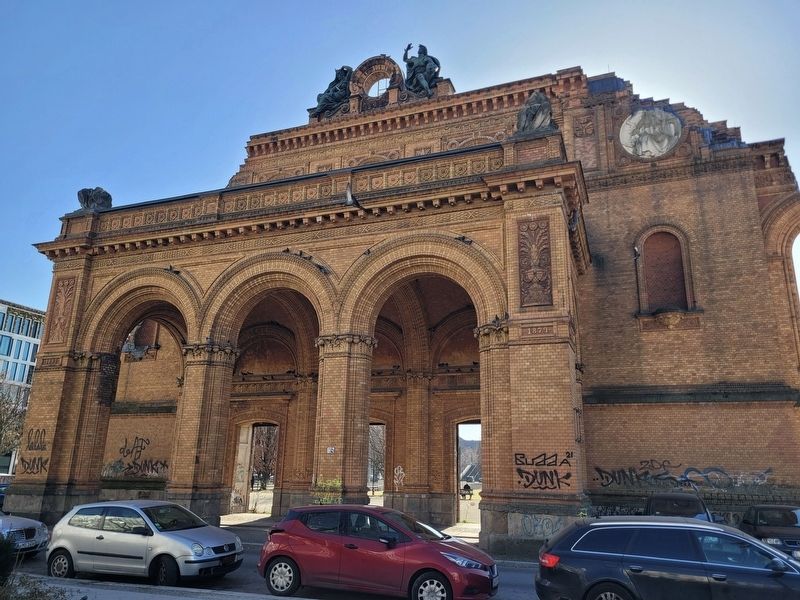
Photographed by James Hulse
4. Der Anhalter Bahnhof / Anhalter Railway Station Marker
Ruins of the front facade of the Anhalter Bahnhof.
Photographed by James Hulse, March 6, 2026
5. Der Anhalter Bahnhof / Anhalter Railway Station Marker
Ceiling archway of the train station ruins.
Photographed by James Hulse, March 6, 2026
6. Der Anhalter Bahnhof / Anhalter Railway Station Marker
Ruins facing towards the former train hall area.
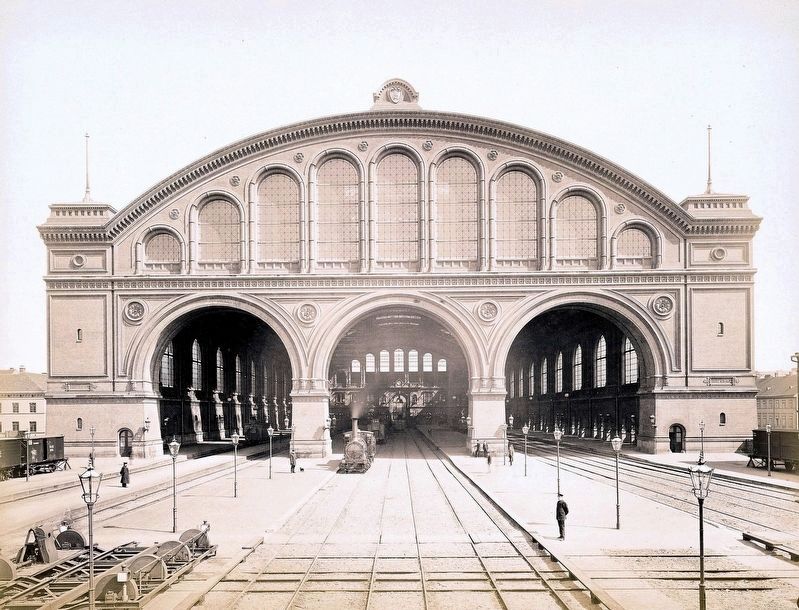
Public Domain via Hermann Rückwardt and Wikipedia Commons, circa 1881
7. Anhalter Bahnhof terminal station, southern facade and platforms
Credits. This page was last revised on September 14, 2026. It was originally submitted on September 13, 2026, by James Hulse of Medina, Texas. This page has been viewed 8 times since then. Photos: 1, 2, 3, 4, 5, 6, 7. submitted on September 14, 2026, by James Hulse of Medina, Texas.
