Berliner Innenstadt in Friedrichshain-Kreuzberg, Germany — Northeast German Plain (The European Plain)
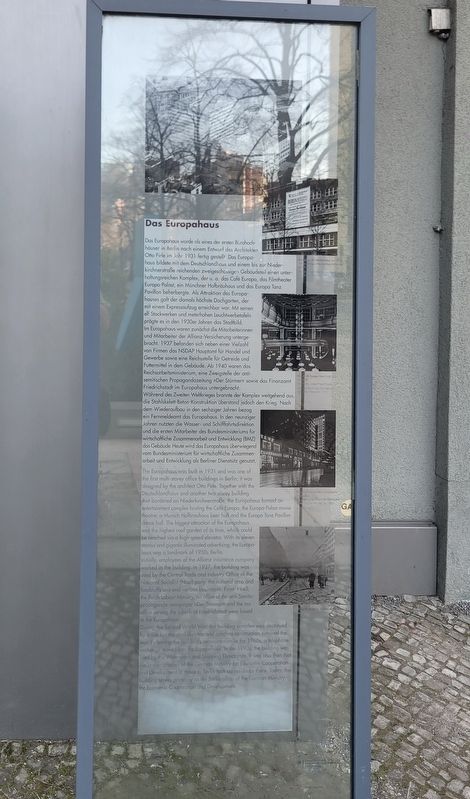
Das Europahaus
Photographed by James Hulse, March 6, 2026
1. Das Europahaus Marker

Im Europahaus waren zunächst die Mitarbeiterinnen und Mitarbeiter der Allianz-Versicherung untergebracht. 1937 befanden sich neben einer Vielzahl von Firmen das NSDAP Hauptamt für Handel und Gewerbe sowie eine Reichsstelle für Getreide und Futtermittel in dem Gebäude. Ab 1940 waren das Reichsarbeitsministerium, eine Zweigstelle der antisemitischen Propagandazeitung »Der Stürmer« sowie das Finanzamt Friedrichstadt im Europahaus untergebracht.
Während des Zweiten Weltkrieges brannte der Komplex weitgehend aus, die Stahlskelett-Beton-Konstruktion überstand jedoch den Krieg. Nach dem Wiederaufbau in den sechziger Jahren bezog ein Fernmeldeamt das Europahaus. In den neunziger Jahren nutzten die Wasser- und Schifffahrtsdirektion und die ersten Mitarbeiter des Bundesministeriums für wirtschaftliche Zusammenarbeit und Entwicklung (BMZ) das Gebäude. Heute wird das Europahaus überwiegend vom Bundesministerium für wirtschaftliche Zusammenarbeit und Entwicklung als Berliner Dienstsitz genutzt.
Luftbild des Europahauses, 2000, Bundespresseamt
Baubeginn mit Werbeplakat für die bevorstehende Eröffnung, ca. 1929, Aus dem Buch Das Europahaus von Albert Heilmann, 1931
Das »Café Europa-Haus« von innen, um 1930, Aus dem Buch Das Europahaus von Albert Heilmann, 1931
Das Hochhaus mit dem Lichtreklame-Dachaufbau, 1932, Landesbildstelle
Luftangriff auf Berlin, 3. Februar 1945, bpk Berlin / Foto: Arthur Grimm
this page online
Initially, employees of the Allianz insurance company worked in the building. In 1937, the building was used by the Central Trade and Industry Office of the National-Socialist (Nazi) party, the national crop and foodstuffs unit and various businesses. From 1940, the Reich Labour Ministry, an office of the anti-Semitic propaganda newspaper »Der Stürmer« and the tax office serving the suburb of Friedrichstadt were based in the Europahaus.
During the Second World War,
Photographed by James Hulse, March 6, 2026
2. Das Europahaus Marker (Right Side)
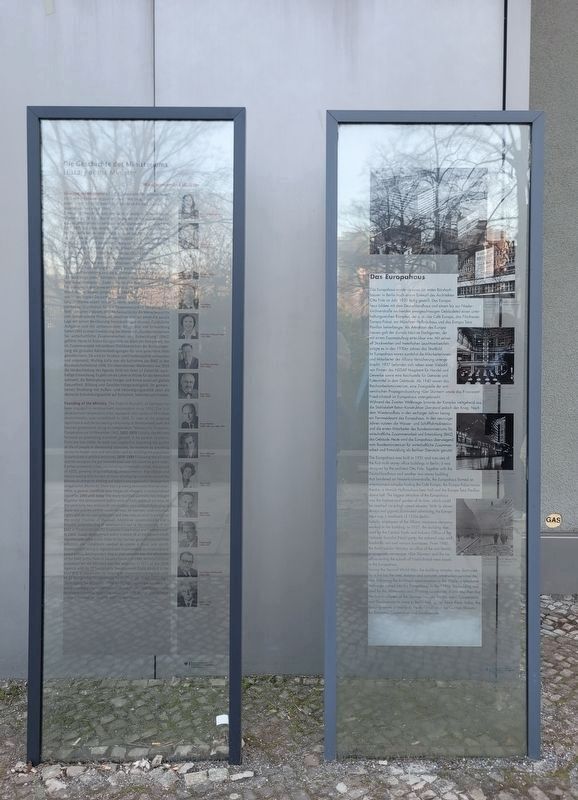
The marker on the left side is the History of the Ministry.
Aerial view of the Europahaus, 2000, Federal Press Office
The beginning of construction with an advertising poster for the forthcoming opening, ca. 1929, From the book Das Europahaus by Albert Heilmann, 1931
The “Café Europa-Haus” inside, ca. 1930, From the book Das Europahaus by Albert Heilmann, 1931
The high-rise building with illuminated advertising on the roof, ca. 1932, Landesbildstelle
After an air raid, February 1945, bpk Berlin / Photograph: Arthur Grimm
Erected 2008 by Federal Ministry for Economic Cooperation and Development (BMZ).
Topics.
Photographed by James Hulse, March 6, 2026
3. Das Europahaus Marker
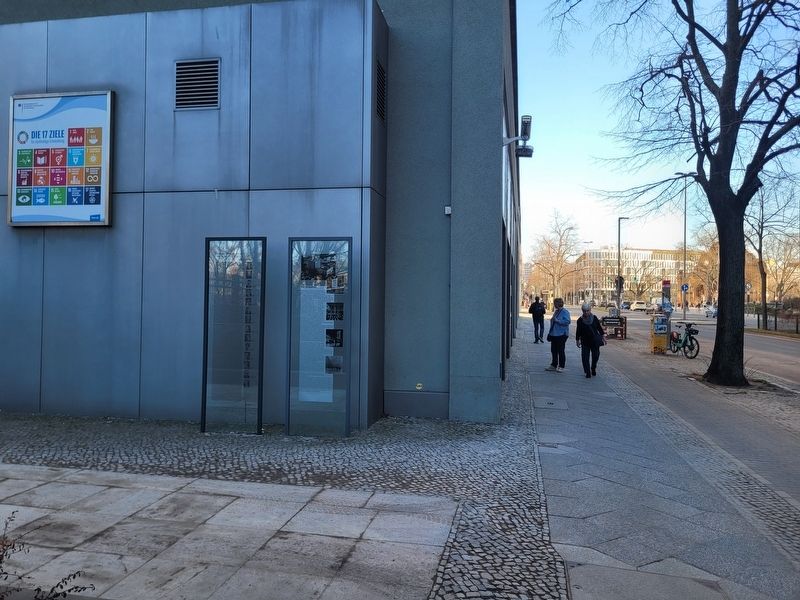
Location. 52° 30.33′ N, 13° 22.884′ E. Marker is in Berlin, in Friedrichshain-Kreuzberg. It is in Berliner Innenstadt. It is on Stresemannstraße just north of Bernburger Str., on the right when traveling north. Touch for map. Marker is at or near this postal address: Stresemannstraße 94, Berlin 10963, Germany. Touch for directions.

Regionally, it is in Europe, the European Union, Atlantic Europe, Central Europe, the Schengen Area, Western Europe, and the Western World. Historically, it finds itself in what was once the Holy Roman Empire, the former West Germany, and at the Berlin Wall.
Other nearby markers. At least 8 other markers are within walking distance of this marker: Die Geschichte des Ministeriums / History of the Ministry (here, next to this marker); Das „Hausgefängnis“ der Gestapo-Zentrale / The “House Prison” at Gestapo Headquarters (about 150 meters away, measured in a direct line); Das Hausgefängnis des Geheimen Staatspolizeiamts (about 150 meters away); Myra Warhaftig (about 150 meters away); Baudenkmal Berliner Mauer / Berlin Wall Monument (about 180 meters away); Europahaus-Komplex / Europahaus Complex (about 180 meters away); Remains of the Berlin Wall (about 210 meters away); Der Anhalter Bahnhof / Anhalter Railway Station (about 210 meters away). Touch for a list and map of all markers in Berlin.
Credits. This page was last revised on September 14, 2026. It was originally submitted on September 13, 2026, by James Hulse of Medina, Texas. This page has been viewed 7 times since then. Photos: 1, 2, 3. submitted on September 14, 2026, by James Hulse of Medina, Texas.
