Berliner Innenstadt in Friedrichshain-Kreuzberg, Germany — Northeast German Plain (The European Plain)
Die Alte Berliner Philharmonie
⎯⎯⎯
Berlin’s Old Philharmonic Hall
Photographed by James Hulse, March 6, 2026
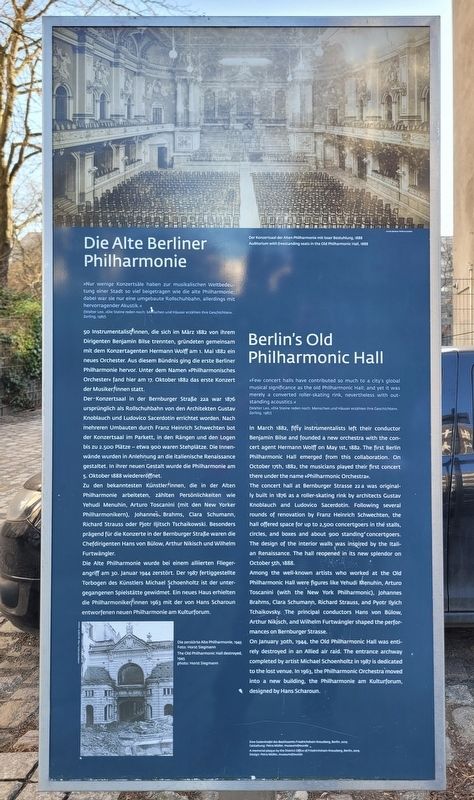
1. Die Alte Berliner Philharmonie / Berlin’s Old Philharmonic Hall Marker

»Nur wenige Konzertsäle haben zur musikalischen Weltbedeutung einer Stadt so viel beigetragen wie die alte Philharmonie, dabei war sie nur eine umgebaute Rollschuhbahn, allerdings mit hervorragender Akustik.« (Walter Leo, »Die Steine reden noch: Menschen und Häuser erzählen ihre Geschichten«, Zerling, 1987)
50 Instrumentalist*innen, die sich im März 1882 von ihrem Dirigenten Benjamin Bilse trennten, gründeten gemeinsam mit dem Konzertagenten Hermann Wolff am 1. Mai 1882 ein neues Orchester. Aus diesem Bündnis ging die erste Berliner Philharmonie hervor. Unter dem Namen »Philharmonisches Orchester« fand hier am 17. Oktober 1882 das erste Konzert der Musiker*innen statt.
Der Konzertsaal in der Bernburger Straße 22a war 1876 ursprünglich als Rollschuhbahn von den Architekten Gustav Knoblauch und Ludovico Sacerdotin errichtet worden. Nach mehreren Umbauten durch Franz Heinrich Schwechten bot der Konzertsaal im Parkett, in den Rängen und den Logen bis zu 2.500 Plätze – etwa 900 waren Stehplätze. Die Innenwände wurden in Anlehnung an die italienische Renaissance gestaltet. In ihrer neuen Gestalt wurde die Philharmonie am 5. Oktober 1888 wiedereröffnet.
Zu den bekanntesten Künstler*innen, die in der Alten Philharmonie arbeiteten, zählten Persönlichkeiten wie Yehudi Menuhin, Arturo Toscanini (mit den New Yorker Philharmonikern), Johannes Brahms, Clara Schumann, Richard Strauss oder Pjotr Iljitsch Tschaikowski. Besonders prägend für die Konzerte in der Bernburger Straße waren die Chefdirigenten Hans von Bülow, Arthur Nikisch und Wilhelm Furtwängler.
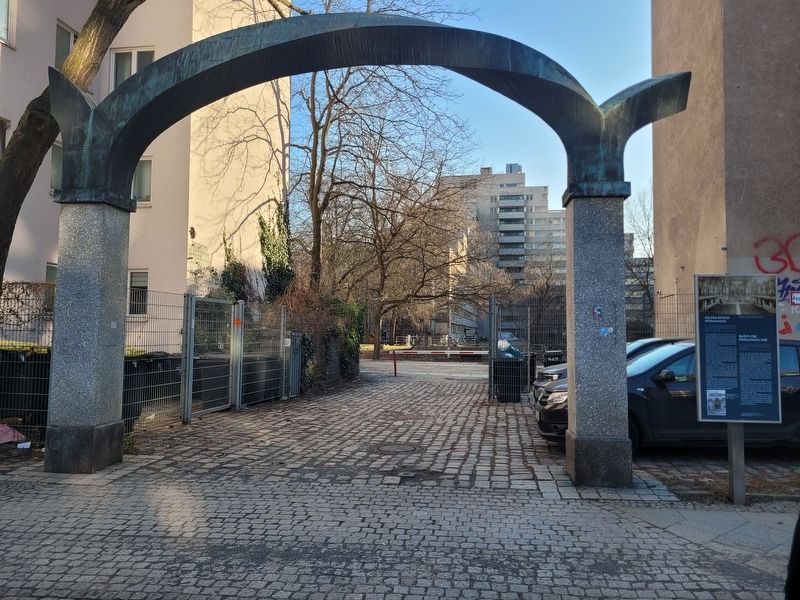
Die Alte Philharmonie wurde bei einem alliierten Fliegerangriff am 30. Januar 1944 zerstört. Der 1987 fertiggestellte Torbogen des Künstlers Michael Schoenholtz ist der untergegangenen Spielstätte gewidmet. Ein
this page online
Der Konzertsaal der Alten Philharmonie mit loser Bestuhlung, 1888, Archiv Berliner Philharmoniker
Die zerstörte Alte Philharmonie, 1945, Foto: Horst Siegmann
»Few concert halls have contributed so much to a city’s global musical significance as the old Philharmonic Hall; and yet it was merely a converted roller-skating rink, nevertheless with outstanding acoustics.« (Walter Leo, »Die Steine reden noch: Menschen und Häuser erzählen ihre Geschichten«, Zerling, 1987)
In March 1882, fifty instrumentalists left their conductor Benjamin Bilse and founded a new orchestra with the concert agent Hermann Wolff on May 1st, 1882. The first Berlin Philharmonic Hall emerged from this collaboration. On October 17th, 1882, the musicians played their first concert there under the name »Philharmonic Orchestra«.
The concert hall at Bernburger Strasse 22a was originally built in 1876 as a roller-skating rink by architects Gustav Knoblauch and Ludovico Sacerdotin. Following
Photographed by James Hulse, March 6, 2026
2. Die Alte Berliner Philharmonie / Berlin’s Old Philharmonic Hall Marker
Among the well-known artists who worked at the Old Philharmonic Hall were figures like Yehudi Menuhin, Arturo Toscanini (with the New York Philharmonic), Johannes Brahms, Clara Schumann, Richard Strauss, and Pyotr Ilyich Tchaikovsky. The principal conductors Hans von Bülow, Arthur Nikisch, and Wilhelm Furtwängler shaped the performances on Bernburger Strasse.
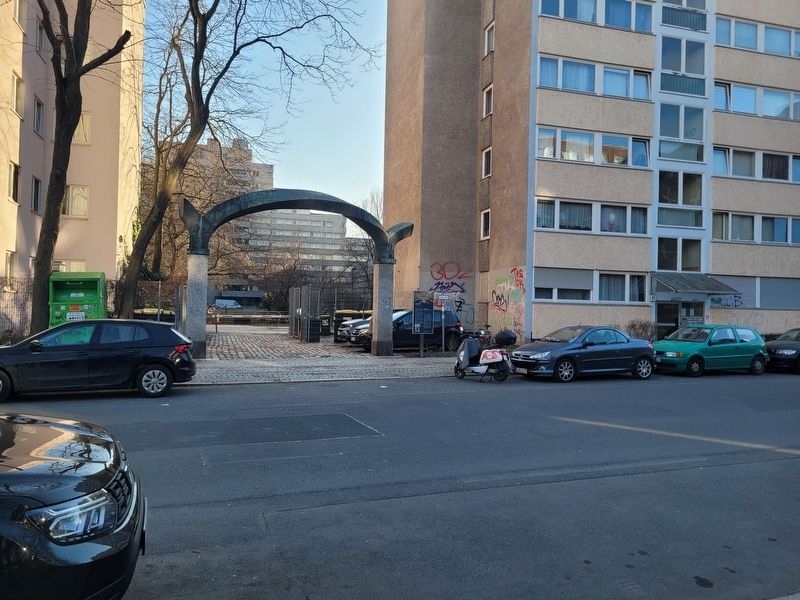
On January 30th, 1944, the Old Philharmonic Hall was entirely destroyed in an Allied air raid. The entrance archway completed by artist Michael Schoenholtz in 1987 is dedicated to the lost venue. In 1963, the Philharmonic Orchestra moved into a new building, the Philharmonie am Kulturforum, designed by Hans Scharoun.
Auditorium with freestanding seats in the Old Philharmonic Hall, 1888, Berlin Philharmonic Archive
The Old Philharmonic Hall destroyed, 1945, Photograph: Horst Siegmann
Erected 2019
Photographed by James Hulse, March 6, 2026
3. Die Alte Berliner Philharmonie / Berlin’s Old Philharmonic Hall Marker
Topics. This historical marker is listed in these topic lists: Arts, Letters, Music • Notable Buildings • War, World II. A significant historical date for this entry is January 30, 1944.
Location. 52° 30.322′ N, 13° 22.624′ E. Marker is in Berlin, in Friedrichshain-Kreuzberg. It is in Berliner Innenstadt. It is on Bernburger Straße just east of Köthener Str., on the right when traveling east. Touch for map. Marker is at or near this postal address: Bernburger Str 21, Berlin 10963, Germany. Touch for directions.

Regionally, it is in Europe, the European Union, Atlantic Europe, Central Europe, the Schengen Area, Western Europe, and the Western World. Historically, it finds itself in what was once the Holy Roman Empire, the former West Germany, and at the Berlin Wall.
Other nearby markers. At least 8 other markers are within walking distance of this marker: Myra Warhaftig (about 180 meters away, measured in a direct line); Das Europahaus (approx. 0.3 kilometers away); Die Geschichte des Ministeriums / History of the Ministry (approx. 0.3 kilometers away); Jacob Grimm / Wilhelm Grimm (approx. 0.4 kilometers away); Der Anhalter Bahnhof / Anhalter Railway Station (approx. 0.4 kilometers away); Gedenken an die Deportationen nach Theresienstadt / Commemoration of the Deportations to Theresienst (approx. 0.4 kilometers away); Lilli Henoch Sportplatz (approx. 0.4 kilometers away); Das Hausgefängnis des Geheimen Staatspolizeiamts (approx. 0.4 kilometers away). Touch for a list and map of all markers in Berlin.
Credits. This page was last revised on September 14, 2026. It was originally submitted on September 13, 2026, by James Hulse of Medina, Texas. This page has been viewed 14 times since then. Photos: 1, 2, 3. submitted on September 14, 2026, by James Hulse of Medina, Texas.
