Rugby in Warwickshire, England, United Kingdom — Northwestern Europe (the British Isles)
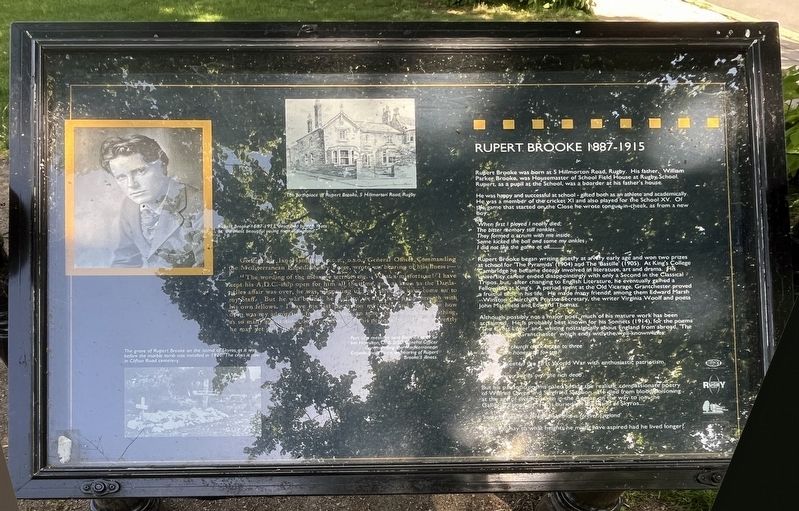
Rupert Brooke 1887-1915
Photographed by Ray Gurganus, May 25, 2026
1. Rupert Brooke Marker
He was happy and successful at school - gifted both as an athlete and academically. He was a member of the cricket XI and also played for the School XV. Of the game that started on the Close he wrote tongue-in-cheek, as from a new boy:
When first I played I nearly died;
The bitter memory still rankles.
They formed a scrum with me inside.
Some kicked the ball and some my ankles.
I did not like the game at all....
Rupert Brooke began writing poetry at any early age and won two prizes at school for 'The Pyramids' (1904) and 'The Bastile" (1905). At King's College Cambridge he became deeply involved in literature, art and drama. His university career ended disappointingly with only a Second in the Classical Tripos, but after changing to English Literature, he eventually gained a fellowship at King's. A period spent at the Old Vicarage, Grantchester, proved a fruitful time in his life. He made many friends,
this page online
Although possibly not a major poet, much of his mature work has been acclaimed. He is probably best known for his Sonnets (1914), for the poems 'The Great Lover' and, writing nostalgically about England from abroad. The Old Vicarage, Grantchester' which ends with the well-known lines:
'Stands the church clock at ten to three
And is there honey still for tea?
Brooke greeted the First World War with enthusiastic patriotism.
'Blow out you bugles over the rich dead.
But his patriotic poems paled beside the realistic compassionate poetry of Wilfred Owen and Siegfried Sassoon. He died from blood poisoning at the age of twenty-seven in the Aegean on the way to join the Gallipolli campaign. He is buried on the island of Skyros.....
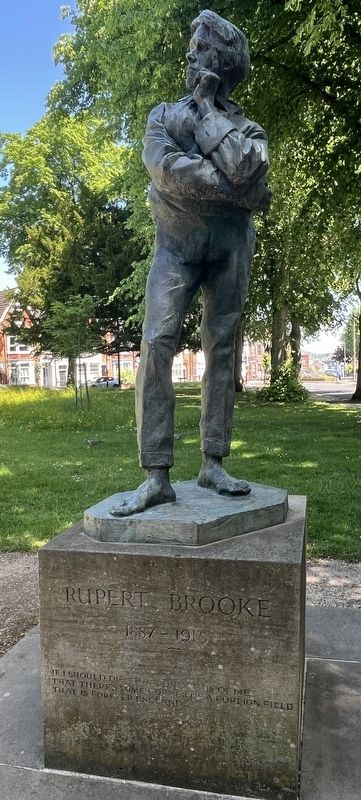
'some corner of a foreign field that is forever England'
Who can say to what heights he might have aspired had he lived longer?
General Sir Ian Hamilton, C.C.E., D.S.O., General Officer Commanding the Mediterranean Expeditionary Force, wrote on hearing of
Photographed by Ray Gurganus, May 25, 2026
2. Rupert Brooke Statue
"The wording of the message terrifies me. What a misfortune! I have kept his A.D.C.-ship open for him all the time, and as soon as the Dardanelles affair was over, he was, supposing us both alive, to have come on to my Staff. But he was bound, he said, to see this first fight through with his own fellows. I have his last poem on my table and you know how deep was my admiration for his intellect, an admiration which lost nothing, as so many admirations do, by contact with his personality. pray fervently he may vet vet pull through."
-- Part of a message sent from General Sir Ian Hamilton, GCB. DSO. General Officer Commanding the Mediterranean Expeditionary Force, on hearing of Rupert Brooke's illness.
Topics. This historical marker is listed in these topic lists: Arts, Letters, Music • War, World I.
Location. 52° 22.486′ N, 1° 15.63′ W. Marker is in Rugby, England, in Warwickshire. It is on Regent Street, on the left when traveling north. Touch for map. Marker is at or near this postal address: 48 Regent Street, Rugby, England CV21 2PS, United Kingdom. Touch for directions.

Regionally,
Photographed by Ray Gurganus, May 25, 2026
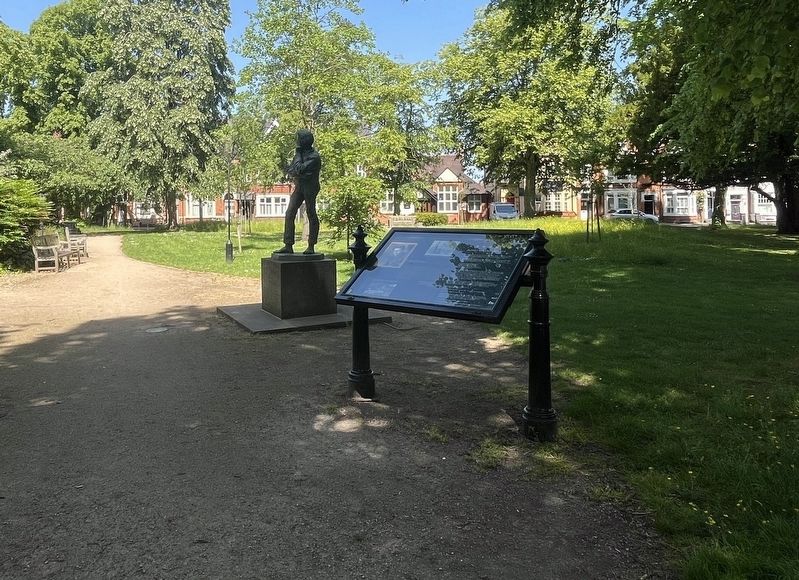
3. Rupert Brooke Statue and Marker
Credits. This page was last revised on September 16, 2026. It was originally submitted on September 15, 2026, by Ray Gurganus of Washington, District of Columbia. This page has been viewed 6 times since then. Photos: 1, 2, 3. submitted on September 15, 2026, by Ray Gurganus of Washington, District of Columbia. • Andrew Ruppenstein was the editor who published this page.
