Enkhuizen, North Holland, Netherlands — Northwestern Europe
Stadhuis
⎯⎯⎯
Town Hall
Photographed by Andrew Ruppenstein, September 7, 2026
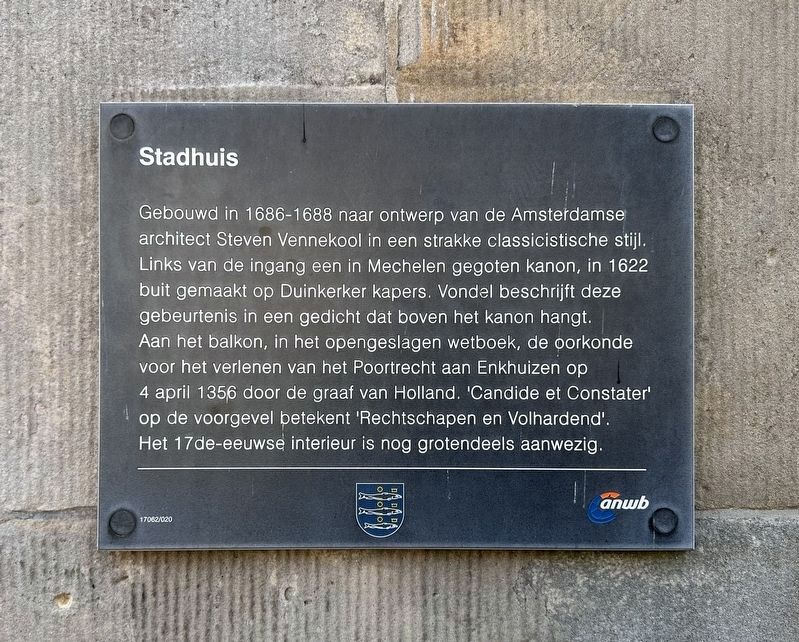
1. Stadhuis / Town Hall Marker

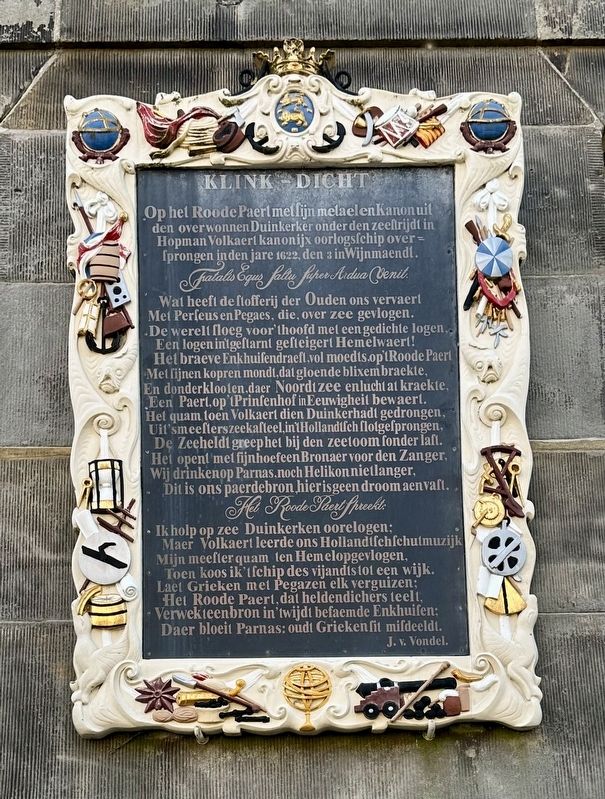
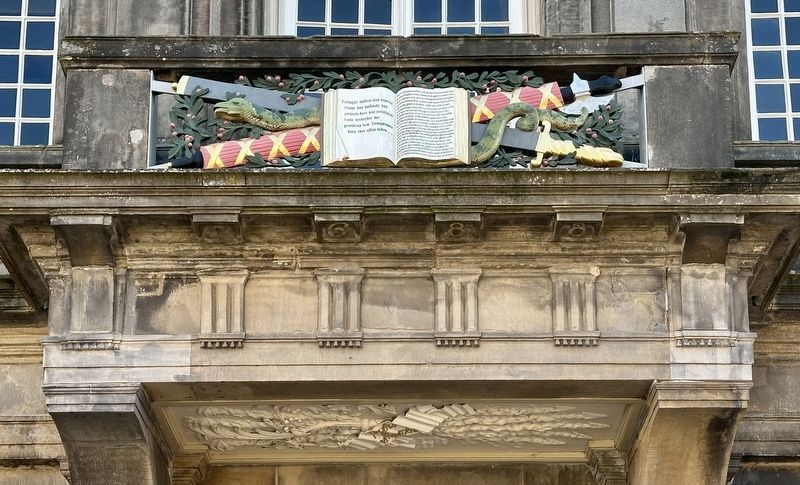
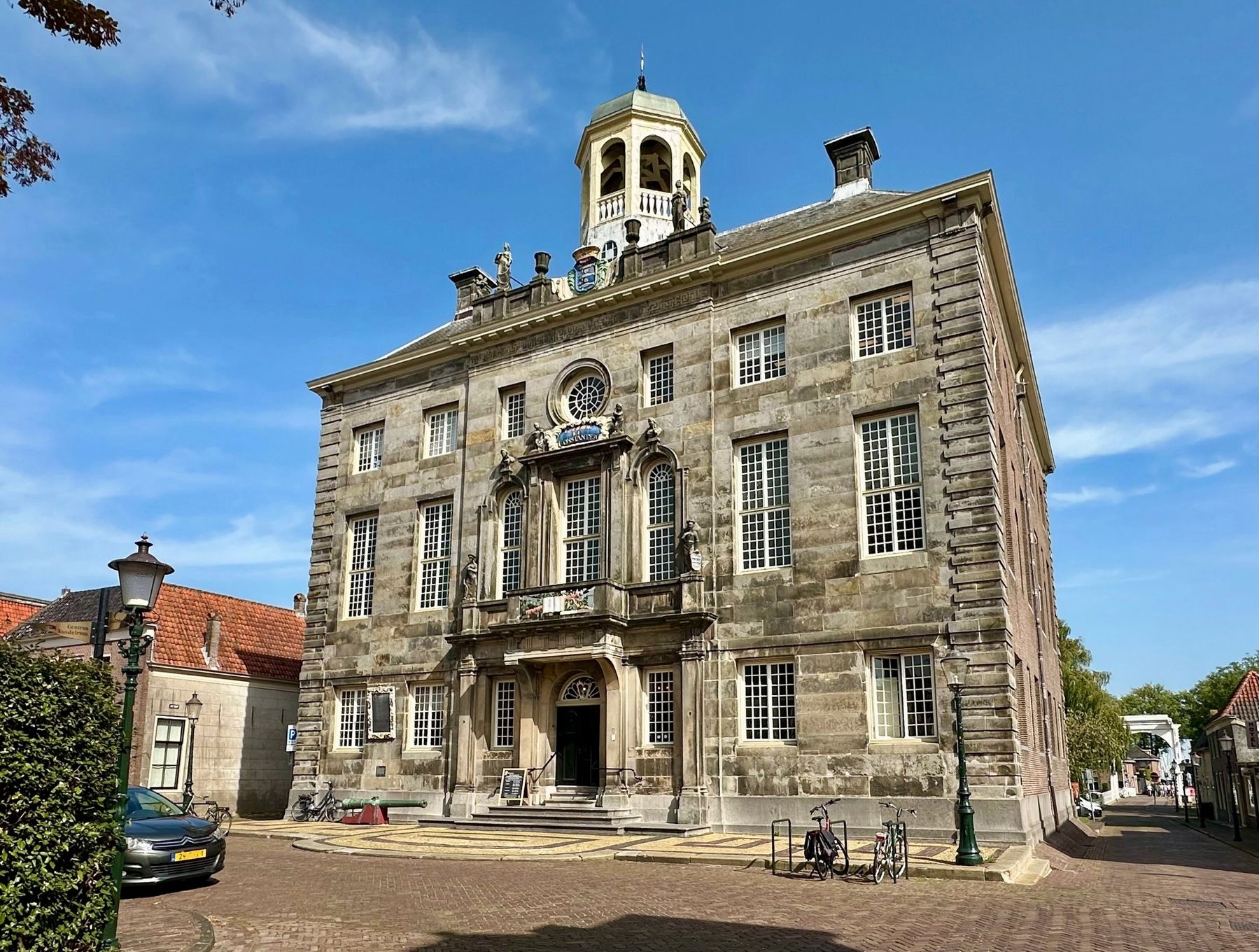
Gebouwd in 1686-1688 naar ontwerp van de Amsterdamse architect Steven Vennekool in een strakke classicistische stijl. Links van de ingang een in Mechelen gegoten kanon, in 1622 buit gemaakt op Duinkerker kapers. Vondel beschrijft deze gebeurtenis in een gedicht dat boven het kanon hangt. Aan het balkon, in het opengeslagen wetboek, de oorkonde voor het verlenen van het Poortrecht aan Enkhuizen op 4 april 1356 door de graaf van Holland. 'Candide et Constater' op de voorgevel betekent 'Rechtschapen en Volhardend'. Het 17de-eeuwse interieur is nog grotendeels aanwezig.
Town Hall
Built between 1686 and 1688 to a design by the Amsterdam architect Steven Vennekool, in a restrained Classical style. To the left of the entrance stands a cannon cast in Mechelen, captured from Dunkirk privateers in 1622; Vondel describes this event in a poem displayed above the cannon. On the balcony, depicted within an open law book, is the charter granting town rights (Poortrecht) to Enkhuizen on 4 April 1356 by the Count of Holland. The inscription 'Candide et Constanter' on the façade means 'Upright and Steadfast'. Much of the 17th-century interior remains intact.
Erected by Gemeente Enkhuizen, ANWB. (Marker Number 17062/020.)
Topics.
this page online
Location. 52° 42.248′ N, 5° 17.691′ E. Marker is in Enkhuizen, Noord-Holland (North Holland). It is at the intersection of Breedstraat and Het Glop, on the right when traveling north on Breedstraat. Touch for map. Marker is at or near this postal address: Breedstraat 53, Enkhuizen, Noord-Holland 1601 KA, Netherlands. Touch for directions.

Regionally, it is in Europe, the European Union, Atlantic Europe, the Benelux Low Countries, the Schengen Area, Western Europe, and the Western World. Historically, it finds itself in what was once the Holy Roman Empire.
Other nearby markers. At least 8 other markers are within walking distance of this marker: Gevangenis / Prison (within shouting distance of this marker); Synagoge / Synagogue (about 120 meters away, measured in a direct line); Waaggebouw / Weighing House (about 120 meters away); St. Pancras- of Zuidertoren / St. Pancras- or Southern Tower (about 150 meters away); Sint Janstraat 9 (approx. 0.3 kilometers away); Vermaning (Doopsgezinde kerk) / Vermaning (Mennonite Church) (approx. 0.3 kilometers away); Zuiderpoort of Drommedaris / South Gate or Drommedaris (approx. 0.4 kilometers

Photographed by Andrew Ruppenstein, September 7, 2026
2. Stadhuis / Town Hall Marker with Mechelen cannon (mentioned on the marker)
Also see . . . The Town Hall (Bezoek Enkhuizen). Excerpt:
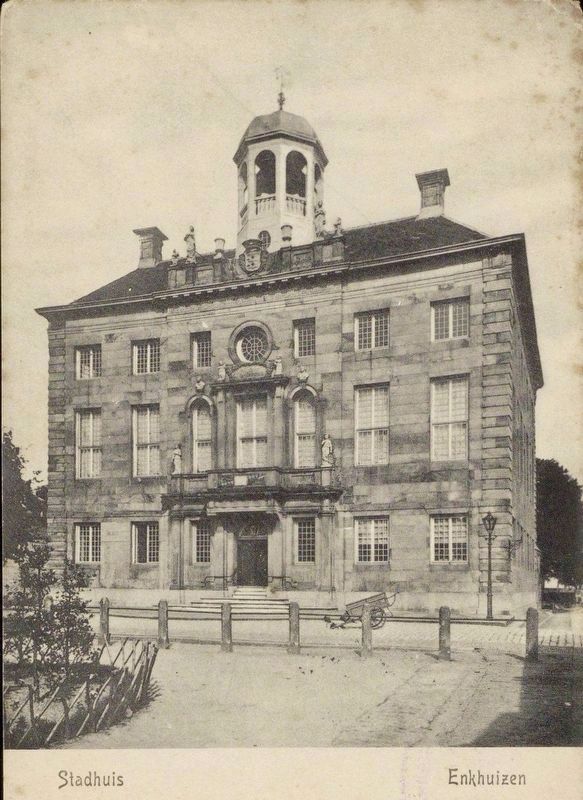
The imposing town hall is an example of the large, prosperous city that Enkhuizen was in the Golden Age. It was built in 1686/1688 and bears a striking resemblance to the Palace on Dam Square, which was the town hall of Amsterdam at the time.(Submitted on September 18, 2026.)
The administrators at the time wanted not only a new city hall, but also a status symbol. Steven Vennekool from Amsterdam was given the honor of making a design. His father, Jacob Vennekool, was a student of Jacob van Campen, who was the architect of the palace on the Dam in Amsterdam, perhaps the most prestigious city hall in the Netherlands.
Enkhuizen had already passed its economic peak at the time of construction, but still ventured into this prestigious project. On the first floor are the Witte- or Burgerzaal, the council chamber with velours d’Utrecht, the mayor’s room with painted scenes by Romeijn de Hooge, the wedding room and the Weeskamer with the tapestries.
The interior is largely authentic and features rich paintwork. The workrooms are still in use and the historic Schepenenkamer is a popular wedding location.
Photographed by Andrew Ruppenstein, September 7, 2026
3. Poem by Vondel describing the capture of the cannon
Photographed by Andrew Ruppenstein, September 7, 2026
4. Relief above entrance with law book granting town rights (mentioned on marker)
Photographed by A. Dekema (courtesy Noord-Hollands Archief, Inventaris 13549), circa 1905
5. Enkhuizen Stadhuis
Photographed by Andrew Ruppenstein
6. Stadhuis / Town Hall Marker
Credits. This page was last revised on September 18, 2026. It was originally submitted on September 18, 2026, by Andrew Ruppenstein of Lamorinda, California. This page has been viewed 3 times since then. Photos: 1, 2, 3, 4, 5, 6. submitted on September 18, 2026, by Andrew Ruppenstein of Lamorinda, California.
