Schwetzingerstadt in Mannhiem in Mannheim, Baden-Württemberg, Germany — Central Europe
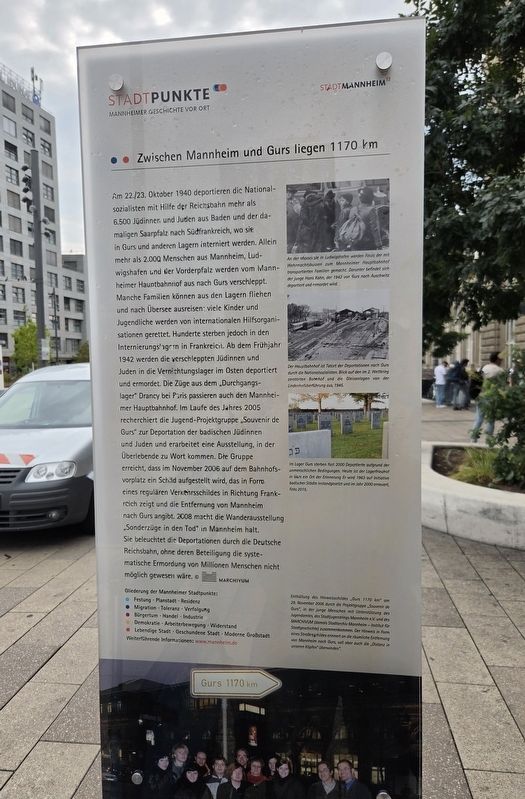
Zwischen Mannheim und Gurs liegen 1170 km
⎯⎯⎯
Mannheim and Gurs Are 1,170 Kilometers Apart
| — | Stadtpunkte – Mannheimer Geschichte vor Ort | — |
Photographed by James Hulse, September 16, 2026
1. Zwischen Mannheim und Gurs liegen 1170 km / Mannheim and Gurs Are 1,170 Kilometers Apart Marker

An der Maxschule in Ludwigshafen werden Fotos der mit Wehrmachtsbussen zum Mannheimer Hauptbahnhof transportierten Familien gemacht. Darunter befindet sich der junge Hans Kahn, der 1942 von Gurs nach Auschwitz deportiert und ermordet wird.
Der Hauptbahnhof ist Tatort der Deportationen nach Gurs durch die Nationalsozialisten. Blick auf den im 2. Weltkrieg zerstörten Bahnhof und die Gleisanlagen von der Lindenhofüberführung aus, 1945.
Im Lager Gurs sterben fast 2000 Deportierte aufgrund der unmenschlichen Bedingungen. Heute ist der Lagerfriedhof in Gurs ein Ort der Erinnerung. Er wird 1963 auf Initiative badischer Städte instandgesetzt und im Jahr 2000 erneuert. Foto 2015.
Enthüllung des Hinweisschildes „Gurs 1170 km“ am 29. November 2006 durch die Projektgruppe „Souvenir de Gurs“, in der junge Menschen mit Unterstützung des Jugendamtes, des Stadtjugendrings Mannheim e.V. und des MARCHIVUM (damals Stadtarchiv Mannheim – Institut für Stadtgeschichte) zusammenkommen. Der Hinweis in Form eines Straßenschildes erinnert an die räumliche Entfernung von Mannheim nach Gurs, soll aber auch die „Distanz in unseren Köpfen“ überwinden.
On
this page online
Photographed by James Hulse, September 16, 2026
2. Zwischen Mannheim und Gurs liegen 1170 km / Mannheim and Gurs Are 1,170 Kilometers Apart Marker
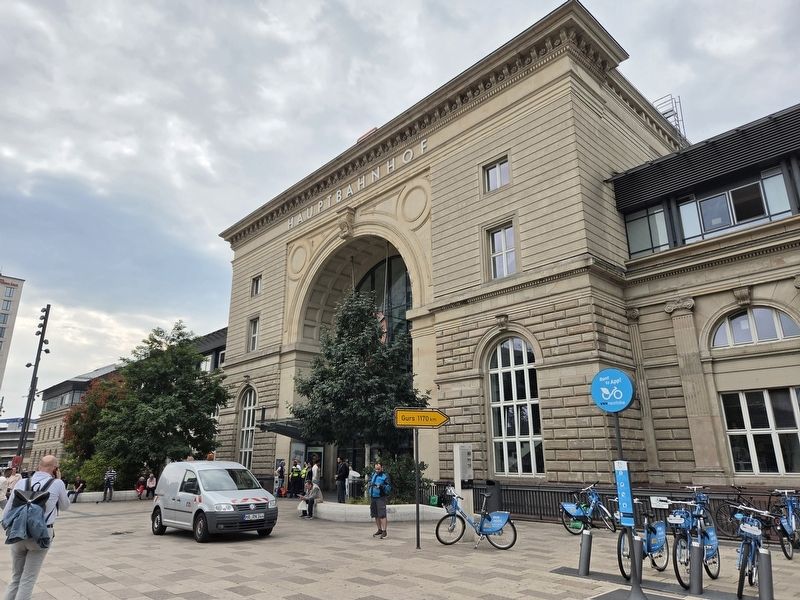
The Gurs sign with the marker in front of the train station.
At the Maxschule in Ludwigshafen, photographs were taken of families being transported by German military buses to Mannheim Central Station. Among them was the young Hans Kahn, who was deported from Gurs to Auschwitz and murdered in 1942.
Mannheim Central Station was a departure point for the National Socialist deportations to Gurs. This 1945 photograph shows the station, destroyed during the Second World War, and its railway tracks as seen from the Lindenhof overpass.
Almost 2,000 deportees died at the Gurs camp because of its inhumane conditions. Today, the camp cemetery is a place of remembrance. It was restored in 1963 at the initiative of cities in Baden and renovated again in 2000. Photograph from 2015.
The “Gurs 1170 km” sign was unveiled on November 29, 2006, by the “Souvenir de Gurs” project group, which brought young people together with support from the Youth Welfare Office, the Mannheim Youth Council, and MARCHIVUM—then known as the Mannheim City Archives–Institute for City History. Designed like a road sign, it recalls the physical distance between Mannheim and Gurs while also seeking to overcome the “distance in our minds.”
Erected 2006 by MARCHIVUM / City of Mannheim.
Topics. This historical marker is listed in these topic lists: Railroads & Streetcars • War, World II. A significant historical date for this entry is October 22, 1940.
Location. 49° 28.798′ N, 8° 28.189′ E. Marker is in Mannhiem, Baden-Württemberg, in Mannheim. It is in Schwetzingerstadt. It is on Willy-Brandt-Platz 0.1 kilometers west of Tattersallstraße, on the left when traveling west. Touch for map. Marker is at or near this postal address: Willy-Brandt-Platz 17, Mannhiem BW 68161, Germany. Touch for directions.

Regionally, this marker is on the German Upper Rhine. Globally, it is in Europe, the European Union, Atlantic Europe, Central Europe, the Schengen Area, Western Europe, and the Western World. Historically, it finds itself in what was once the Roman Empire, the Holy Roman Empire, and the former West Germany.
Other nearby markers. At least 8 other markers are within walking distance of this marker: Hauptbahnhof / Central Railway Station (here, next to this marker); Henriette Wagner (approx. 0.3 kilometers away); Frieda Berger (approx. 0.4 kilometers away); Ferdinand Maas (approx. 0.4 kilometers away); Gertrud Hirschler (approx. 0.4 kilometers away); Josef Hirschler (approx. 0.4 kilometers away); Inge Maria Hirschler (approx. 0.4 kilometers away); Schloss, Universität / Palace, University (approx. half a kilometer away). Touch for a list and map of all markers in Mannhiem.
More about this marker. There is another marker separately attached on the other side of the post.
Credits. This page was last revised on September 19, 2026. It was originally submitted on September 19, 2026, by James Hulse of Medina, Texas. This page has been viewed 7 times since then. Photos: 1, 2. submitted on September 19, 2026, by James Hulse of Medina, Texas.
