F5 in Mannheim, Baden-Württemberg, Germany — Central Europe
Sozialer Wohnungsbau im Quadrat F 5
⎯⎯⎯
Social Housing in Square F 5
Photographed by James Hulse, September 16, 2026
1. Sozialer Wohnungsbau im Quadrat F 5 / Social Housing in Square F 5 Marker

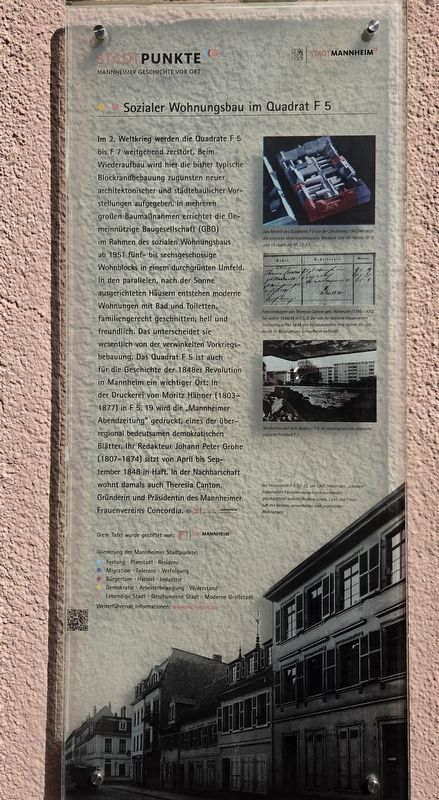
Das Modell des Quadrates F 5 vor der Zerstörung 1943/44 zeigt die intensive Vorkriegsbebauung. Markiert sind die Häuser Nr. 8 und 19 sowie die Nr. 22–27.
Familienbogen von Theresia Canton geb. Hartmuth (1795–1870). Sie wohnt 1848/49 in F 5, 8. Der von ihr initiierte Frauenverein Concordia stiftet 1849 den Revolutionären eine Fahne, die sich heute im Museum von Schopfheim befindet.
Neubauten auf dem Quadrat F 6. Im Vordergrund der planierte Jüdische Friedhof F 7.
Die Häuserzeile F 5, 22–27, um 1907. Hinter den „schönen“ historischen Fassaden ducken sich ineinandergeschachtelte Innenhöfe ohne Sonne, Licht und Frischluft mit kleinen, verwinkelten und ungesunden Wohnungen.
Diese Tafel wurde gestiftet
this page online
© Stadtarchiv Mannheim Institut Für Stadtgeschichte
Weiterführende Informationen: www.mannheim.de
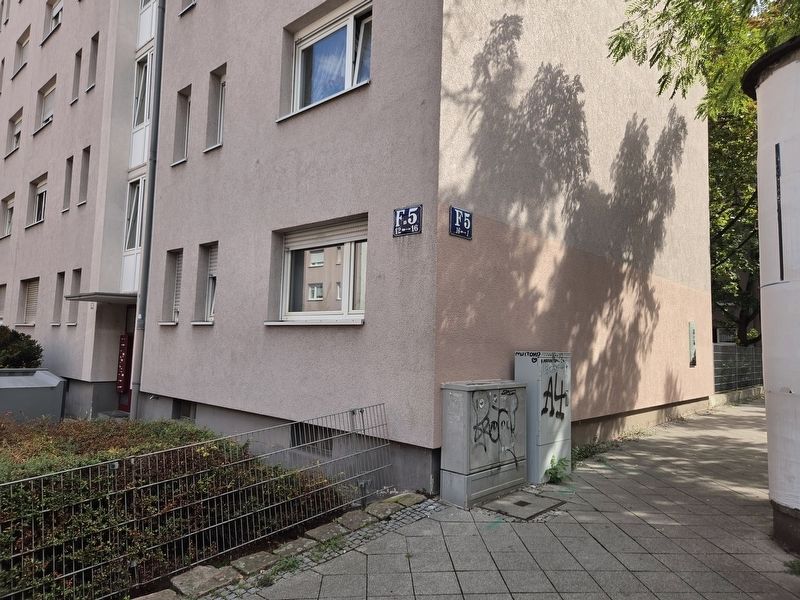
Squares F 5 through F 7 were largely destroyed during World War II. During reconstruction, the traditional perimeter-block development was replaced with new architectural and urban-planning ideas. Beginning in 1951, the nonprofit housing association GBG constructed several large social-housing projects consisting of five- and six-story apartment blocks surrounded by green space. The parallel buildings were aligned with the sun and contained modern apartments with bathrooms and toilets. They were bright, welcoming and designed for families, making them very different from the crowded prewar buildings. Square F 5 was also important to the history of Mannheim’s Revolution of 1848. The “Mannheimer Abendzeitung,” an influential democratic newspaper with significance beyond the region, was printed at Moritz Hähner’s printing shop at F 5, 19. Its editor, Johann Peter Grohe (1807–1874), was imprisoned from April until September 1848. Theresia Canton, founder and president of Mannheim’s Concordia
Photographed by James Hulse, September 16, 2026
2. Sozialer Wohnungsbau im Quadrat F 5 / Social Housing in Square F 5 Marker
The model of Square F 5 before its destruction in 1943–44 shows the dense prewar development. Buildings Nos. 8 and 19 and Nos. 22–27 are marked.
Family record of Theresia Canton, née Hartmuth (1795–1870). She lived at F 5, 8 in 1848–49. In 1849, the Concordia Women’s Association, which she founded, presented the revolutionaries with a flag that is now held by the museum in Schopfheim.
New buildings in Square F 6. In the foreground is the leveled Jewish cemetery in F 7.
The row of houses at F 5, 22–27, around 1907. Behind the “beautiful” historic façades were interconnected courtyards without sunlight, daylight or fresh air, surrounded by small, irregular and unhealthy apartments.
This marker was donated by: GBG Mannheim
Further information: www.mannheim.de
Erected by City of Mannheim – Mannheim City Archives, Institute for Urban History.
Topics. This historical marker is listed in this topic list: Notable Buildings. A significant historical month for this entry is September 1848.
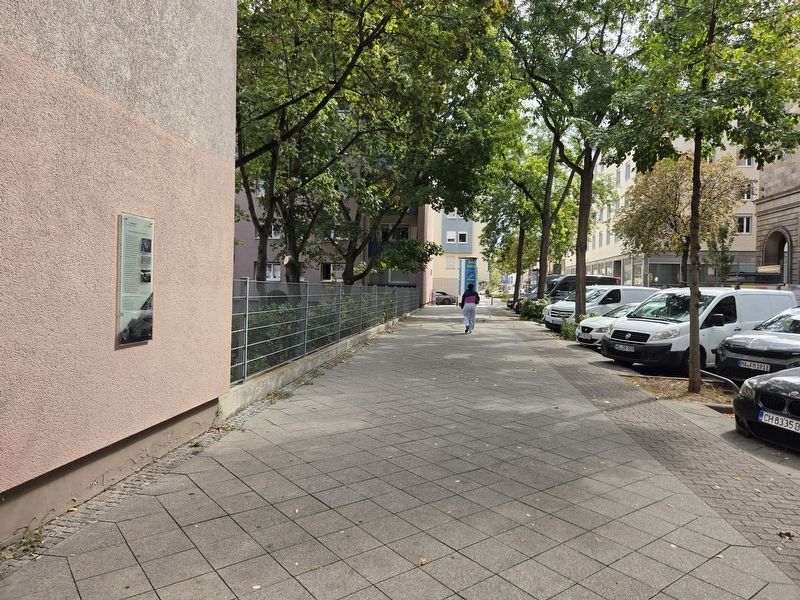
Location. 49° 29.401′ N, 8° 27.777′ E. Marker is in Mannheim, Baden-Württemberg. It is in F5.
Photographed by James Hulse, September 16, 2026
3. Sozialer Wohnungsbau im Quadrat F 5 / Social Housing in Square F 5 Marker

Regionally, this marker is on the German Upper Rhine. Globally, it is in Europe, the European Union, Atlantic Europe, Central Europe, the Schengen Area, Western Europe, and the Western World. Historically, it finds itself in what was once the Roman Empire, the Holy Roman Empire, and the former West Germany.
Other nearby markers. At least 8 other markers are within walking distance of this marker: Katholisches Bürgerhospital, E 6, 1 / Catholic Citizens’ Hospital, E 6, 1 (within shouting distance of this marker); Friedensengel, E 6 / Angel of Peace, E 6 (within shouting distance of this marker); Gedenken an die Mannheimer Sinti / In Memory of Mannheim’s Sinti (within shouting distance of this marker); Goethe-Zitat über Mannheim / Goethe Quotation About Mannheim (about 120 meters away, measured in a direct line); Trinitatiskirche, G 4 / Trinity Church, G 4 (about 120 meters away); Börse E 4, 14-16 / Stock Exchange E 4, 14-16 (about 120 meters away); Städtisches Leihamt D 4, 9-10 / Municipal Loan Office D 4, 9-10 (about 120 meters away); Studentenwohnheim des Goethe-Instituts D 4, 4 / Goethe-Institute Student Residence D 4, 4 (about 150 meters away). Touch for a list and map of all markers in Mannheim.
Credits. This page was last revised on September 22, 2026. It was originally submitted on September 20, 2026, by James Hulse of Medina, Texas. This page has been viewed 5 times since then. Photos: 1, 2, 3. submitted on September 22, 2026, by James Hulse of Medina, Texas.
