F3 in Mannheim, Baden-Württemberg, Germany — Central Europe
Juden in Mannheim
⎯⎯⎯
Jews in Mannheim
Photographed by James Hulse, September 16, 2026
1. Juden in Mannheim / Jews in Mannheim Marker

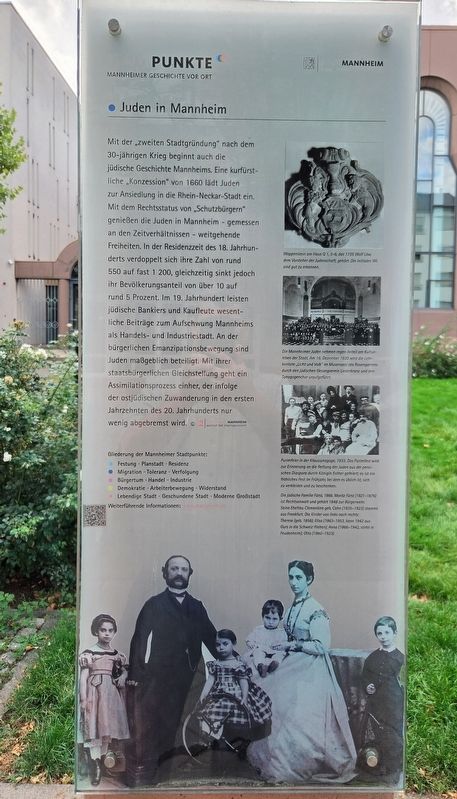
Wappenstein am Haus O 1, 5–6, das 1735 Wolf Löw, dem Vorsteher der Judenschaft, gehört. Die Initialen WL sind gut zu erkennen.
Die Mannheimer Juden nehmen regen Anteil am Kulturleben der Stadt. Am 16. Dezember 1930 wird die Lehrkantate „Licht und Volk“ im Musensaal des Rosengartens durch den Jüdischen Gesangverein Liederkranz und den Synagogenchor uraufgeführt.
Purimfeier in der Klaussynagoge, 1933. Das Purimfest wird zur Erinnerung an die Rettung der Juden aus der persischen Diaspora durch Königin Esther gefeiert; es ist ein fröhliches Fest im Frühjahr, bei dem es üblich ist, sich zu verkleiden und zu beschenken.
Die jüdische Familie Fürst, 1866. Moritz Fürst (1821–1876) ist Rechtsanwalt und gehört 1848 zur Bürgerwehr. Seine Ehefrau Clementine geb. Cahn (1835–1923) stammt aus Frankfurt. Die Kinder von links nach rechts: Therese (geb. 1856); Elisa (1863–1953, kann 1942 aus Gurs in die Schweiz fliehen); Anna (1866–1942, stirbt in Feudenheim); Otto (1860–1923).
© Stadtarchiv Mannheim Institut Für Stadtgeschichte
Weiterführende
this page online
Mannheim’s Jewish history began with the city’s “second founding” after the Thirty Years’ War. An electoral concession issued in 1660 invited Jews to settle in the Rhine-Neckar city. With the legal status of “protected citizens,” Mannheim’s Jews enjoyed considerable freedoms for that period. During Mannheim’s time as an electoral residence in the 18th century, the Jewish population doubled from about 550 to almost 1,200. At the same time, its share of the total population fell from more than 10 percent to around 5 percent. During the 19th century, Jewish bankers and merchants made important contributions to Mannheim’s growth as a commercial and industrial city. Jews also played a major role in the movement for civic emancipation. Their achievement of equal citizenship was accompanied by a process of assimilation that was only slightly slowed by immigration from Eastern Europe during the early decades of the 20th century.
Coat-of-arms stone on the house at O 1, 5–6, which belonged in 1735 to Wolf Löw, head of the Jewish community. The initials WL are clearly visible.
Mannheim’s Jews took an active part in the city’s cultural life. On December 16, 1930, the educational cantata “Light and People” was performed for the first time in the Musensaal of the Rosengarten by the Jewish Liederkranz Choral Society and the synagogue choir.
Purim celebration in the Klaus Synagogue, 1933. Purim commemorates Queen Esther’s rescue of the Jews in the Persian diaspora. It is a joyful spring festival during which people traditionally wear costumes and exchange gifts.
The Jewish Fürst family, 1866. Moritz Fürst (1821–1876) was an attorney and served in the citizens’ militia in 1848. His wife, Clementine, née Cahn (1835–1923), came from Frankfurt. Their children from left to right: Therese (born 1856); Elisa (1863–1953, escaped from Gurs to Switzerland in 1942); Anna (1866–1942, died in Feudenheim); and Otto (1860–1923).
Further
Photographed by James Hulse, September 16, 2026
2. Juden in Mannheim / Jews in Mannheim Marker
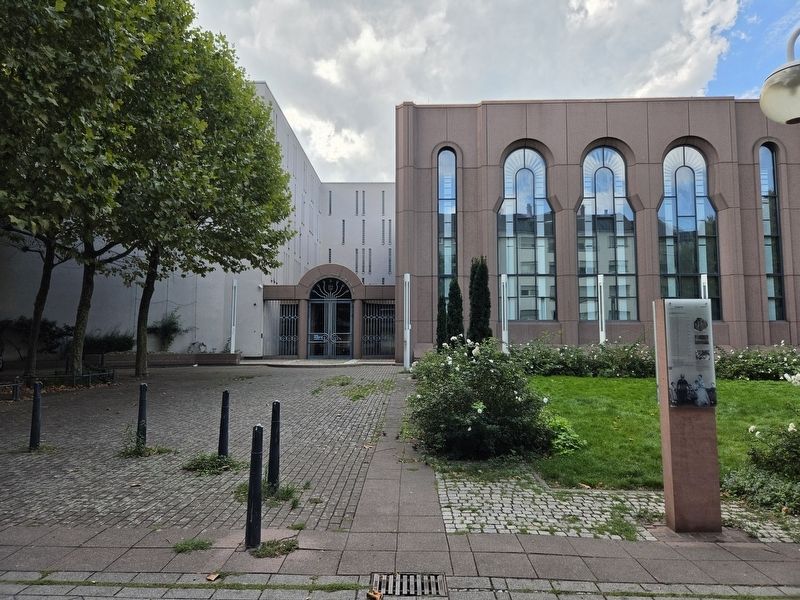
The marker stands in front of the synagogue.
Erected by Stadtpunkte Mannheimer Geschichte Vor Ort and Stadt Mannheim.
Topics. This historical marker is listed in these topic lists: Religion & Religious Structures • War, World II. A significant historical date for this entry is December 16, 1930.
Location. 49° 29.392′ N, 8° 27.925′ E. Marker is in Mannheim, Baden-Württemberg. It is in F3. It is at the intersection of F3 and F2, on the right when traveling east on F3. Touch for map. Marker is at or near this postal address: F3 4, Mannheim BW 68159, Germany. Touch for directions.

Regionally, this marker is on the German Upper Rhine. Globally, it is in Europe, the European Union, Atlantic Europe, Central Europe, the Schengen Area, Western Europe, and the Western World. Historically, it finds itself in what was once the Roman Empire, the Holy Roman Empire, and the former West Germany.
Other nearby markers. At least 8 other markers are within walking distance of this marker: Hauptsynagoge F 2 und Lemle-Moses-Klaus F 1 / Main Synagogue F 2 and Lemle Moses Klaus F 1 (here, next to this marker); Trinitatiskirche, G 4 / Trinity Church, G 4 (about 90
Photographed by James Hulse, September 16, 2026
3. Juden in Mannheim / Jews in Mannheim Marker
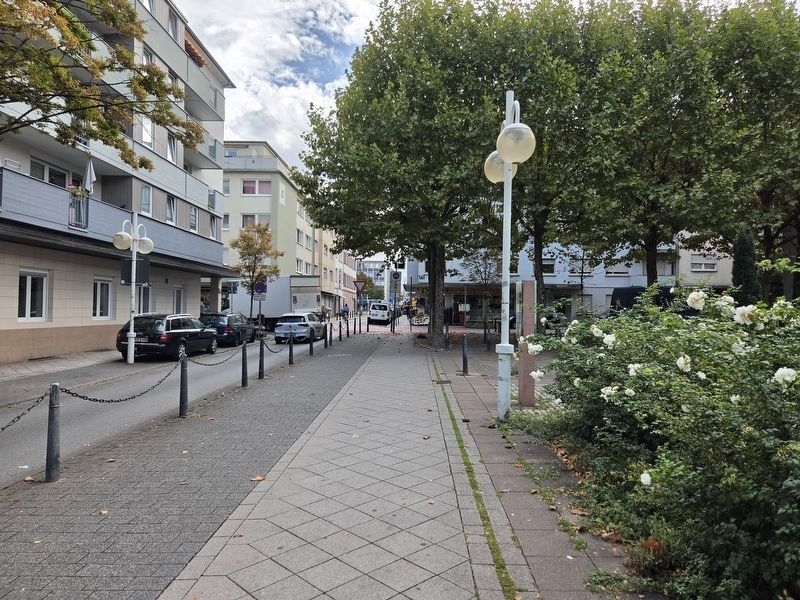
The view of the markers along the sidewalk in from of the synagogue.
More about this marker. There is a non-related marker separately attached on the other side of the post.
Credits. This page was last revised on September 22, 2026. It was originally submitted on September 20, 2026, by James Hulse of Medina, Texas. This page has been viewed 5 times since then. Photos: 1, 2, 3. submitted on September 22, 2026, by James Hulse of Medina, Texas.
