The Beaches in Jacksonville Beach in Duval County, Florida — The American South (South Atlantic)
Florida East Coast Railway Depot
Photographed by Stephen Thomas White, February 4, 2026
1. Florida East Coast Railway Depot Marker
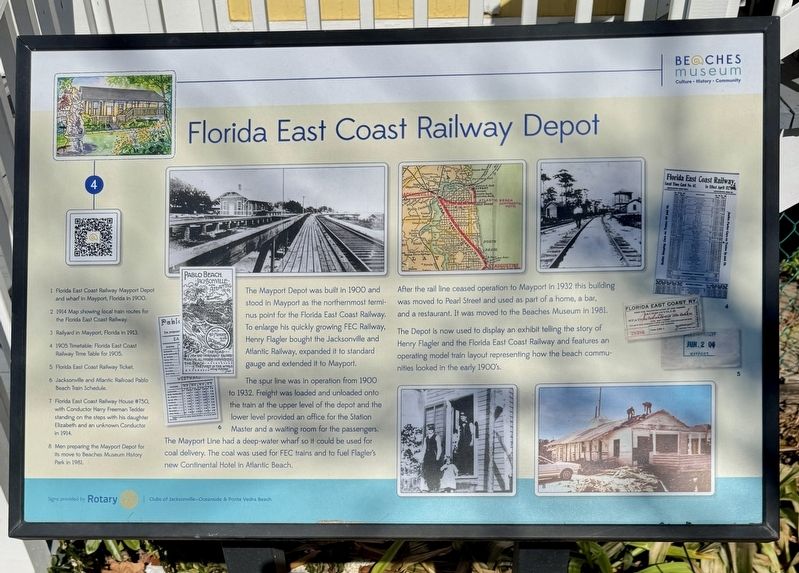
The spur line was in operation from 1900 to 1932. Freight was loaded and unloaded onto the train at the upper level of the depot and the lower level provided an office for the Station Master and a waiting room for the passengers.
The Mayport Line had a deep-water wharf so it could be used for coal delivery. The coal was used for FEC trains and to fuel Flagler's new Continental Hotel in Atlantic Beach.
After the rail line ceased operation to Mayport in 1932 this building was moved to Pearl Street and used as part of a home, a bar, and a restaurant. It was moved to the Beaches Museum in 1981.
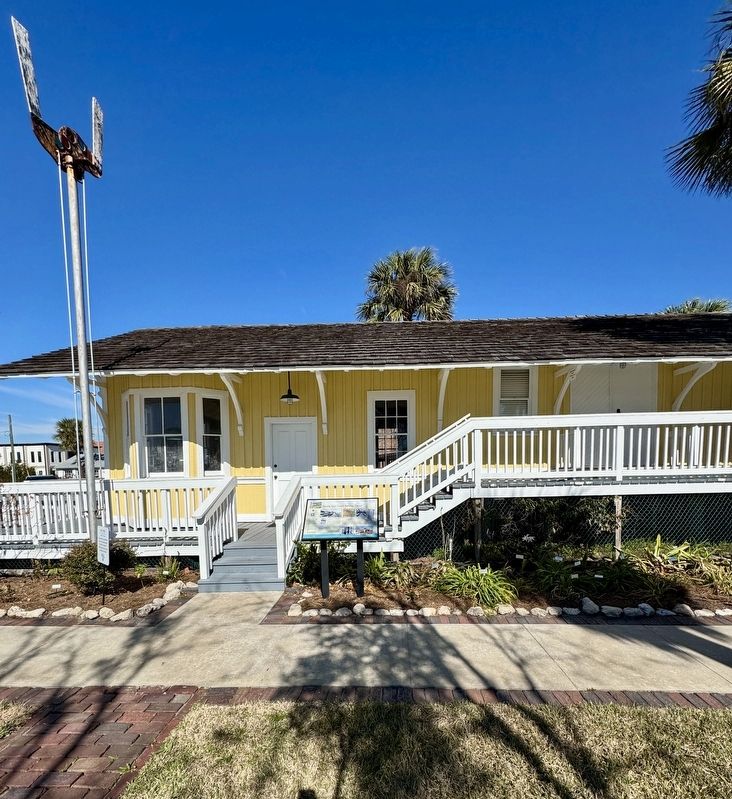
The Depot is now used to display an exhibit telling the story of Henry Flagler and the Florida East Coast Railway and features an operating model train layout representing how the beach communities looked in the early 1900's.
(captions)
Florida East Coast Railway Mayport Depot and wharf in Mayport, Florida In 1900.
1914 Map showing local train routes for the Florida East Coast Railway.
Railyard in Mayport, Florida in 1913
1905 Timetable: Florida East Coast Railway Time Table for 1905.
Florida East Coast Railway Ticket.
Jacksonville and Atlantic Railroad Pablo Beach Train Schedule.
Florida East Coast Railway House #750, with Conductor Harry Freeman Tedder standing on the steps with his daughter Elizabeth and an unknown Conductor in 1914.
Men preparing the Mayport Depot for its move to Beaches Museum History Park in 1981.
Erected by Beaches
this page online
Topics. This historical marker is listed in these topic lists: Industry & Commerce • Railroads & Streetcars. A significant historical year for this entry is 1900.
Location. 30° 17.315′ N, 81° 23.62′ W. Marker is in Jacksonville Beach, Florida, in Duval County. It is in The Beaches. It is at the intersection of Pablo Avenue and 4th Street South, on the right when traveling east on Pablo Avenue. The marker is located within the Beaches Museum History Park. Touch for map. Marker is at or near this postal address: 381 Pablo Avenue, Jacksonville Beach FL 32250, United States of America. Touch for directions.

Regionally, this marker is in First Coast, in Greater Jacksonville, and on the Sea Islands. It is also in the American South and on the Eastern Seaboard. Globally, it is in the North Atlantic Region, North America, a Gulf of Mexico state, the Western Hemisphere, the Western World, and the Anglosphere. Historically, it finds itself in what was once New Spain, the territory of the Mississippian Culture, one of the Confederate States
Photographed by Stephen Thomas White, February 4, 2026
2. Florida East Coast Railway Depot Marker
Other nearby markers. At least 8 other markers are within walking distance of this marker: Porter Wood Burning Locomotive (here, next to this marker); The 1911 Train Engine (a few steps from this marker); Steam Locomotive No.7 (a few steps from this marker); Florida East Coast Foreman’s House (a few steps from this marker); Doolittle's 1922 Record Flight (a few steps from this marker); Pablo Beach Post Office (within shouting distance of this marker); Oesterreicher-McCormick Homestead (within shouting distance of this marker); First Settlers At Ruby, Florida (within shouting distance of this marker). Touch for a list and map of all markers in Jacksonville Beach.
Another marker is no longer nearby. Pablo Beach FEC Foreman's House (was a few steps from this marker but has been replaced with another marker now near it).
More about this marker. This marker replaces an earlier marker and includes additional information.
Also see . . .
1. Historic Ferdinand Beach Train Depot: Then, Now and the Future . (Submitted on September 20, 2026, by Stephen Thomas White of Norfolk, Virginia.)
2. Beaches Museum & History . (Submitted on September 20, 2026, by Stephen Thomas White of Norfolk, Virginia.)
Credits. This page was last revised on September 20, 2026. It was originally submitted on September 20, 2026, by Stephen Thomas White of Norfolk, Virginia. This page has been viewed 16 times since then. Photos: 1, 2. submitted on September 20, 2026, by Stephen Thomas White of Norfolk, Virginia. • Andrew Ruppenstein was the editor who published this page.
