The Beaches in Jacksonville Beach in Duval County, Florida — The American South (South Atlantic)
The 1911 Train Engine
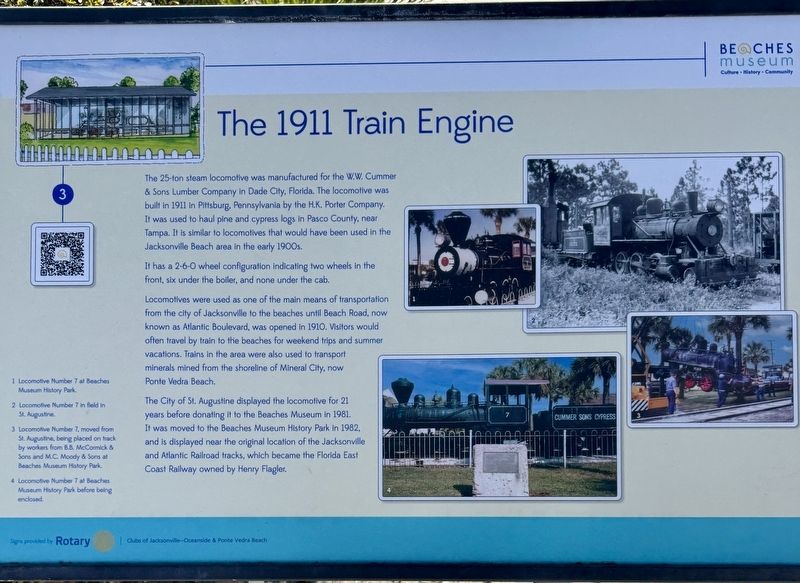
Photographed by Stephen Thomas White, February 4, 2026
1. The 1911 Train Engine Marker
It has a 2-6-0 wheel configuration indicating two wheels in the front, six under the boiler, and none under the cab.
Locomotives were used as one of the main means of transportation from the city of Jacksonville to the beaches until Beach Road, now known as Atlantic Boulevard, was opened in 1910. Visitors would often travel by train to the beaches for weekend trips and summer vacations. Trains in the area were also used to transport minerals mined from the shoreline of Mineral City, now Ponte Vedra Beach.
The City of St. Augustine displayed the locomotive for 21 years before donating it to the Beaches Museum in 1981. It was moved to the Beaches Museum History Park in 1982, and is displayed near the original location of the Jacksonville and Atlantic
this page online
Erected by Beaches Museum History Park, and the Rotary Clubs of Jacksonville- Oceanside & Ponte Vedra Beach.
Topics and series. This historical marker is listed in these topic lists: Industry & Commerce • Railroads & Streetcars. In addition, it is included in the Rotary International series list. A significant historical year for this entry is 1911.
Location. 30° 17.318′ N, 81° 23.616′ W. Marker is in Jacksonville Beach, Florida, in Duval County. It is in The Beaches. It is at the intersection of Beach Boulevard and 4th Street South, on the right when traveling west on Beach Boulevard. The marker is located within the Beaches Museum History Park. Touch for map. Marker is at or near this postal address: 381 Beach Boulevard, Jacksonville Beach FL 32250, United States of America. Touch for directions.

Regionally, this marker is in First Coast, in Greater Jacksonville, and on the Sea Islands. It is also in the American South and on the Eastern Seaboard. Globally, it is in the North Atlantic Region, North America, a Gulf of Mexico state,
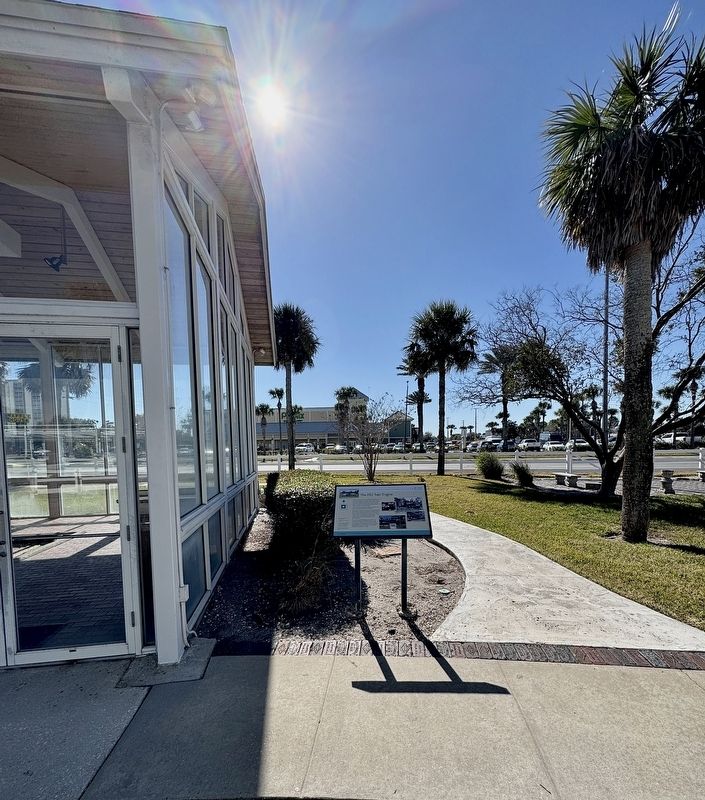
Photographed by Stephen Thomas White, February 4, 2026
2. The 1911 Train Engine Marker
Other nearby markers. At least 8 other markers are within walking distance of this marker: Florida East Coast Railway Depot (a few steps from this marker); Porter Wood Burning Locomotive (a few steps from this marker); Steam Locomotive No.7 (a few steps from this marker); Florida East Coast Foreman’s House (within shouting distance of this marker); Doolittle's 1922 Record Flight (within shouting distance of this marker); Pablo Beach Post Office (within shouting distance of this marker); First Settlers At Ruby, Florida (within shouting distance of this marker); Beaches Museum Chapel (within shouting distance of this marker). Touch for a list and map of all markers in Jacksonville Beach.
Another marker is no longer nearby. Pablo Beach FEC Foreman's House (was within shouting distance of this marker but has been replaced with another marker now near it).
More about this marker. This marker replaces an earlier marker and includes additional information.
Also see . . .
1. 1900 Pablo Beach Florida East Coast Railway Foreman's House #93. (Submitted on September 20, 2026, by Stephen Thomas White of Norfolk, Virginia.)
2. Beach Musem & History. (Submitted on September 20, 2026, by Stephen Thomas White of Norfolk, Virginia.)
Credits. This page was last revised on September 25, 2026. It was originally submitted on September 20, 2026, by Stephen Thomas White of Norfolk, Virginia. This page has been viewed 13 times since then. Photos: 1, 2. submitted on September 20, 2026, by Stephen Thomas White of Norfolk, Virginia. • Andrew Ruppenstein was the editor who published this page.
