Galva in Henry County, Illinois — The American Midwest (Great Lakes)
Galva Opera House/Temperance Hall
Photographed by Cosmos Mariner, June 24, 2021
1. Galva Opera House/Temperance Hall Marker
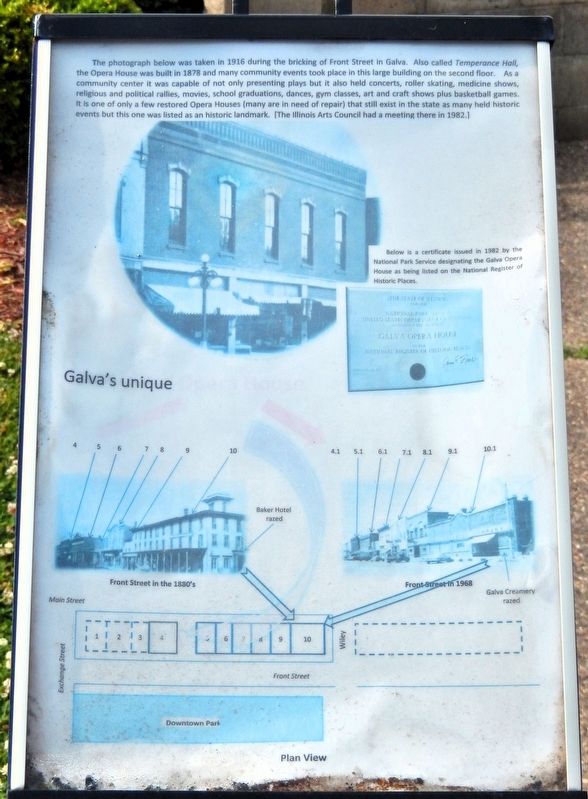
The photograph below was taken in 1916 during the bricking of Front Street in Galva. Also called Temperance Hall, the Opera House was built in 1878 and many community events took place in this large building on the second floor. As a community center it was capable of not only presenting plays but it also held concerts, roller skating, medicine shows, religious and political rallies, movies, school graduations, dances, gym classes, art and craft shows plus basketball games. It is one of only a few restored Opera Houses (many are in need of repair) that still exist in the state as many held historic events but this one was listed as an historic landmark. [The Illinois Arts Council had a meeting there in 1982.]
[image captions]
• Below is a certificate issued in 1982 by the National Park Service designating the Galva Opera House as being listed on the National Register of Historic Places.
• Front Street in the 1880’s / Baker Hotel (razed)
• Front Street in 1968 / Galva Creamery (razed)
Topics and series. This historical marker is listed in these topic lists: Architecture • Entertainment • Notable Buildings.
this page online
Location. 41° 9.972′ N, 90° 2.718′ W. Marker is in Galva, Illinois, in Henry County. It is on Front Street just east of Exchange Street, on the right when traveling east. The marker is beside the walkway in Veterans Memorial Park. Touch for map. Marker is at or near this postal address: 338 Front Street, Galva IL 61434, United States of America. Touch for directions.

Regionally, this marker is in Northern Illinois. It is also in the American Midwest and in the Corn Belt. Globally, it is in North America, the Western Hemisphere, the Western World, and the Anglosphere. Historically, it finds itself in what was once the territory of the Mississippian Culture and also the Northwest Territory.
Other nearby markers. At least 8 other markers are within walking distance of this marker: Olof Krans (a few steps from this marker); Hayes Pump and Planter Company (within shouting distance of this marker); Sgt. Schuyler Brent Patch (within shouting distance of this marker); Wistrand Manufacturing Co. and the Blue Star line
Photographed by Cosmos Mariner, June 24, 2021
2. Galva Opera House/Temperance Hall Marker
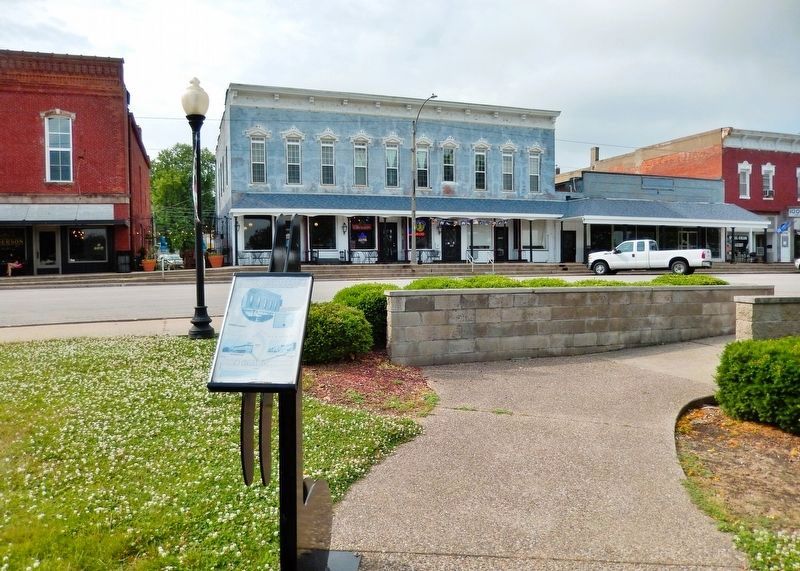
Looking north across Front Street from Veterans Memorial Park. The right/east edge of the Galva Opera House (red brick) is visible in the left background.
Regarding Galva Opera House/Temperance Hall. National Register of Historic Places № 82002538.
From the National Register Nomination prepared by Leslie H. Kenyon, Larry D. Davis and Amy Ulrich, July 8, 1981:
The Galva Opera House is significant in the history of Galva, Illinois. From its beginnings as a Temperance Hall through the era of vaudeville, medicine shows, and local events, this building and its Opera House was a part of the community's cultural and social life.
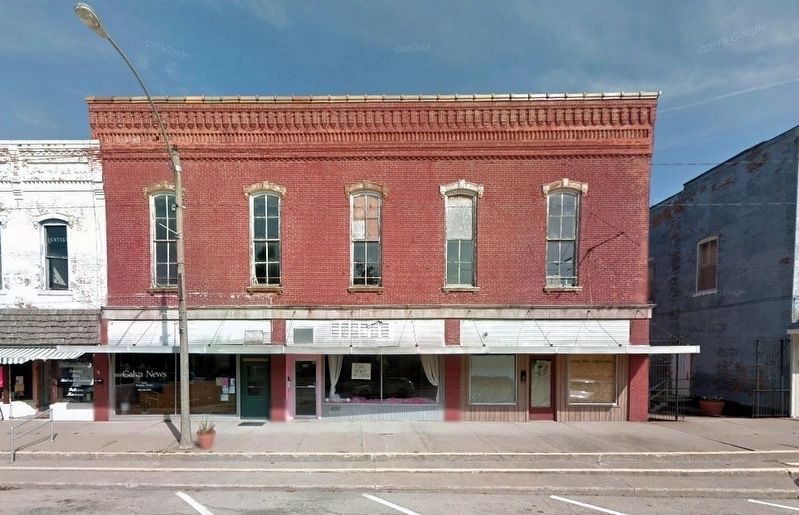
Measuring approximately 66' wide and 80' deep, the Galva Opera House building has two floors and a basement totaling over 15,000 gross square feet. The First Floor consists of shops plus the entrance lobby and stairs to the Second Floor. The Second Floor containsthe auditorium, stage, lavatories, serving kitchen, dressing rooms, and storage areas, all of which make up the Galva Opera House. Construction is of red brick masonry bearing walls with parapets and cast iron interior columns supporting heavy wood framing and sloped roof trusses.Photographed by Google Street View3. Galva Opera House/Temperance Hall
The auditorium is on the Second Floor, measuring approximately 63' wide and 61' deep. Structurally the area is divided into three bays. The center bay is a continuous Tudor vault, from the front wall to the stage wall. The proscenium suggests a Tudor arch. Cast iron columns support heavy timber Warren trusses that run from the front bearing wall to the rear wall. The side walls are three and four wythe thick. The cast iron columns, reeded with slightly flared top, are spaced about 20' apart. The flat portions of the ceiling on each side of the center vault are 17' high. The center vault is 23' to the highest point. Early photographs of the auditorium show chandeliers suspended down the center of the auditorium equipped with gas jets. This was the means of lighting the hall until around 1900 when electric lights were offered in Galva.
Captain J. C. Bontecou, a temperance leader, roused the people of Galva to form a club to further the cause of total abstinence — 888 men and women signed the pledge. After organizing, there followed the need for building a club room and hall for the group. Early in 1878, written reports of their meetings indicate they settled on a “substantial brick edifice on the Square, an ornament to the town and the pride of every member of the club.” It was decided to construct the hall with stores on the First Floor. Capital stock was issued, 750 shares at $10 each for a total of $7,500. Contract for construction was awarded September 7, 1878, to Messers. Price and Payne, whose bid was $6,015. The opening performance was Lady of Lyons on Christmas evening 1878.
By 1886 the Blue Ribbon Temperance Hall had become the Galva Opera House. The Opera House was on the circuit of many leading stock companies. Galva's location on the Chicago, Burlington & Quincy Railroad and the Chicago, Rock Island, and Pacific Railroad afforded many one-night performances in the Opera House. Noted stage personalities of the time played such as Flora DeVoss, playing in “The Girl from Out Yonder”; Minnie Castle and the Basye Standard Dramatic Company; and John E. Dvorak in “Merchant of Venice”. In 1886 the Dora Wiley Opera Company presented “The Mikado”. The Galva Opera House was also used for locally inspired shows. “Olivette” was presented in April 1892.
The folding seats for the auditorium were grouped together with wood cleats across the backs and on the feet of the chairs. This allowed for easy moving of the seats to a storage room so the auditorium could be used as one open space. In the 1920's, the Opera House was taken over by a local citizen, Fred Brown, and used for roller skating and traveling medicine shows. The public schools began using it in the 1920's also. Such activities as junior and senior class plays, basketball games, and graduation exercises all took place in the Opera House auditorium up until the time the Galva High School gymnasium/auditorium was built in 1932. The American Legion used the auditorium for local talent shows. Boy Scout meetings, and dances during this same period. Public dances held by the Galva Fire Department and the Galva Municipal Band were also held once a year in the Opera House.
Also see . . . Galva Opera House (Wikipedia).
Excerpt: The Galva Opera House is a historic theater on Front Street in Galva, Illinois. Built in 1878, the theater opened as the Blue Ribbon Temperance Hall; by 1886, it had lost its association with the temperance movement and was known by its present name. Galva's location on two major railroad lines allowed traveling theatrical troupes to visit the theater; shows produced by local talent performed in the building as well. Local schools also used the building for their graduation ceremonies, sporting events, and school plays until Galva High School opened its own auditorium in 1932. The building was used as a roller skating rink in the 1920s and 1930s and hosted Lions Club events in the 1950s. The building was added to the National Register of Historic Places on February 11, 1982.(Submitted on September 21, 2026, by Cosmos Mariner of Cape Canaveral, Florida.)
Credits. This page was last revised on September 21, 2026. It was originally submitted on September 20, 2026, by Cosmos Mariner of Cape Canaveral, Florida. This page has been viewed 5 times since then. Photos: 1, 2, 3. submitted on September 21, 2026, by Cosmos Mariner of Cape Canaveral, Florida.
