Harrisville in Burrillville in Providence County, Rhode Island — The American Northeast (New England)
Austin T. Levy, Mill Owner, Philanthropist, and Friend
Photographed by Devry Becker Jones (CC0), September 19, 2026
1. Austin T. Levy, Mill Owner, Philanthropist, and Friend Marker
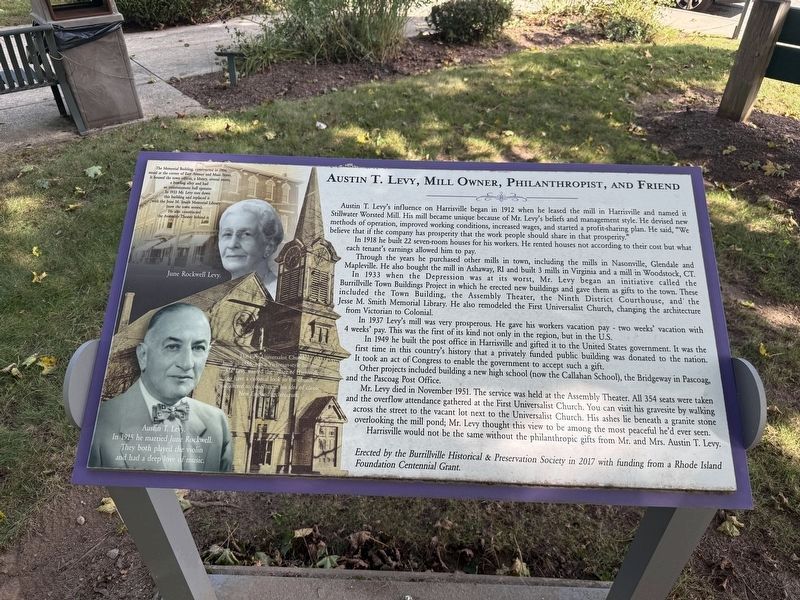
Austin T. Levy's influence on Harrisville began in 1912 when he leased the mill in Harrisville and named it Stillwater Worsted Mill. His mill became unique because of Mr. Levy's beliefs and management style. He devised new methods of operation, improved working conditions, increased wages, and started a profit-sharing plan. He said, "We believe that if the company has prosperity that the work people should share in that prosperity."
In 1918 he built 22 seven-room houses for his workers. He rented housing not according to their cost but what each tenant's earnings allowed him to pay.
Through the years he purchased other mills in town, including the mills in Nasonville, Glendale and Mapleville. He also bought the mill in Ashaway, RI and built 3 mills in Virginia and a mill in Woodstock, CT.
In 1933, when the Depression was at its worst, Mr. Levy began an initiative called the Burrillville Town Buildings Project in which he erected new buildings and gave them as gifts to the town. These included the Town Building, the Assembly Theater, the Ninth District Courthouse, and the Jesse M. Smith Memorial Library. He also
this page online
In 1937 Levy's mill was very prosperous. He gave his workers vacation pay - two weeks' vacation with 4 weeks' pay. This was the first of its kind not only in the region, but in the U.S.
In 1949 he built the post office in Harrisville and gifted it to the United States government. It was the first time in this country's history that a privately funded public building was donated to the nation. It took an act of Congress to enable the government to accept such a gift.
Other projects included building a new high school (now the Callahan School), the Bridgeway in Pascoag, and the Pascoag Post Office.
Mr. Levy died in November 1951. The service was held at the Assembly Theater. All 354 seats were taken and the overflow attendance gathered at the First Universalist Church. You can visit his gravesite by walking across the street to the vacant lot next to the Universalist Church. His ashes lie beneath a granite stone overlooking the mill pond; Mr. Levy though this view to be among the most peaceful he'd ever seen.
Harrisville would
Photographed by Devry Becker Jones (CC0), September 19, 2026
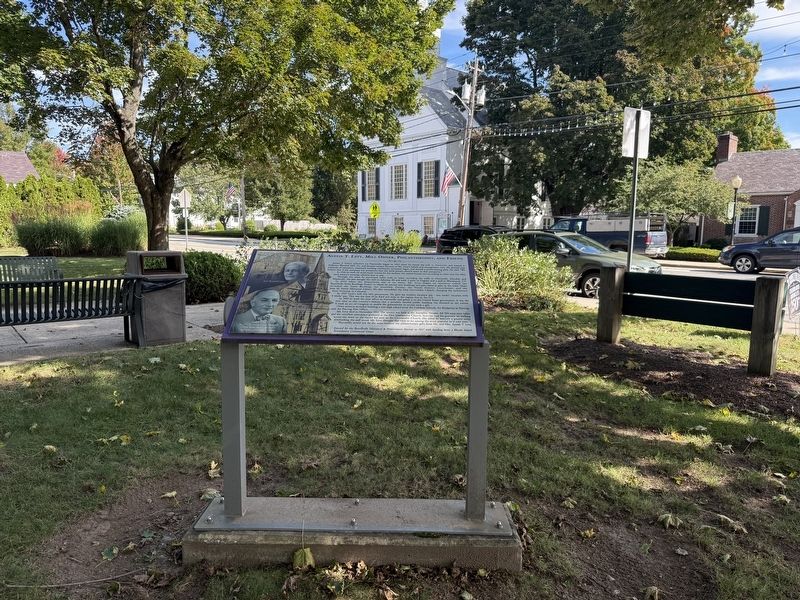
2. Austin T. Levy, Mill Owner, Philanthropist, and Friend Marker
[Captions:]
The Memorial Building, constructed in 1906, stood at the corner of East Avenue and Main Street. It housed the town offices, a library, several stores, a bowling alley and had an entertainment hall upstairs. In 1933 Mr. Levy tore down this building and replaced it with the Jesse M. Smith Memorial Library (now the town annex). He also constructed the Assembly Theater behind it.
June Rockwell Levy.
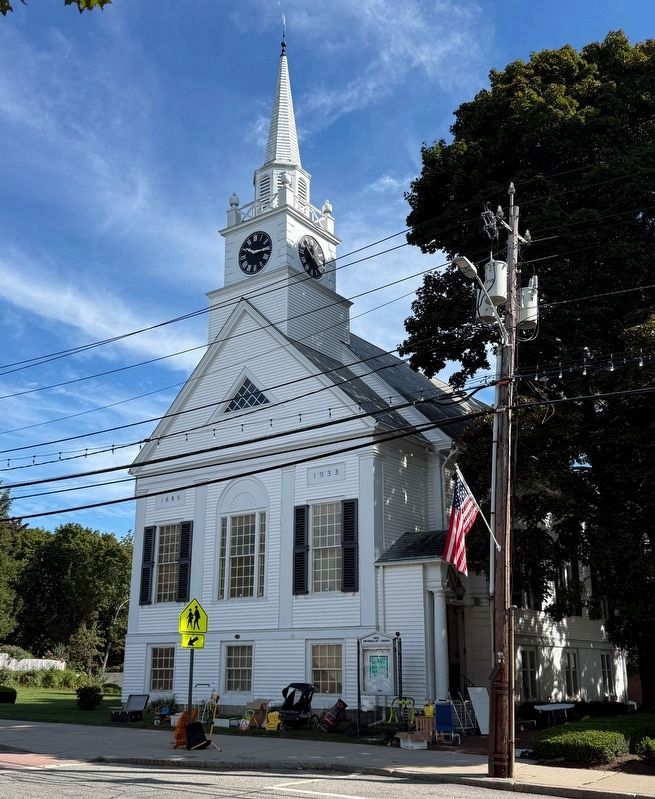
The First Universalist Church, built in 1886, was a Victorian-style building. Mr. Levy wanted the village of Harrisville to have a colonial look so the church was altered to conform to his idea of classic New England architecture.
Austin T. Levy. In 1915 he married June Rockwell. They both played the violin and had a deep love of music.
Erected 2017 by Burrillville Historical & Preservation Society with funding from a Rhode Island Foundation Centennial Grant.
Topics and series. This historical marker is listed in these topic lists: Architecture • Charity & Public Work • Industry & Commerce • Religion & Religious Structures.
Photographed by Devry Becker Jones (CC0), September 19, 2026
3. First Universalist Church
While the congregation has folded, the building remains an active community space.
Location. 41° 57.922′ N, 71° 40.62′ W. Marker is in Burrillville, Rhode Island, in Providence County. It is in Harrisville. It is at the intersection of Harrisville Main Street and East Avenue, on the left when traveling north on Harrisville Main Street. Touch for map. Marker is at or near this postal address: 134 Harrisville Main St, Harrisville RI 02830, United States of America. Touch for directions.

Regionally, this marker is in the Quiet Corner and in Greater Providence. It is also in the American Northeast, in New England, and on the Eastern Seaboard. Globally, it is in the North Atlantic Region, North America, the Western Hemisphere, the Western World, and the Anglosphere. Historically, it finds itself in what was once one of the original Thirteen Colonies.
Other nearby markers. At least 8 other markers are within 4 miles of this marker, measured as the crow flies: Jesse M. Smith Memorial Library (within shouting distance of this marker); Burrillville Veterans Monument (approx. 1.4 miles away);
Photographed by Devry Becker Jones (CC0), September 19, 2026
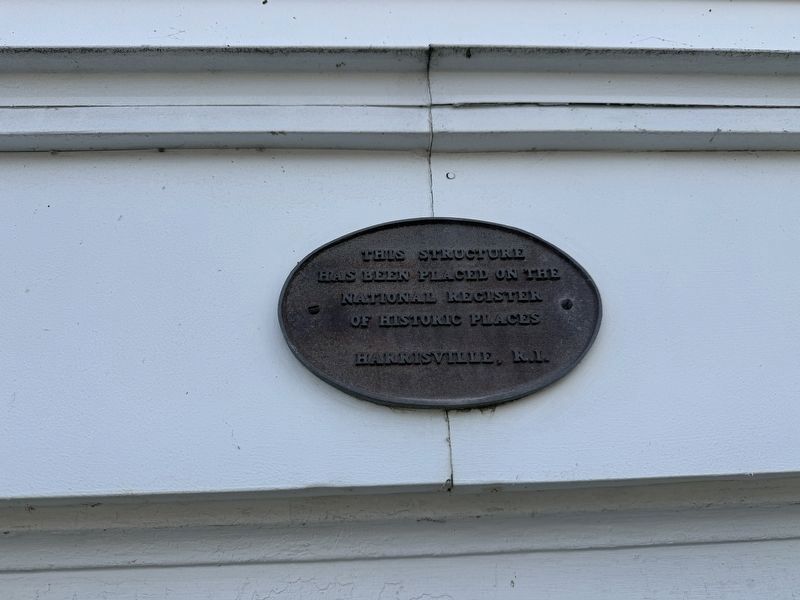
4. National Register of Historic Place plaque for the First Universalist Church
This structure has been placed on the National Register of Historic Places
Also see . . . National Register of Historic Places Nomination Form for the Harrisville Historic District. First Universalist Church is a contributing structure to the Harrisville Historic District. The form was prepared by Robert O. Jones, Jr., Senior Historic Preservation Planner with the Rhode Island Historical Preservation Commission and was certified by the National Park Service on March 21, 1984. The statement of significance begins on page 46:
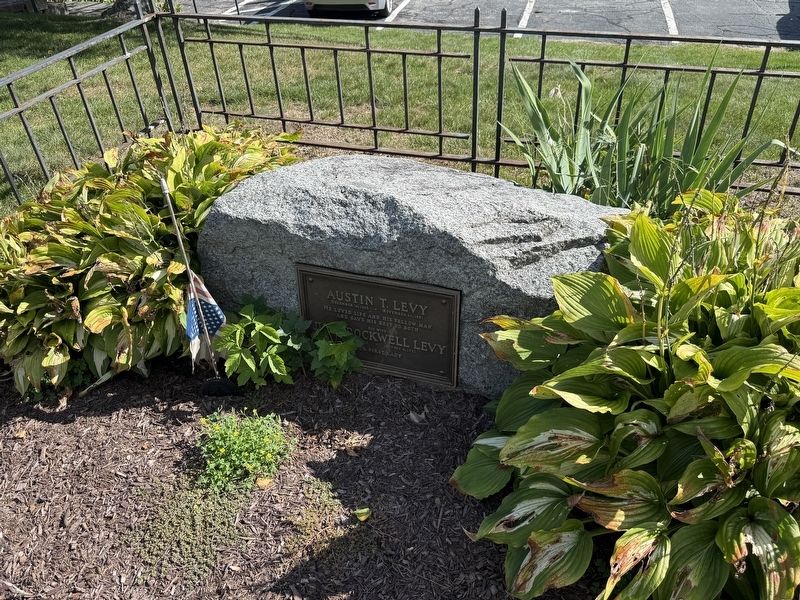
The Harrisville Historic District is significant as a physical record of the area's development as an industrial village. Such villages are an important part of the economic and social history of Rhode Island and constitute a major portion of the state's environment. Harrisville is unique among Rhode Island mill villages, for itrepresents both general trends common to other such villages and developmental forces peculiar to Harrisville alone. The buildings and sites within the district serve to document the establishment and growth of the Harrisville and Graniteville Mills and of institutions created to serve the residents attracted by these mills. The mills, worker's housing, churches, school, library, public buildings, and hotel are an important artifact of social history, an illustration of a mode of life pursued by many Rhode Island residents in past generations. Among the many nineteenth- century buildings that constitute the bulk of the village fabric, there is a significant group of early twentieth-century public buildings and housing. The Town Buildings and New Village, erected under the auspices of one-time Harrisville Mill owner Austin T. Levy, stand as a memorial to his paternalistic attitude toward the community and his unusual, almost Utopian, vision for shaping social and urban development as well as that of the company.Photographed by Devry Becker Jones (CC0), September 19, 20265. Nearby memorialAustin T. Levy
December 16, 1880 - November 24, 1951
He loved life and his fellow man and gave his best to both
His wife
June Rockwell Levy
June 14, 1886 - August 8, 1971 Our First Lady
An architectural description for First Universalist Church is provided on pages 27-28:
First Universalist Church (1886, renovated 1933; James Evans, original architect; Jackson, Robertson and Adams, architects of renovation): A tall, white, 1-story, end-gable-roof, clapboard-covered neo-Classical building set on a high foundation a half-story above grade. The front section, treated as a broad pavilion set off from the main block by a shallow break, is articulated into three facade bays by plain pilasters surmounted by a steep pediment with a steeple perched on the ridge. The central facade bay contains a tripartite window (one large 12-over-12 window flanked on each side by vertical strip 4-over-4 windows) topped by a blind arch, while the bays on either side contain windows under panels inscribed with the dates "1886" and "1933." A 1-story, gable-roof entrance vestibule projects from the south side of the front pavilion, and there is a triangular window in the pediment. On each side of the main block are four windows with blind fans above them. The steeple is composed of a cubical base, containing a clock and ornamented with quoins and a roof balustrade, surmounted by an octagonal, louvered belfry capped by a spire. Built in 1886, this was originally an exuberant Queen Anne/Carpenter Gothic edifice with a 1-story, shed-roof frontal projection and a bulky front corner tower. In 1933 Austin T. Levy offered to subsidize renovation of the building providing the work was done to his specifications. At that time the corner tower and Victorian detailing were removed, the front projection was altered into the present pedimented pavilion, a new ridgetop steeple and neo-Classical detailing were added, and the entire structure was painted white. The renovation was consonant with Levy's scheme to transform Harrisville into an architecturally cohesive "Colonial" New England village.(Submitted on September 21, 2026, by Devry Becker Jones of Washington, District of Columbia.)
Credits. This page was last revised on September 22, 2026. It was originally submitted on September 21, 2026, by Devry Becker Jones of Washington, District of Columbia. This page has been viewed 8 times since then. Photos: 1, 2, 3, 4, 5. submitted on September 21, 2026, by Devry Becker Jones of Washington, District of Columbia.
