Ouderkerk aan de Amstel in Ouder-Amstel, North Holland, Netherlands — Northwestern Europe
Café De Vrije handel
Photographed by Andrew Ruppenstein, September 1, 2026
1. Café De Vrije handel Marker

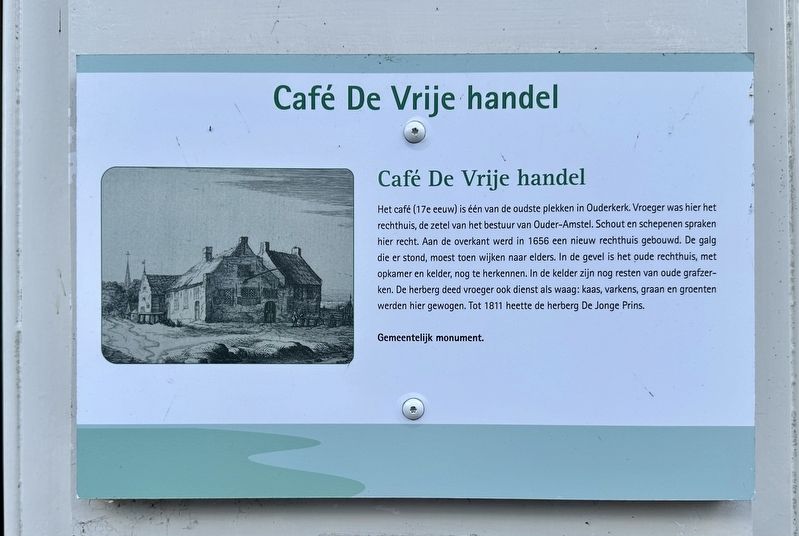
Het café (17e eeuw) is één van de oudste plekken in Ouderkerk. Vroeger was hier het rechthuis, de zetel van het bestuur van Ouder-Amstel. Schout en schepenen spraken hier recht. Aan de overkant werd in 1656 een nieuw rechthuis gebouwd. De galg die er stond, moest toen wijken naar elders. In de gevel is het oude rechthuis, met opkamer en kelder, nog te herkennen. In de kelder zijn nog resten van oude grafzerken. De herberg deed vroeger ook dienst als waag: kaas, varkens, graan en groenten werden hier gewogen. Tot 1811 heette de herberg De Jonge Prins.
Gemeentelijk monument.
This 17th-century café is one of the oldest sites in Ouderkerk. It formerly housed the rechthuis (courthouse), the seat of government for Ouder-Amstel, where the bailiff and aldermen administered justice. A new courthouse was built across the street in 1656, requiring the gallows that stood there to be relocated elsewhere. The structure of the old courthouse—featuring a raised front room (opkamer) and a cellar—is still discernible in the façade. Remains of old tombstones can still be found
this page online
Municipal monument.
Topics. This historical marker is listed in this topic list: Industry & Commerce. A significant historical year for this entry is 1656.
Location. 52° 17.811′ N, 4° 54.221′ E. Marker is in Ouderkerk aan de Amstel, Noord-Holland (North Holland), in Ouder-Amstel. It is at the intersection of Dorpsstraat and Kerkstraat, on the right when traveling east on Dorpsstraat. Touch for map. Marker is at or near this postal address: Dorpsstraat 7, Ouderkerk aan de Amstel, Noord-Holland 1191 BG, Netherlands. Touch for directions.

Regionally, it is in Europe, the European Union, Atlantic Europe, the Benelux Low Countries, the Schengen Area, Western Europe, and the Western World. Historically, it finds itself in what was once the Holy Roman Empire.
Other nearby markers. At least 8 other markers are within walking distance of this marker: Huize Nicolette / Nicolette House (a few steps from this marker); Ouderkerk sinds het jaar 1000 / Ouderkerk Since the Year 1000
Photographed by Andrew Ruppenstein, September 1, 2026
2. Café De Vrije handel and marker
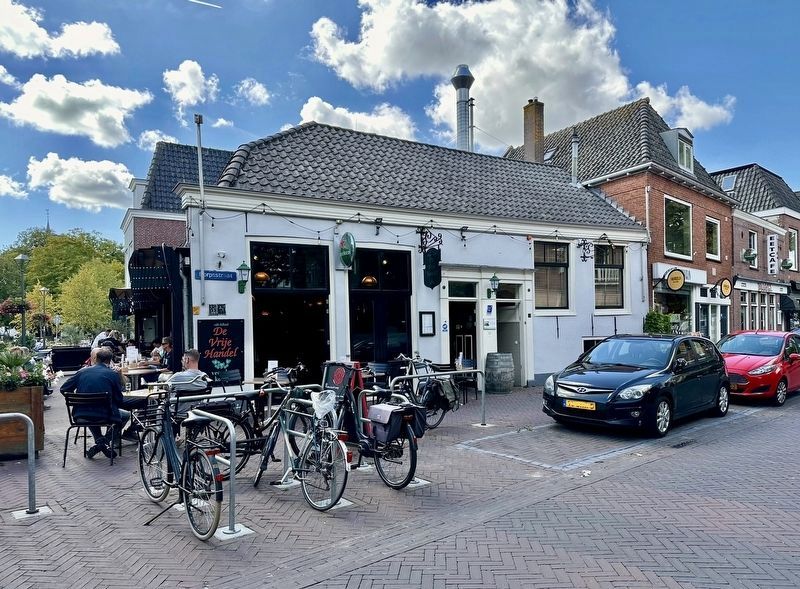
The marker is visible here between the two doors, just above the barrel.
Also see . . . Een Café met een verhaal (Café De Vrije Handel, in Dutch). Excerpt (in translation):
A Rich History: "De Vrije Handel" is not just a name. It originated during the Patriot era of the eighteenth century, when fellow villagers met here to speak freely, discuss politics, and take a stand against the tyranny of the Stadtholder (“Governor”). The pub became a place where freedom and community were central — a spirit that can still be felt today.(Submitted on September 23, 2026.)
Throughout the centuries, De Vrije Handel played a pivotal role in village life. It was a place for weddings, drinking, and gossip. The pub was famous for its notorious gekkenbord (“fools' board”), which displayed the names of couples who had announced their intention to marry. Who was marrying whom would be the talk of the town in Ouderkerk for weeks. Soldiers selected for military service in the eighteenth century also gathered here—often lured by the promise of free spirits.
De Vrije Handel has therefore always been more than just a pub: it was a meeting place where joy and sorrow, seriousness and levity, and tradition and innovation went hand in hand. It is precisely this blend that makes it one of the most distinctive pubs in the Amsterdam region.
Credits. This page was last revised on September 23, 2026. It was originally submitted on September 23, 2026, by Andrew Ruppenstein of Lamorinda, California. This page has been viewed 6 times since then. Photos: 1, 2. submitted on September 23, 2026, by Andrew Ruppenstein of Lamorinda, California.
