Gouda, South Holland, Netherlands — Northwestern Europe
Molen de Rode Leeuw
⎯⎯⎯
“Red Lion” Windmill
Photographed by Andrew Ruppenstein, September 2, 2026
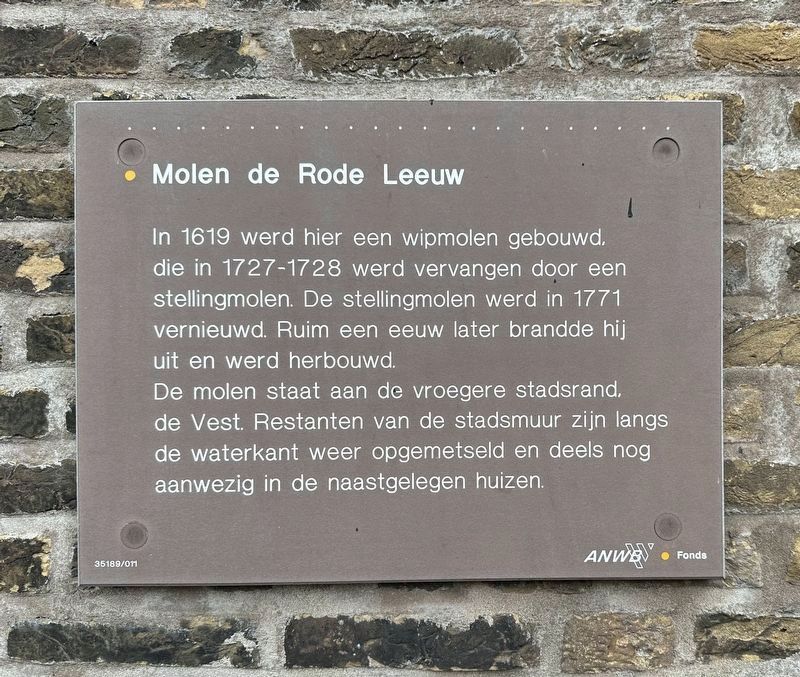
1. Molen de Rode Leeuw / “Red Lion” Windmill Marker

In 1619 werd hier een wipmolen gebouwd, die in 1727-1728 werd vervangen door een stellingmolen. De stellingmolen werd in 1771 vernieuwd. Ruim een eeuw later brandde hij uit en werd herbouwd.
De molen staat aan de vroegere stadsrand, de Vest. Restanten van de stadsmuur zijn langs de waterkant weer opgemetseld en deels nog aanwezig in de naastgelegen huizen.
”Red Lion” Windmill
A hollow-post mill was built here in 1619; it was replaced in 1727–1728 by a gallery mill. This gallery mill was renovated in 1771. More than a century later, it burned down and was subsequently rebuilt.
The mill stands at the edge of the former town boundary, known as the Vest (“moat”). Remnants of the town wall have been reconstructed along the waterfront, and parts of the wall are still visible in the adjacent houses.
Erected by the ANWB, VVV. (Marker Number 35189/011.)
Topics. This historical marker is listed in these topic lists: Forts and Castles • Industry & Commerce. A significant historical year for this entry is 1619.
Location. 52° 0.459′ N, 4° 42.464′ E. Marker is
this page online

Regionally, it is in Europe, the European Union, Atlantic Europe, the Benelux Low Countries, the Schengen Area, Western Europe, and the Western World. Historically, it finds itself in what was once the Roman Empire and specifically also the Holy Roman Empire.
Other nearby markers. At least 8 other markers are within walking distance of this marker: Regina (1908) (a few steps from this marker); IJsfabriek William Barendsz / William Barendsz Ice Factory (about 90 meters away, measured in a direct line); Asschuur / Ash Shed (about 90 meters away); Kaaspakhuizen / Cheese Warehouses (about 180 meters away); Mallegatsluis / Mallegat Lock (approx. 0.3 kilometers away); Lutherse Kerk, voormalige Sint-Joostkapel / Lutheran Church, formerly the St. Joost Chapel (approx. 0.3 kilometers away); Woonhuis van Arie Blanken / Residence of Arie Blanken (approx. 0.3 kilometers away); St. Theodorus-stichting / St. Theodorus Foundation
Photographed by Andrew Ruppenstein, September 2, 2026
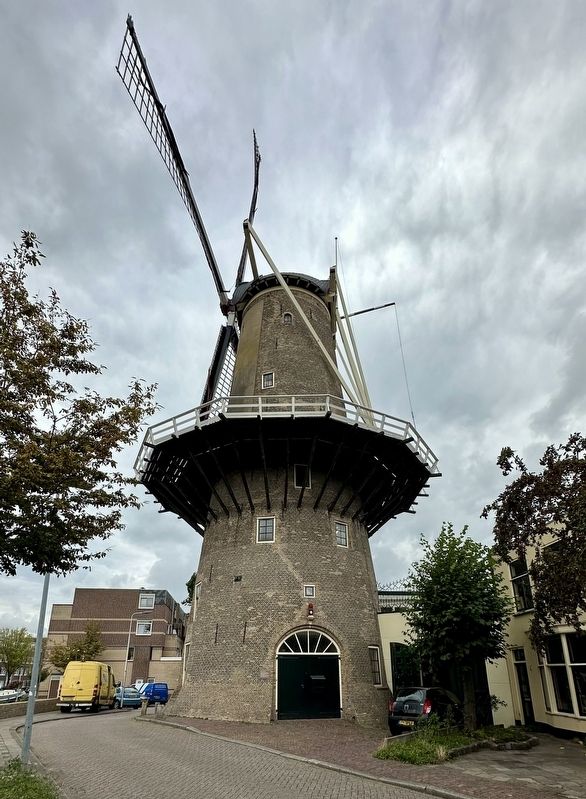
2. Molen de Rode Leeuw / “Red Lion” Windmill and marker
The marker is visible here to the left of the door.
Also see . . . De Roode Leeuw (De Hollandsche Molen, in Dutch). Excerpt from the Dutch Mills database (in translation):
According to the inscription on the windshaft of De Roode Leeuw (“The Red Lion”), the mill was built in 1771. However, its history goes back nearly 150 years further: its predecessor was a hollow-post mill with a gallery, built in 1619. In 1727, this hollow-post mill was replaced by a round stone tower mill with a gallery. More than forty years later, in 1771, the mill required extensive repairs, presumably due to a major fire.(Submitted on September 23, 2026.)
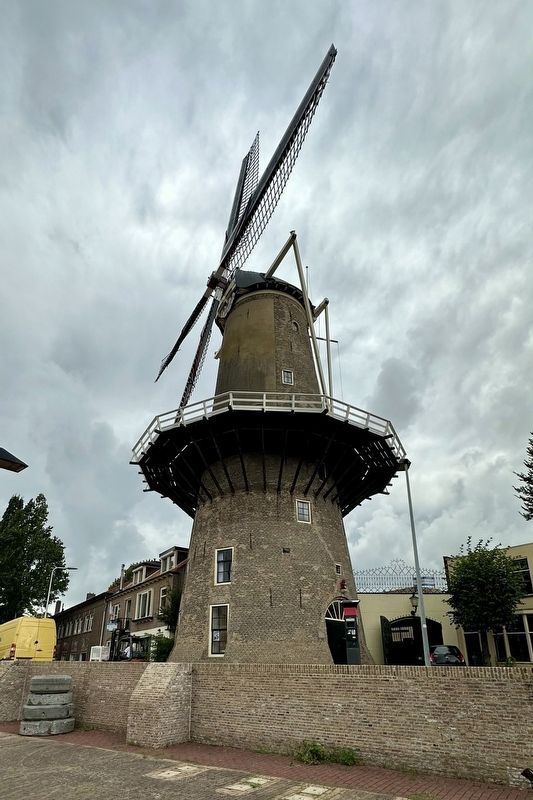
The mill changed hands many times. Its last private owner was C.K. Galama, who ceased milling operations in 1925; specifically, in the April 1, 1925 issue of the trade journal De Molenaar, he offered the mill for sale for demolition, noting in passing the equipment it contained: "...four pairs of millstones, 4 governors with accessories, a milling frame with three pairs of stones—fully complete—plus two oil-cake breakers and a sack hoist, and two three-phase motors (20 and 40 hp) with oil-immersedstarters and switches."Photographed by Andrew Ruppenstein, September 2, 20263. Molen de Rode Leeuw / “Red Lion” Windmill
In 1926, he sold the mill to the Municipality of Gouda for ƒ4,800, subject to the condition that it could not be used for the grain trade until 1952. That condition was indeed honored: the mill fell into disuse and became merely a static monument. It is not entirely clear whether the internal machinery was sold in whole or in part, but during the Second World War, almost everything (except the brake wheel) was stripped out and burned as firewood. Afterward, the mill stood empty and dilapidated.
A major external restoration took place in 1968, including the installation of new sail stocks, but that was the extent of the work. In 1980, the Municipality of Gouda conceived a plan to fully restore the windmill into a working monument. Marcel Koop was appointed miller in 1985. Although he was initially slated to live next to the mill, the municipality stipulated that the mill's original living quarters be restored to their former state; the mill was located in an urban renewal area, and retaining a residential function within the structure made it possible to secure additional subsidy funding. The funds required for the restoration were provided by the Municipality of Gouda, the Province, and the then-National Department for the Preservation of Monuments…
Credits. This page was last revised on September 23, 2026. It was originally submitted on September 23, 2026, by Andrew Ruppenstein of Lamorinda, California. This page has been viewed 16 times since then. Photos: 1, 2, 3. submitted on September 23, 2026, by Andrew Ruppenstein of Lamorinda, California.
