Merna in Custer County, Nebraska — The American Midwest (Upper Plains)
Brenizer Public Library
Built in 1916
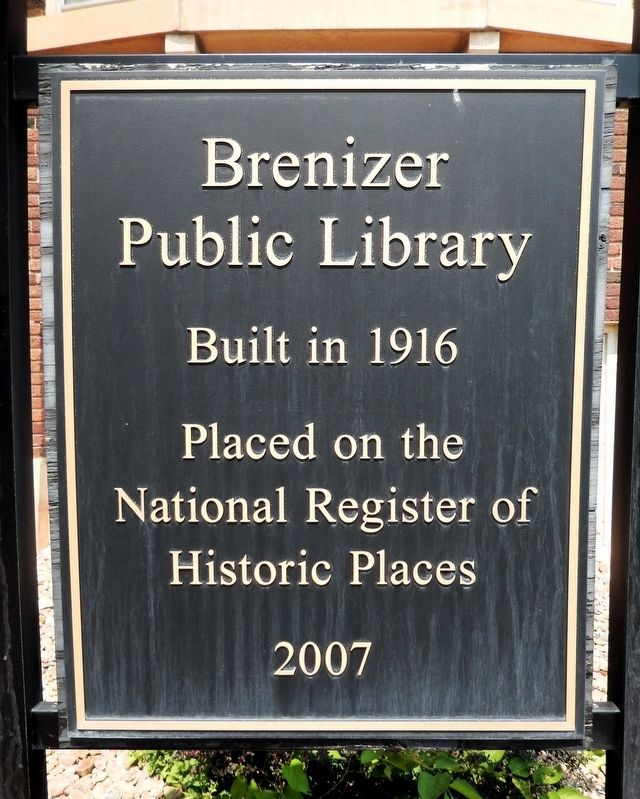
Photographed by Cosmos Mariner, August 6, 2021
1. Brenizer Public Library Marker
Topics and series. This historical marker is listed in these topic lists: Architecture • Charity & Public Work • Education • Notable Buildings. In addition, it is included in the National Register of Historic Places (NRHP) series list. A significant historical year for this entry is 1916.
Location. 41° 29.055′ N, 99° 45.708′ W. Marker is in Merna, Nebraska, in Custer County. It is at the intersection of West Center Avenue and North Thomas Steet, on the left when traveling east on West Center Avenue. The marker is directly in front of the subject building. Touch for map. Marker is at or near this postal address: 430 West Center Avenue, Merna NE 68856, United States of America. Touch for directions.

Regionally, this marker is in the American Midwest, in the Corn Belt, and on the prairies. Globally, it is in North America, the Western Hemisphere, the Western World, and the Anglosphere. Historically, it finds itself in what was once the Louisiana Purchase.
Other nearby markers. At least 8 other markers are within 11 miles of this marker, measured
this page online
Regarding Brenizer Public Library. National Register of Historic Places № 07000654.
From the National Register Nomination prepared by Jill E. Dolberg, March 12, 2007:
The Brenizer Public Library is historically significant in both education and architecture. The library has been in continuous service since 1917 and has had only eight librarians since 1917.
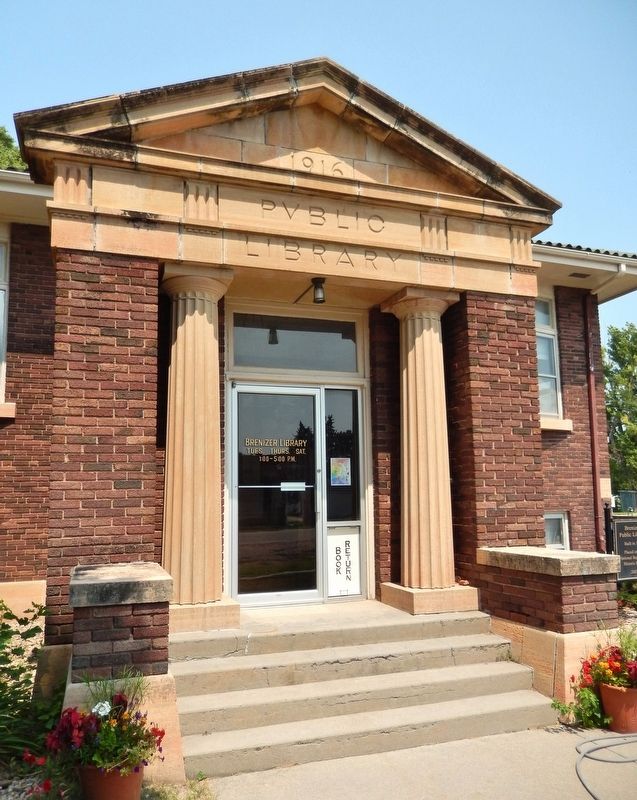
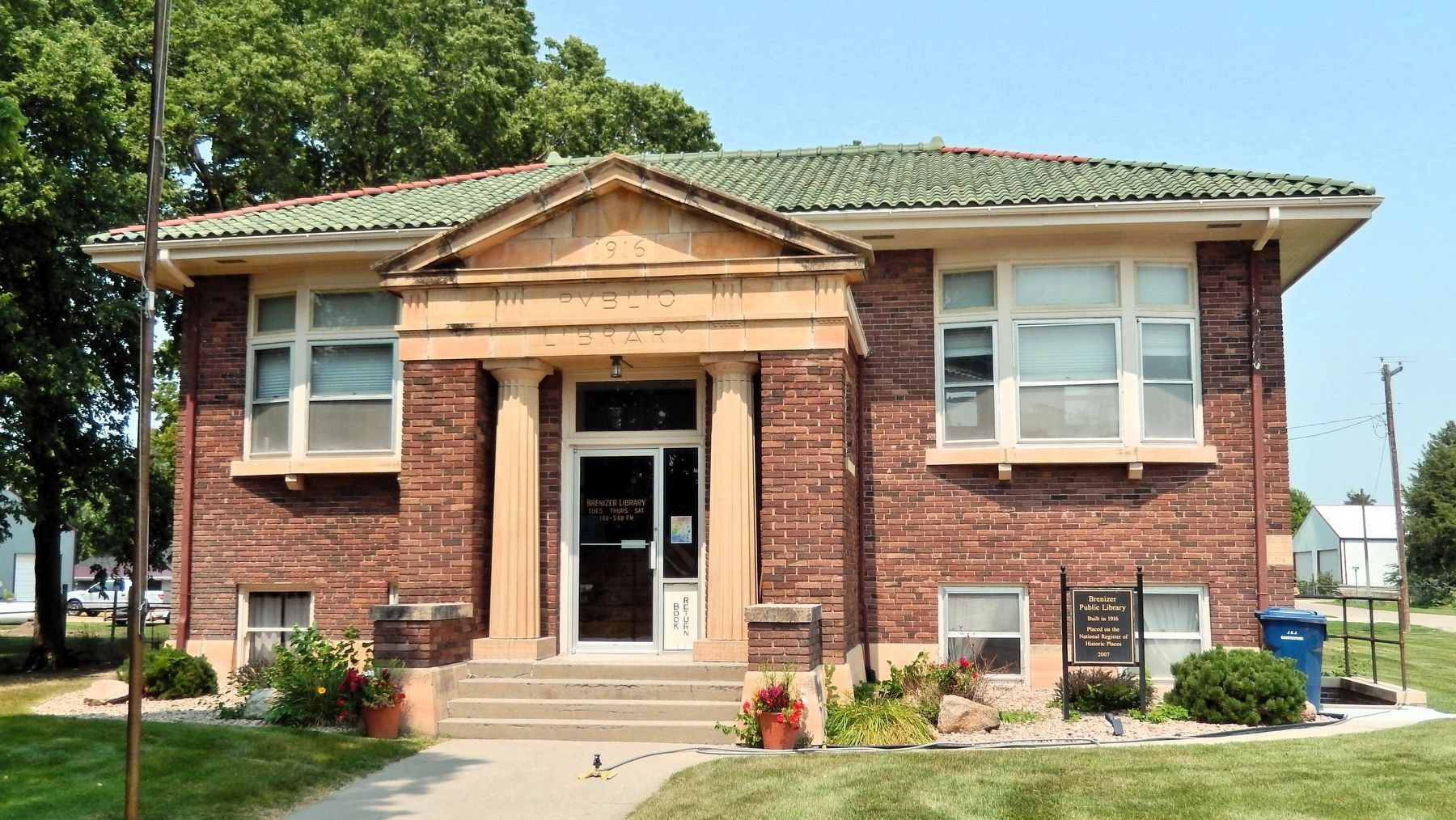
This Prairie style library is a rectangular shaped, one and a half story, brick veneer structure with a clay tile hipped roof. It has a Kasota limestone foundation. The facade contains a central entrance in a projecting vestibule entry under a pedimented gable with a large, fluted Doric column of Kasota limestone on either side of the door, evoking elements of the ClassicalRevival style. Carved into the pediment and frieze of the entrance is the date, “1916”, and the words “PVBLIC LIBRARY,” along with carved vertical lines in groups of four at intervals along the frieze. A broad limestone base approximately two feet in height surrounds the building. The fenestration on the main facade of the library is quite elaborate, with sets of windows in groups of three, canted and projecting a bit from the face of the building.Photographed by Cosmos Mariner, August 6, 20212. Brenizer Public Library (entrance)
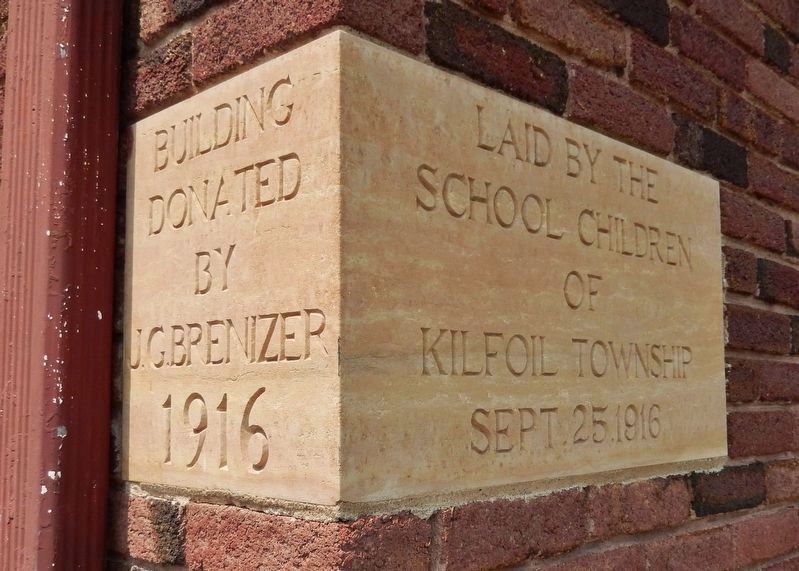
Upon entering the building through its projecting vestibule entry, a set of stairs leads up to the main library space, while another set leads to the basement. At the top of the stairs, two oak and glass French doors admit entry into the library space. An oak, canted librarian's desk sits right in front of a small oak paneled office space. Oak bookshelves have been set along all the outside walls, as well as some freestanding shelves in the middle of the room, to maximize space for books. The library still utilizes the original oak tables and chairs, both child and adult size, that were provided to the library when it opened, including one rocking chair. The library has a tin ceiling andcornice. The downstairs space has a meeting room that fills approximately one half of the west side of the building. The room has a tin ceiling, oak floor, and a trifold door of five-paneled oak. There is a restroom with paneled oak stalls, and a furnace room along the back of the building.Photographed by Cosmos Mariner, August 6, 20213. Brenizer Public Library (cornerstone)Building donated by J. G. Brenizer 1916
Laid by the school children of Kilfoil Township
Sept. 25, 1916
Dr. Brenizer was well regarded in Custer County in part as a result of his philanthropic gifts, most significant of which was his gift of $6500 toward a library to be erected in Kilfoil Township in Merna in February 1916. His only stipulation was that the voters approve a small annual mill levy for its maintenance. That spring, voters approved the levy, 156 to 15. C. H. Empfield and Bert Elder of Anselmo were the contractors for the project. On September 25, 1916, the schoolchildren of the township participated in the laying of the cornerstone. The rural schools participating in the ceremony included Dale, East Table, Pleasant Valley, and Thomas, and thirteen girls representing the original thirteen colonies laid bouquets of flowers on the stone. One thousand people attended the celebration. With the rural schools represented at the ceremony, andmore than twice the number of people in attendance as the current population of Merna, it is clear that this library was intended to serve not just Merna, but the surrounding area as well.Photographed by Cosmos Mariner, August 6, 20214. Brenizer Public Library (front/south elevation)The marker is in front of the windows on the right/east side of the façade.
Although the Brenizer Public Library is not a Carnegie Library, constructed with monies donated by entrepreneur and philanthropist Andrew Carnegie, it was built during the era in which Carnegie's gifts were being most prodigiously constructed, and was built for the same reasons. The desire on the part of communities to have their own public libraries was influenced by many factors, including the philosophy of progressivism, the spread of free public education, the growth of democracy, industrialization, urbanization, and rising prosperity.
Also see . . . Brenizer Library (Wikipedia).
Excerpt: The Brenizer Library was built in 1916-1917 by C.H. Empfield & Bert Elder thanks to a $6,500 donation from homesteader James G. Brenizer and designed in the Prairie School and Classical Revival styles by architect Claude W. Way. It has been listed on the National Register of Historic Places since July 3, 2007.(Submitted on September 23, 2026, by Cosmos Mariner of Cape Canaveral, Florida.)
Credits. This page was last revised on September 23, 2026. It was originally submitted on September 23, 2026, by Cosmos Mariner of Cape Canaveral, Florida. This page has been viewed 5 times since then. Photos: 1, 2, 3, 4. submitted on September 23, 2026, by Cosmos Mariner of Cape Canaveral, Florida.
