Northampton in West Northamptonshire, England, United Kingdom — Northwestern Europe (the British Isles)
Thomas Becket
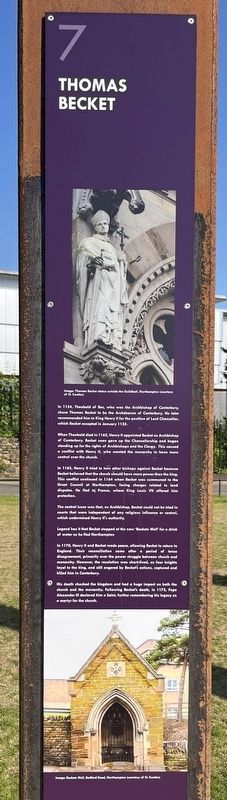
Photographed by Ray Gurganus, May 25, 2026
1. Thomas Becket Marker
When Theobald died in 1162, Henry II appointed Becket as Archbishop of Canterbury. Becket soon gave up the Chancellorship and began standing up for the rights of Archbishops and the Clergy. This caused a conflict with Henry II, who wanted the monarchy to have more control over the church.
In 1163, Henry II tried to turn other bishops against Becket because Becket believed that the church should have more power than the king. This conflict continued in 1164 when Becket was summoned to the Great Council at Northampton, facing charges related to land disputes. He fled to France, where King Louis VII offered him protection.
The central issue was that, as Archbishop, Becket could not be tried in courts that were independent of any religious influence or control, which undermined Henry II's authority.
Legend has it that Becket stopped at the now 'Beckets Well' for a drink of water
this page online
In 1170, Henry II and Becket made peace, allowing Becket to return to England. Their reconciliation came after a period of tense disagreement, primarily over the power struggle between church and monarchy. However, the resolution was short-lived, as four knights loyal to the king, and still angered by Becket's actions, captured and killed him in Canterbury.
His death shocked the kingdom and had a huge impact on both the church and the monarchy. Following Becket's death, in 1173, Pope Alexander III declared him a Saint, further remembering his legacy as a martyr for the church. (Marker Number 7.)
Topics. This historical marker is listed in this topic list: Religion & Religious Structures. A significant month for this entry is January.
Location. 52° 14.259′ N, 0° 54.237′ W. Marker is in Northampton, England, in West Northamptonshire. It is on Chalk Lane. Touch for map. Marker is at or near this postal address: 14 Chalk Lane, Northampton, England NN1 2RW, United Kingdom. Touch for directions.

Regionally, it is on the Atlantic Ocean, in the North Atlantic Region, in Europe, in Atlantic Europe, on one of the British Isles, in the Western World, and in the Anglosphere. Historically, it finds itself in what was once the Roman Empire.
Other nearby markers. At least 8 other markers are within walking distance of this marker: Visitors to the Castle (here, next to this marker); Royals and the Castle (here, next to this marker); The Castle (here, next to this marker); Stories from the Castle (here, next to this marker); The Story of Simon de Senlis (a few steps from this marker); Hazelrigg House and the Old Black Lion (a few steps from this marker); Earl of Northampton (a few steps from this marker); The Fall of the Castle Walls (a few steps from this marker). Touch for a list and map of all markers in Northampton.
Also see . . . Thomas Becket (Wikipedia). Overview:
Thomas Becket (also known as Saint Thomas of Canterbury, Thomas of London and later Thomas à Becket (21 December 1119 or 1120 – 29 December 1170), was an English cleric and statesman who served as Lord Chancellor from 1155 to 1162, and then as Archbishop of Canterbury from 1162 until his death in 1170. He is known for his conflict with King Henry II over the rights and privileges of the Church and was murdered by followers of the king. Becket is venerated as a saint and martyr by the Catholic Church and the Anglican Communion.(Submitted on September 24, 2026.)
Credits. This page was last revised on September 24, 2026. It was originally submitted on September 24, 2026, by Ray Gurganus of Washington, District of Columbia. This page has been viewed 7 times since then. Photo 1. submitted on September 24, 2026, by Ray Gurganus of Washington, District of Columbia. • Andrew Ruppenstein was the editor who published this page.
