Coventry in West Midlands, England, United Kingdom — Northwestern Europe (the British Isles)
William Bawden's Coventry, 1919
A man who knew heartbreak set about documenting the world around him.
Photographed by Ray Gurganus, May 25, 2026
1. William Bawden's Coventry, 1919 Marker
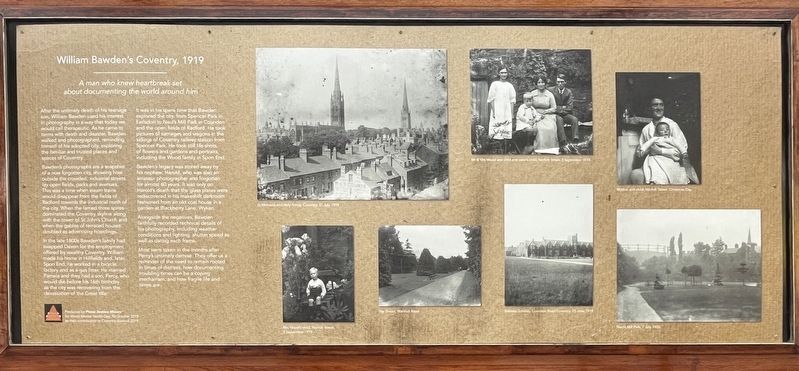
Bawden's photographs are a snapshot of a now forgotten city, showing how outside the crowded, industrial streets lay open fields, parks and avenues. This was a time when steam trains would disappear from the fields of Radford towards the industrial north of the city. When the famed three spires dominated the Coventry skyline along with the tower of St John's Church and when the gables of terraced houses doubled as advertising hoardings.
In the fate 1800s Bawden's family had swapped Devon for the employment offered by wealthy Coventry. William made his home in Hillfields and, later, Spon End, he worked in a bicycle factory and as a gas fitter. He married Pamela and they had a son, Percy, who would die before his 16th birthday as the city was recovering from the devastation of the Great War.
It was
this page online
Bawden's legacy was stored away by his nephew, Harold, who was also an amateur photographer and forgotten for almost 60 years. It was only on Harold's death that the glass plates were rediscovered in his makeshift darkroom fashioned from an old coal house in a garden at Blackberry Lane, Wyken.
Alongside the negatives, Bawden faithfully recorded technical details of his photography, including weather conditions and lighting, shutter speed as well as dating each frame.
Most were taken in the months after Percy's untimely demise. They offer us a reminder of the need to remain rooted in times of distress, how documenting troubling times can be a coping mechanism, and how fragile life and times are.
Topics. This historical marker is listed in this topic list: Arts, Letters, Music.
Location. 52° 24.052′ N, 1° 30.785′ W. Marker is in Coventry, England, in West Midlands. It can be reached from Station Square. On the platform of the Coventry train station. Touch for map. Marker is at or near this postal address: 10 Station Square, Coventry, England CV3 6HF, United Kingdom. Touch for directions.

Regionally, this marker is in the Midlands. Globally, it is on the Atlantic Ocean, in the North Atlantic Region, in Europe, in Atlantic Europe, on one of the British Isles, in the Western World, and in the Anglosphere. Historically, it finds itself in what was once the Roman Empire.
Other nearby markers. At least 8 other markers are within walking distance of this marker: Angela Brazil (approx. half a kilometer away); The Quadrant (approx. half a kilometer away); Dresden Place (approx. 0.6 kilometers away); Christchurch Spire (approx. 0.6 kilometers away); Grey Friars Gate (approx. 0.6 kilometers away); Ford’s Hospital (approx. 0.6 kilometers away); The Council House (approx. 0.8 kilometers away); Dame Ellen Terry (approx. 0.8 kilometers away). Touch for a list and map of all markers in Coventry.
Credits. This page was last revised on September 24, 2026. It was originally submitted on September 24, 2026, by Ray Gurganus of Washington, District of Columbia. This page has been viewed 5 times since then. Photo 1. submitted on September 24, 2026, by Ray Gurganus of Washington, District of Columbia. • Andrew Ruppenstein was the editor who published this page.
Editor’s want-list for this marker. photo of the marker within its surroundings • Can you help?
