St Katharine's & Wapping in Tower Hamlets in Greater London, England, United Kingdom — Northwestern Europe (the British Isles)
London Wall
Photographed by Brandon Fletcher, June 12, 2013
1. London Wall
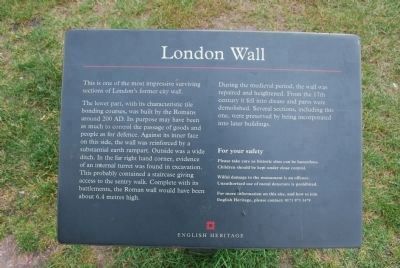
This is one of the most impressive surviving section of London's former city wall.
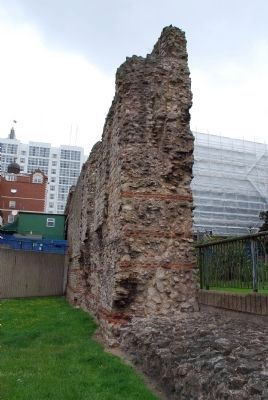
The lower part, with its characteristic tile bonding courses, was built by the Romans around 200 AD. Its purpose may have been as much to control passage of goods and people as for defence. Against its inner face on this side, the wall was reinforced by a substantial earth rampart. Outside was a wide ditch. In the far right hand corner, evidence of an internal turret was found in excavation. This probably contained a staircase giving access to the sentry walk. Complete with its battlements, the Roman wall would have been about 6.4 metres high.
During the medieval period, the wall was repaired and heightened. From the 17th century it fell into disuse and parts were demolished. Several sections, including this one, were preserved by being incorporated into later buildings.
For Your Safety
Please take care as historic sites can be hazardous.
Children should be kept under close control.
Wilfull damage to the monument is an offense.
Unauthorised use of metal detectors is prohibited.
For more information on this site, and how
this page online
Statue believed to be of the Roman Emperor Trajan, A.D. 98-117. 'Imperator Caesar Nerva Trajanus Augustus' Presented by the Tower Hill improvement trust at the request of the Reverend P.B. Clayton, CH, MC, DD. Founder Padre of TOC H.
Erected by English Heritage.
Topics. This historical marker is listed in this topic list: Forts and Castles.
Location. This marker has been replaced by another marker nearby. It was located near 51° 30.593′ N, 0° 4.569′ W. Marker was in Tower Hamlets, England, in Greater London. It was in St Katharine's & Wapping. It was on Tower Hill. Touch for map. Marker was at or near this postal address: 40 Tower Hill, Tower Hamlets, England EC3N 2LY, United Kingdom. Touch for directions.

Regionally, this marker was in the Greater South East. Globally, it was on the Atlantic Ocean, in the North Atlantic Region, in Europe, in Atlantic Europe, on one of the British Isles, in the Western World, and in the Anglosphere. Historically, it found itself in what was once the Roman Empire.
Photographed by Brandon Fletcher, June 12, 2013
2. London Wall
Other nearby markers. At least 8 other markers are within walking distance of this location: Tower Hill, City Wall (here, next to this marker); The Pool of London (a few steps from this marker); A Walled City (a few steps from this marker); The Origins of the Tower (a few steps from this marker); Tower Hill Passageway: Henry III (a few steps from this marker); Tower Hill Passageway: Panoramic View of the Tower (within shouting distance of this marker); Tower Hill Passageway: Queen’s Guard (within shouting distance of this marker); Tower Hill Passageway: Crown Jewels — St Edward's Crown (within shouting distance of this marker). Touch for a list and map of all markers in Tower Hamlets.
Also see . . . History of the London Wall. English Heritage's history of the London Wall: "From its earliest foundation the Roman city of Londinium was almost certainly surrounded by some kind of fortification. As well as providing defence, the construction of a stone wall represented the status of the city. Using the evidence of excavated coins, archaeologists have dated the construction of the first stone city wall to between ad 190 and 225. The
Photographed by Brandon Fletcher, June 12, 2013
3. Roman Emperor Trajan Statue with the London Wall in the Background
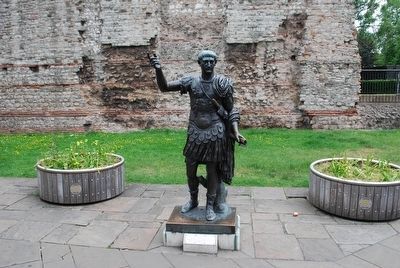
Statue believed to be of the Roman Emperor Trajan, A.D. 98-117. 'Imperator Caesar Nerva Trajanus'. Presented by the Tower Hill improvement trust at the request of the Reverend P.B. Clayton, CH, MC, DD. Founder Padre of TOC H. - From plaque on statue.
Note the red tile bands on the wall, as mentioned in the English Heritage link.
Note the red tile bands on the wall, as mentioned in the English Heritage link.
Credits. This page was last revised on September 25, 2026. It was originally submitted on July 20, 2015, by Brandon Fletcher of Chattanooga, Tennessee. This page has been viewed 594 times since then and 35 times this year. Last updated on September 24, 2026, by Ian Lefkowitz of New York, New York. Photos: 1, 2, 3. submitted on July 20, 2015, by Brandon Fletcher of Chattanooga, Tennessee. • Devry Becker Jones was the editor who published this page.
