Bulla in Hume, Victoria, Australia — Oceania
Lost and Unconfirmed Roses
| — | Alister Clark Memorial Rose Garden | — |
Photographed by Dean Barton-Ancliffe, August 27, 2026
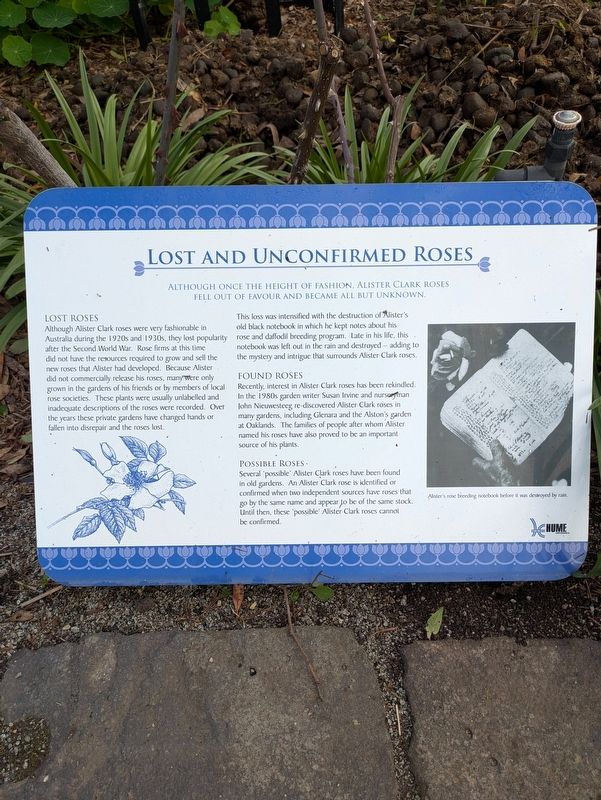
1. Lost and Unconfirmed Roses Marker
Lost Roses
Although Alister Clark roses were very fashionable in Australia during the 1920s and 1930s, they lost popularity after the Second World War. Rose firms at this time did not have the resources required to grow and sell the new roses that Alister had developed. Because Alister did not commercially release his roses, many were only grown in the gardens of his friends or by members of local rose societies. These plants were usually unlabelled and inadequate descriptions of the roses were recorded. Over the years these private gardens have changed hands or fallen into disrepair and the roses lost.
This loss was intensified with the destruction of Alister's old black notebook in which he kept notes about his rose and daffodil breeding program. Late in his life, this notebook was left out in the rain and destroyed - adding to the mystery and intrigue that surrounds Alister Clark roses.
Found Roses
Recently, interest in Alister Clark roses has been rekindled. In the 1980s garden writer Susan Irvine and
this page online
Possible Roses
Several 'possible' Alister Clark roses have been found in old gardens. An Alister Clark rose is identified or confirmed when two independent sources have roses that go by the same name and appear to be of the same stock. Until then, these 'possible' Alister Clark roses cannot be confirmed.
Erected by Hume City Council.
Topics. This historical marker is listed in this topic list: Horticulture & Forestry. A significant historical year for this entry is 1920.
Location. 37° 38.188′ S, 144° 48.248′ E. Marker is in Bulla, Victoria, in Hume. It can be reached from Green Street 0.1 kilometers north of Bulla Road (Victoria Route C743). Touch for map. Marker is at or near this postal address: 1 Green Street, Bulla VIC 3428, Australia. Touch for directions.

Regionally, it is in Oceania, in Australasia, in the Pacific Ocean, in South Pacific, on the Pacific Rim, in the Western
Photographed by Dean Barton-Ancliffe, August 27, 2026
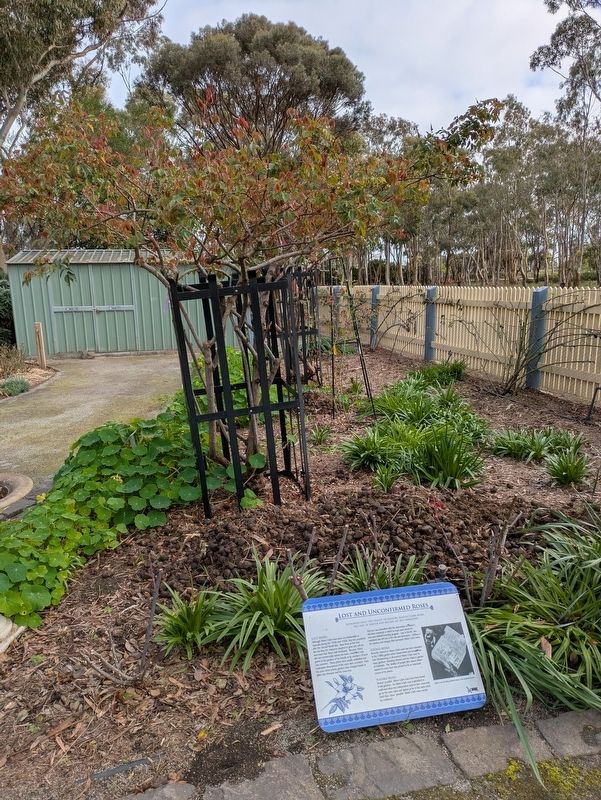
2. Lost and Unconfirmed Roses Marker in the Rose Garden
Other nearby markers. At least 8 other markers are within walking distance of this marker: Daffodils (a few steps from this marker); Nancy Hayward (a few steps from this marker); Lorraine Lee (a few steps from this marker); Mrs Maud Alston (a few steps from this marker); Mrs Harold Brookes (a few steps from this marker); Roses (a few steps from this marker); Mrs Hugh Dettman (a few steps from this marker); Countess of Stradbroke (within shouting distance of this marker). Touch for a list and map of all markers in Bulla.
Also see . . . Alister Clark (1864–1949). Australian Dictionary of Biography
Clark was best known as a rosarian. He was a foundation member of the National Rose Society of Victoria in 1900 and served as its president. He put great effort and skill into developing new varieties, and his 'Lorraine Lee', 'Black Boy', 'Sunny South', 'Nancy Hayward' and many others were grown throughout Australia; they were highly regarded in the United States of America. He supplied his new varieties without charge to State rose societies for propagation and sale. He won many awards but his greatest triumph was the 1936 Dean Hole Memorial Medal of the National Rose Society (England). His rose garden survives at Glenara and a selection of his roses grows in a memorial garden in Blessington Street, St Kilda.(Submitted on September 26, 2026, by Dean Barton-Ancliffe of Rowville, Victoria.)
Credits. This page was last revised on September 27, 2026. It was originally submitted on September 26, 2026, by Dean Barton-Ancliffe of Rowville, Victoria. This page has been viewed 5 times since then. Photos: 1, 2. submitted on September 26, 2026, by Dean Barton-Ancliffe of Rowville, Victoria. • Andrew Ruppenstein was the editor who published this page.
