Bordentown in Burlington County, New Jersey — The American Northeast (Mid-Atlantic)
Bordentown Friends Meetinghouse
Photographed by Kevin Vincent, September 25, 2026
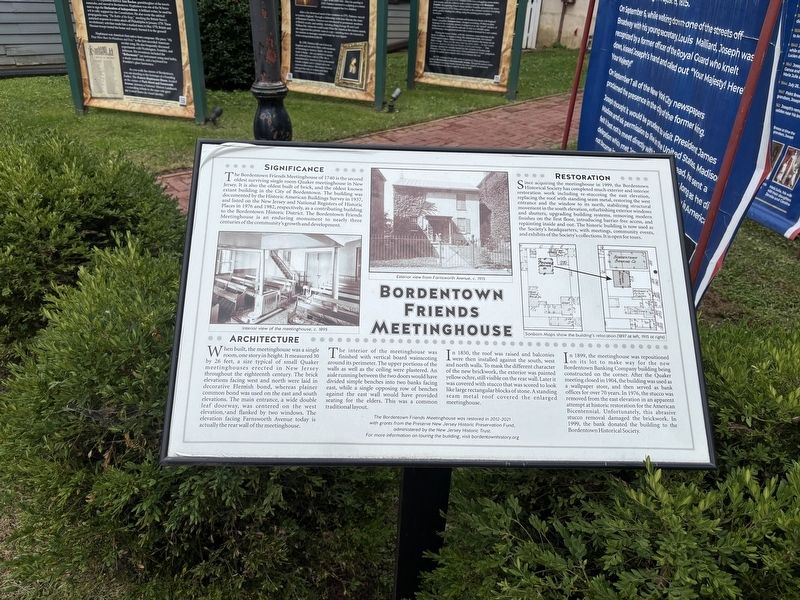
1. Bordentown Friends Meetinghouse Marker
this page online
The interior of the meetinghouse was finished with vertical board wainscoting around its perimeter. The upper portions of the walls as well as the celling were plastered. An aisle running between the two doors would have divided simple benches into two banks facing east, while a single opposing row of benches against the east wall would have provided seating for the elders. This was a common traditional
Photographed by Kevin Vincent, September 25, 2026
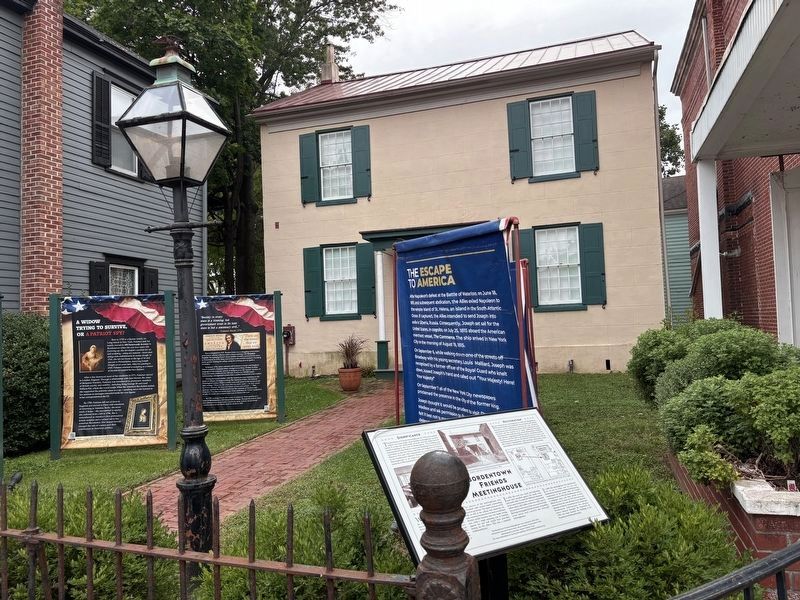
2. Bordentown Friends Meetinghouse Marker
Banners apparently erected for America's 250th commemoration in front of the meetinghouse.
In 1850, the roof was raised and balconies were then installed against the south, west and north walls. To mask the different character of the new brickwork, the exterior was painted yellow ochre, still visible on the rear wall. Later it was covered with stucco that was scored to look like large rectangular blocks of stone. A standing seam metal roof covered the enlarged meetinghouse.
In 1899, the meetinghouse was repositioned on its lot to make way for the new Bordentown Banking Company building being constructed on the corner. After the Quaker meeting closed in 1904, the building was used as a wallpaper store, and then served as bank offices for over 70 years. In 1976, the stucco was removed from the east elevation in an apparent attempt at historic restoration for the American Bicentennial. Unfortunately, this abrasive stucco removal damaged the brickwork. In 1999, the bank donated the building to the Bordentown Historical Society.
The Bordentown Friends Meetinghouse was restored in 2012 – 2021 with grants from the Preserve New Jersey Preservation Fund, administered by the New Jersey Historic Trust. For more information on touring the building visit bordentownhistory.org.
Erected 2021 by Bordentown Historical Society.
Topics. This historical marker is listed in these topic lists: Architecture • Industry & Commerce • Religion & Religious Structures. A significant historical year for this entry is 1740.
Location. 40° 8.767′ N, 74° 42.714′ W. Marker is in Bordentown, New Jersey, in Burlington County. It is at the intersection of Farnsworth Avenue and Crosswicks Street, on the right when traveling south on Farnsworth Avenue. Touch for map. Marker is at or near this postal address: 304 Farnsworth Avenue, Bordentown NJ 08505, United States of America. Touch for directions.

Regionally, this marker is in South Jersey and in Greater Philadelphia. It is also in the American Northeast, in the Mid-Atlantic, and on the Eastern Seaboard. Globally, it is in the North Atlantic Region, North America, the Western Hemisphere, the Western World, and the Anglosphere. Historically, it finds itself in what was once New Netherland and also one of the original Thirteen Colonies.
Other nearby markers. At least 8 other markers are within walking distance of this marker: Friends Meeting House (a few steps from this marker); Bordentown Female College (a few steps from this marker); The Telephone made its Bordentown Debut in 1882 (within shouting distance of this marker); World Wars I and II Memorial (about 300 feet away, measured in a direct line); Tower Clock (about 300 feet away); Thomas Paine (about 400 feet away); First Baptist Church (about 600 feet away); First movement by steam on a railroad in New Jersey (about 700 feet away). Touch for a list and map of all markers in Bordentown.
Another marker is no longer nearby. Bordentown (was a few steps from this marker but has been confirmed missing).
Also see . . . Bordentown History. (Submitted on October 7, 2026, by Michael Herrick of Southbury, Connecticut.)
Credits. This page was last revised on October 7, 2026. It was originally submitted on September 26, 2026, by Kevin Vincent of Arlington, Virginia. This page has been viewed 38 times since then. Photos: 1, 2. submitted on September 26, 2026, by Kevin Vincent of Arlington, Virginia. • Michael Herrick was the editor who published this page.
