Aylesbury in Buckinghamshire, England, United Kingdom — Northwestern Europe (the British Isles)
Aylesbury Lace
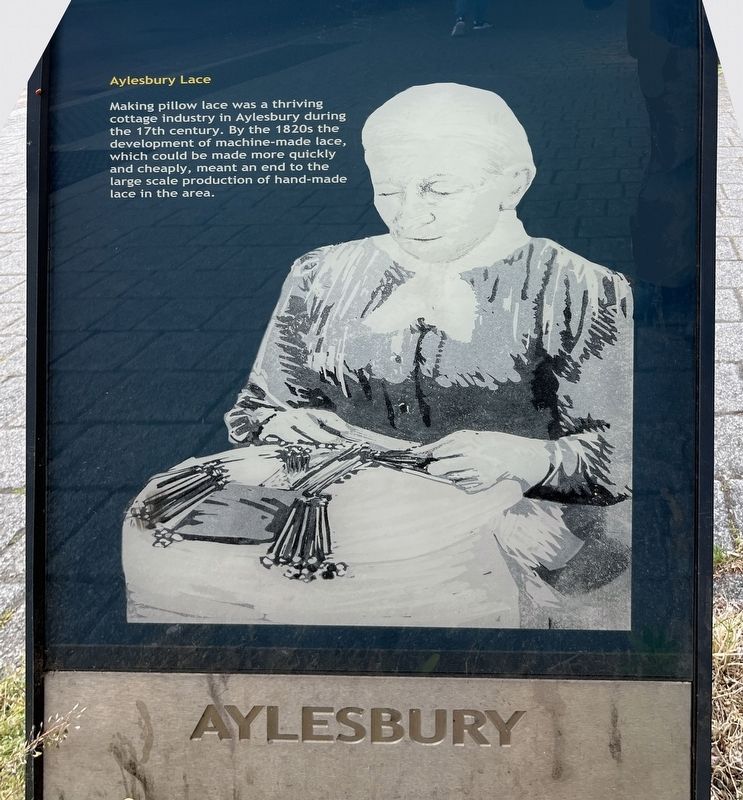
Photographed by Ray Gurganus, May 23, 2026
1. Aylesbury Lace Marker
Topics. This historical marker is listed in this topic list: Industry & Commerce.
Location. 51° 48.903′ N, 0° 48.854′ W. Marker is in Aylesbury, England, in Buckinghamshire. It is on Great Western Street. Touch for map. Marker is at or near this postal address: 21 Great Western Street, Aylesbury, England HP20 2FU, United Kingdom. Touch for directions.

Regionally, this marker is in the Greater South East. Globally, it is on the Atlantic Ocean, in the North Atlantic Region, in Europe, in Atlantic Europe, on one of the British Isles, in the Western World, and in the Anglosphere. Historically, it finds itself in what was once the Roman Empire.
Other nearby markers. At least 8 other markers are within walking distance of this marker: Cubitt Cars (here, next to this marker); Ronnie Barker (1929-2005) (about
this page online
Also see . . . Aylesbury (Wikipedia). Excerpt:
17th century – lace making: In 1672, poor children in Buckinghamshire were taught to make lace as a way to make a living. Bucks lace, as it became known, quickly became very sought after and production boomed as the lace was mainly made by poor women and children. The lace-making industry had died out by Victorian times, however, as new machine-made lace became cheaper.(Submitted on September 29, 2026.)
Credits. This page was last revised on September 29, 2026. It was originally submitted on September 26, 2026, by Ray Gurganus of Washington, District of Columbia. This page has been viewed 6 times since then. Photo 1. submitted on September 26, 2026, by Ray Gurganus of Washington, District of Columbia. • Andrew Ruppenstein was the editor who published this page.
Editor’s want-list for this marker. photo of the marker within its surroundings • Can you help?
