Newport in Newport County, Rhode Island — The American Northeast (New England)
Bellevue Avenue
Walk Newport's History
| — | Newport Historical Society | — |
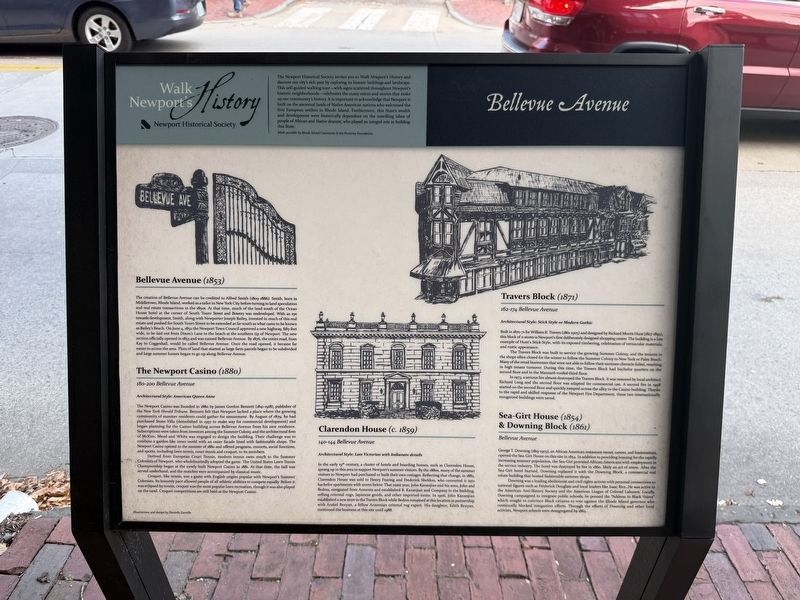
The Newport Historical Society invites you to Walk Newport's History and discover our city's rich past by exploring its historic buildings and landscape. This self-guided walking tour—with signs scattered throughout Newport's historic neighborhoods—celebrates the many voices and stories that make up our community's history. It is important to acknowledge that Newport is built on the ancestral lands of Native American nations who welcomed the first European settlers to Rhode Island. Furthermore, this State's wealth and development were historically dependent on the unwilling labor of people of African and Native descent, who played an integral role in building this state.
Made possible the Rhode Island Commerce & the Pomeroy Foundation
Bellevue Avenue (1853)
The creation of Bellevue Avenue can be credited to Alfred Smith (1809-1886). Smith, born in Middletown, Rhode Island, worked as a tailor in New York City before turning to land speculation and real estate transactions in the 1850s. At that time, much of the land south of the Ocean House hotel at the corner of South Touro Street and Bowery was undeveloped. With
this page online
The Newport Casino (1880)
180-200 Bellevue Avenue
Architectural Style: American Queen Anne
The Newport Casino was founded in 1880 by James Gordon Bennett (1841-1918), publisher of the New York Herald Tribune. Bennett felt that Newport lacked a place where the growing community of summer residents could gather for amusement. By August of 1879, he had purchased Stone Villa (demolished in 1957 to make way for commercial
Derived from European Court Tennis, modern tennis owes much to the Summer Colonists of Newport, who wholeheartedly adopted the game. The United States Lawn Tennis Championship began at the newly beat Newport Casino in 1881. At that time, the ball was served underhand, and the matches were accompanied by classical music.
Croquet, like tennis, was a game with English origins popular with Newport's Summer Colonists. Its leisurely pace allowed people of all athletic abilities to compete equally. Before it was eclipsed by tennis, croquet was the most popular lawn recreation, though it was also played on the sand. Croquet competitions are still held at the Newport Casino.
Clarendon House (c. 1859)
140-144 Bellevue Avenue
Architectural Style: Late Victorian with Italianate details
In the early 19th century, a cluster of hotels and boarding houses, such as Clarendon House, sprang up in this area to support Newport's summer visitors. by the 1880s, many of the summer visitors to Newport had purchased or built their own cottages. Reflecting that change, in 1882, Clarendon House was sold to Henry Fearing and Frederick Sheldon, who converted it into bachelor apartments with stores below. That same year, John Kazanjian and his sons, John and Bedros, emigrated from Armenia and established B. Kazanjian and Company in the building, selling oriental rugs, Japanese goods, and other imported items. In 1906, John Kazanjian established a new store in the Travers Block while Bedros remained at this location in partnership with Arakel Bozyan, a fellow Armenian oriental rug expert. His daughter, Edith Bozyan, continued the business at this site until 1988.
Travers Block (1871)
162-174 Bellevue Avenue
Architectural Style: Stick Style or Modern Gothic
Built in 1870-71 for William R. Travers (1861-1905) and designed by Richard Morris Hunt (1827-1895), this block of 11 stores is Newport's first deliberately designed shopping center. The building is a late example of Hunt's Stick Style, with its exposed timbering, celebration of vernacular materials, and rustic appearance.
The Travers Block was built to service the growing Summer Colony, and the tenants in the shops often closed for the winter to follow the Summer Colony to New York or Palm Beach. Many of the retail businesses that were not able to follow their summer clientele failed, resulting in high tenant turnover. During that time, the Travers Block had bachelor quarters on the second floor and in the Mansard-roofed third floor.
In 1973, a serious fire almost destroyed the Travers Block. It was restored by local architect Richard Long and the second floor was adapted for commercial use. A second fire in 1998 started on the second floor and quickly jumped across the alley to the Casino building. Thanks to the rapid and skilled response to the Newport Fire Department, these two internationally recognized buildings were saved.
Sea-Girt House (1854) & Downing Block (1861)
Bellevue Avenue
George T. Downing (1819-1903), an African American restaurant owner, caterer, and businessman, opened the Sea-Girt House on this site in 1854. In addition to providing housing for the rapidly increasing summer population, the Sea-Girt provided African Americans with employment in the service industry. The hotel was destroyed by fire in 1860, likely an act of arson. After the Sea-Girt hotel burned, Downing replaced it with the Downing Block, a commercial real estate building that hosted fashionable summer shops.
Downing was a leading abolitionist and civil rights activist with personal connections to national figures such as Frederick Douglass and local leaders like Isaac Rice. He was active in the American Anti-Slavery Society and the American League of Colored Laborers. Locally, Downing campaigned to integrate public schools; he penned the "Address to Black Voters" which sought to convince Black citizens to vote against the Rhode Island governor who continually blocked integration efforts. Through the efforts of Downing and other local activists, Newport schools were desegregated by 1865.
Erected by Newport Historical Society made possible the Rhode Island Commerce & the William G. Pomeroy Foundation.
Topics and series. This historical marker is listed in these topic lists: African Americans • Architecture • Industry & Commerce • Sports. In addition, it is included in the William G. Pomeroy Foundation series list. A significant historical date for this entry is June 4, 1852.
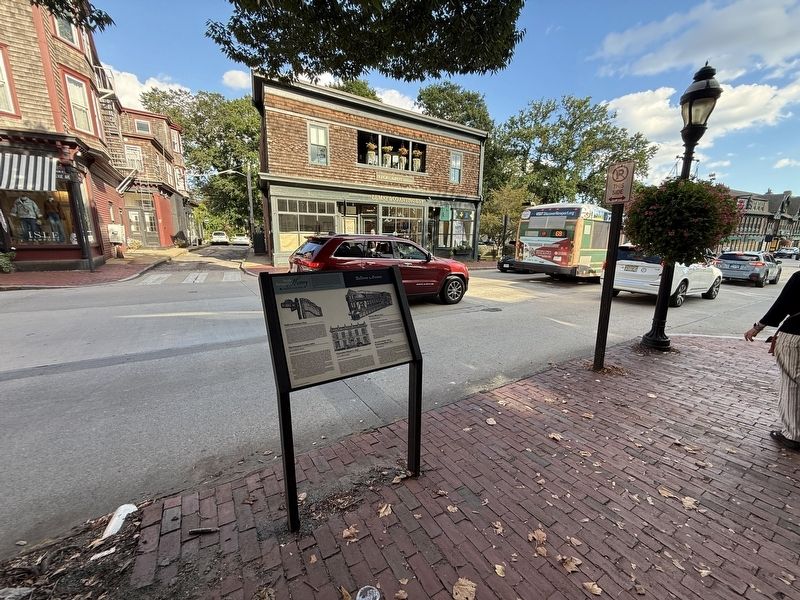
Location. 41° 29.048′ N, 71° 18.517′ W. Marker is in Newport, Rhode Island, in Newport County. It is on Bellevue Avenue north of John Street, on the right when traveling south. Touch for map. Marker is at or near this postal address: 138 Bellevue Ave, Newport RI 02840, United States of America. Touch for directions.

Regionally, this marker is on Narragansett Bay and in Newport and Aquidneck Island. It is also in the American Northeast, in New England, and on the Eastern Seaboard. Globally, it is in the North Atlantic Region, North America, the Western Hemisphere, the Western World, and the Anglosphere. Historically, it finds itself in what was once one of the original Thirteen Colonies.
Other nearby markers. At least 8 other markers are within walking distance of this marker: Christopher Columbus (within shouting distance of this marker); Touro Park (about 400 feet away, measured in a direct line); International Tennis Hall of Fame (about 500 feet away); The Newport Casino & Its Neighors: Commercial Development (about 500 feet away); The League of American Wheelmen (about 500 feet away); James Henry "Jimmy" Van Allen (about 500 feet away); The 2012 Shimoda Tomodachi Declaration (about 600 feet away); Matthew Perry Monument (about 600 feet away). Touch for a list and map of all markers in Newport.
Other markers no longer nearby. Bellevue Ave. at John St. (was here, next to this marker but has been replaced with another marker now near it); a different marker also named Touro Park (was about 400 feet away but has been replaced with another marker now near it); a different marker also named International Tennis Hall of Fame (was about 500 feet away but has been replaced with another marker now near it); a different marker also named International Tennis Hall of Fame (was about 500 feet away but has been replaced with another marker now near it).
Credits. This page was last revised on September 27, 2026. It was originally submitted on September 27, 2026, by Devry Becker Jones of Washington, District of Columbia. This page has been viewed 5 times since then. Photos: 1, 2. submitted on September 27, 2026, by Devry Becker Jones of Washington, District of Columbia.
