Whitchurch in Shropshire, England, United Kingdom — Northwestern Europe (the British Isles)
Welcome to Whitchurch
Photographed by Ray Gurganus, May 18, 2026
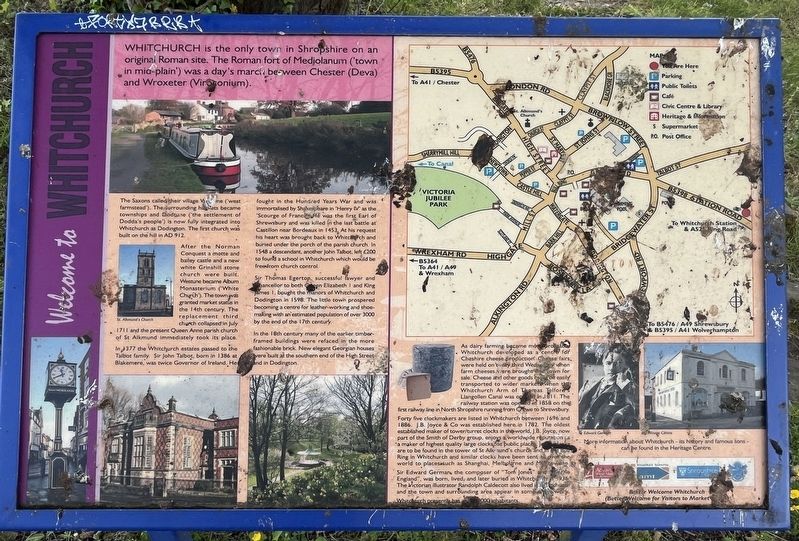
1. Welcome to Whitchurch Marker
The Saxons called their village Westune ('west farmstead'). The surrounding hamlets became townships and Dodtune ('the settlement of Dodda's people') is now fully integrated in Whitchurch Dodington. The first church was built on the hill in AD 912.
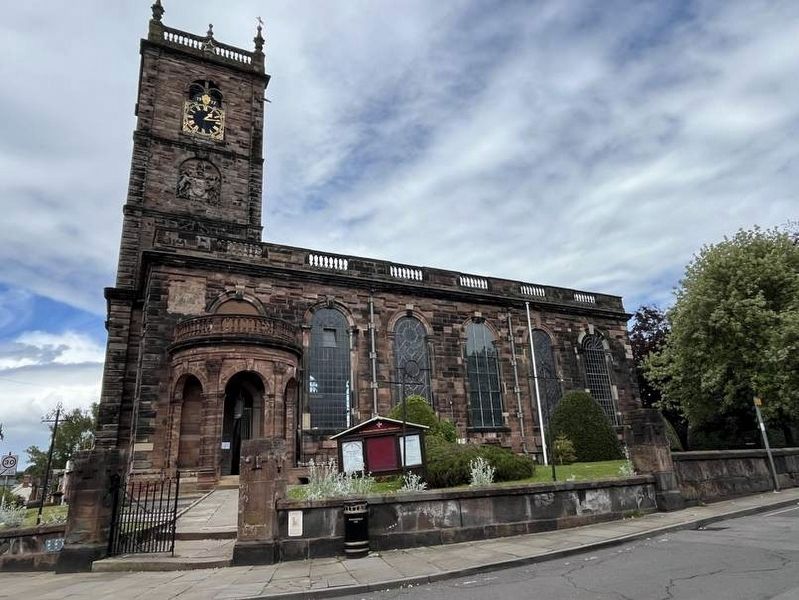
After the Norman Conquest a motte and bailey castle and a new white Grinshill stone church were built. Westune became Album Monasterium ('White Church'). The town was granted market status in the 14th century. The replacement third church collapsed in July 1711 and the present Queen Anne parish church of St Alkmund immediately took its place.
In 1377 the Whitchurch estates passed to the To family John Talbot, born in 1386 at Blakemere, was twice Governor of Ireland. He fought in the Hundred Years War and was immortalised by Shakespeare in 'Henry IV' as the 'Scourge of France'. He was the first Earl of Shrewsbury and was killed in the last battle at Castillon near Bordeaux in 1453. At
this page online
Sir Thomas Egerton, successful lawyer and chancellor to both Queen Elizabeth I and King James I, bought the manors of Whitchurch and Dodington in 1598. The town prospered becoming a centre for leather-working and shoe making with an estimated population of over 3000 by the end of the 17th century.
In the 18th century many of the earlier timber-framed buildings were refaced in the more fashionable brick. New elegant Georgian houses were built at the southern end of the High Street and in Dodington.
As dairy farming became more profitable, Whitchurch developed as a centre for Cheshire cheese production. Cheese fairs were held on every third Wednesday when farm cheeses are brought into town for sale. Cheese and other goods could be easily transported to wider markets when the Whitchurch Arm of Thomas Telford's Llangollen Canal was opened in 1811. The railway station was opened in 1858 on the first railway
Photographed by Ray Gurganus, May 18, 2026
2. Church of St Alkmund
Forty five clockmakers are listed in Whitchurch between 1696 and 1886. J.B. Joyce & Co was established here 1782. The oldest established maker of tower/turret clocks in the world, J.B. Joyce, now part of the Smith of Derby group, enjoys a worldwide reputation as a maker of highest quality large clocks for public places. Joyce Clocks are to be found in the tower of St Alkmund's church and in the Bull Ring in Whitchurch and similar clocks have been sent world to places such as Shanghai, Melbourne and Montevideo.
Sir Edward German, the composer of ‘Tom Jones’ and ‘Merrie England’ was born born, lived, and later buried in Whitchurch in 1936. The Victorian illustrator Randolph Caldecott also lived in Whitchurch and the town and surrounding area appear in some of his work.
Topics. This historical marker is listed in these topic lists: Industry & Commerce • Settlements & Settlers.
Location. 52° 58.054′ N, 2° 40.326′ W. Marker is in Whitchurch, England, in Shropshire. It is on Waymills. The marker is located some 30 meters south of the entrance to the railway station, just as one enters/exits the car park. Touch for map. Marker is at or near this postal address: 4 Waymills, Whitchurch, England SY13 1RL, United Kingdom. Touch for directions.

Regionally, this marker is in the Midlands. It is also on the British Marches. Globally, it is on the Atlantic Ocean, in the North Atlantic Region, in Europe, in Atlantic Europe, on one of the British Isles, in the Western World, and in the Anglosphere. Historically, it finds itself in what was once the Roman Empire.
Other nearby markers. At least 6 other markers are within 16 kilometers of this marker, measured as the crow flies: Walks around Whitchurch (within shouting distance of this marker); History on the Spot (approx. 0.8 kilometers away); Life in 18th & 19th century Whitchurch (approx. 0.8 kilometers away); a different marker also named History on the Spot (approx. 0.9 kilometers away); Whitchurch Road Cemetery (approx. 12.2 kilometers away); The Great Church of St Mary's (approx. 15 kilometers away).
Credits. This page was last revised on September 29, 2026. It was originally submitted on September 27, 2026, by Ray Gurganus of Washington, District of Columbia. This page has been viewed 4 times since then. Photos: 1, 2. submitted on September 27, 2026, by Ray Gurganus of Washington, District of Columbia. • Andrew Ruppenstein was the editor who published this page.
Editor’s want-list for this marker. photo of the marker within its surroundings • Can you help?
