Jasper, Alberta — Canada’s Prairie Region (North America)
Railway Ties
⎯⎯⎯
Petit train va loin
| — | Jasper Discovery Trail / Sentier de la découverte-de-Jasper | — |
Photographed by Cosmos Mariner, July 5, 2022
1. Railway Ties / Petit train va loin Marker

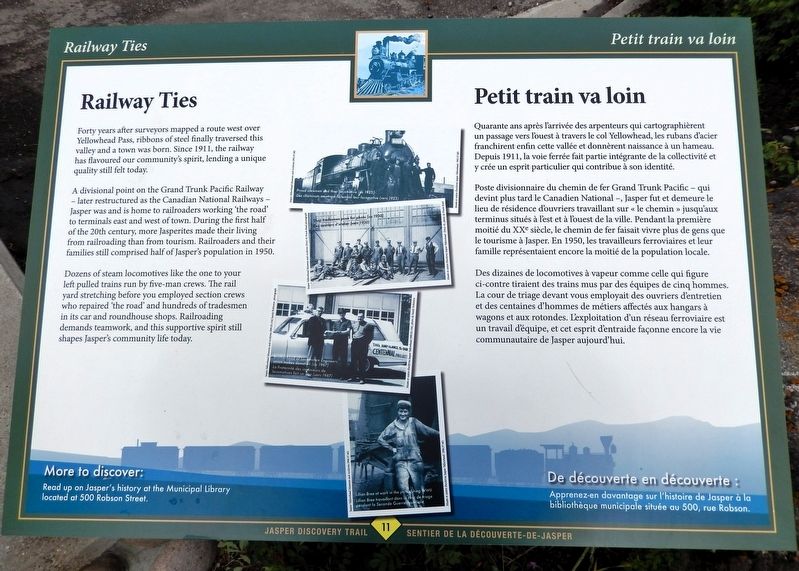
Forty years after surveyors mapped a route west over Yellowhead Pass, ribbons of steel finally traversed this valley and a town was born. Since 1911, the railway has flavoured our community's spirit, lending a unique quality still felt today.
A divisional point on the Grand Trunk Pacific Railway — later restructured as the Canadian National Railways — Jasper was and is home to railroaders working ‘the road’ to terminals east and west of town. During the first half of the 20th century, more Jasperites made their living from railroading than from tourism. Railroaders and their families still comprised half of Jasper's population in 1950.
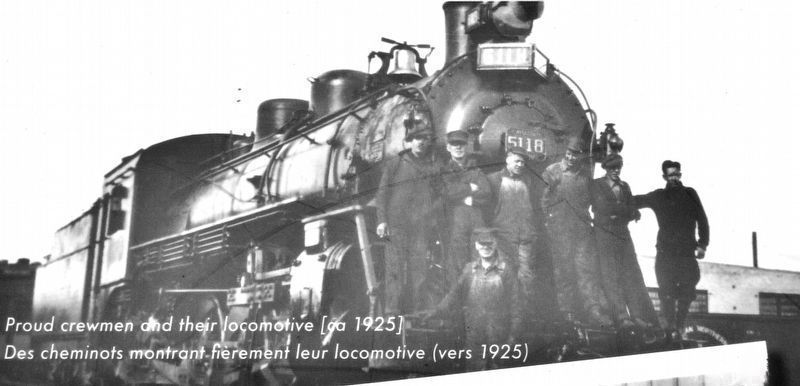
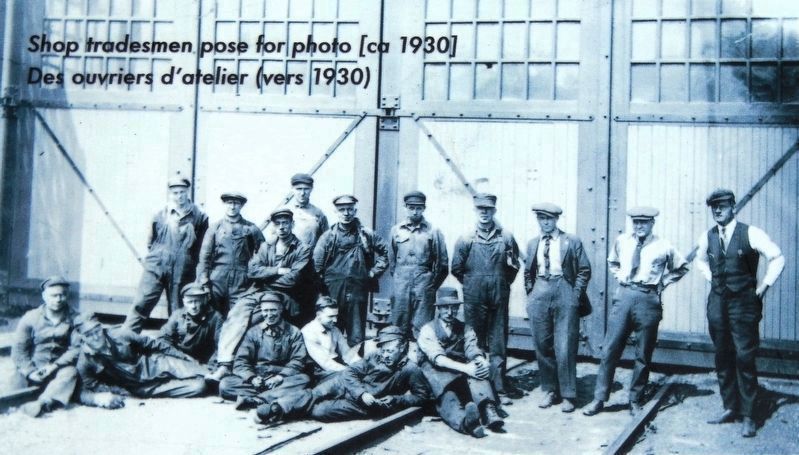
Dozens of steam locomotives like the one to your left pulled trains run by five-man crews. The rail yard stretching before you employed section crews who repaired 'the road' and hundreds of tradesmen in its car and roundhouse shops. Railroading demands teamwork, and this supportive spirit still shapes Jasper's community life today.
More to discover: Read up on Jasper’s history at the Municipal Library located at 500 Robson Street.
Quarante ans après l'arrivée
this page online
Poste divisionnaire du chemin de fer Grand Trunk Pacific - qui devint plus tard le Canadien National -, Jasper fut et demeure le lieu de résidence d'ouvriers travaillant sur « le chemin » jusqu'aux terminus situés à l'est et à l'ouest de la ville. Pendant la première moitié du XXe siècle, le chemin de fer faisait vivre plus de gens que le tourisme à Jasper. En 1950, les travailleurs ferroviaires et leur famille représentaient encore la moitié de la population locale.
Des dizaines de locomotives à vapeur comme celle qui figure ci-contre tiraient des trains mus par des équipes de cinq hommes. La cour de triage devant vous employait des ouvriers d'entretien et des centaines d'hommes de métiers affectés aux hangars à wagons et aux rotondes. L’exploitation d'un réseau ferroviaire est un travail d'équipe, et cet esprit d'entraide façonne
Jasper-Yellowhead Museum and Archives (993.37.68)
2. Marker detail: Proud crewmen and locomotive (ca 1925)
Des cheminots montrant fièrement locomotive (vers 1925)
De découverte en découverte : Apprenez-en davantage sur l’histoire de Jasper a la bibliothèque municipale située au 500, rue Robson.
Erected by Jasper Discovery Trail / Sentier de la découverte-de-Jasper. (Marker Number 11.)
Topics. This historical marker is listed in these topic lists: Industry & Commerce • Railroads & Streetcars • Settlements & Settlers. A significant historical year for this entry is 1911.
Location. 52° 52.454′ N, 118° 4.847′ W. Marker is in Jasper, Alberta. It is on Connaught Drive just north of Hazel Avenue, on the right when traveling north. The marker is beside the sidewalk near the Jasper public parking lot. Touch for map. Marker is at or near this postal address: 607 Connaught Drive, Jasper AB T0E 0A8, Canada. Touch for directions.

Regionally, this marker is in the Canadian Rockies. It is also in the Prairies. Globally, it is in North America, the Rocky Mountains, the Western Hemisphere, the Western World, and the Anglosphere. Historically, it finds itself in what was once a British colony and also Rupert’s Land.
Other nearby markers. At
Jasper-Yellowhead Museum and Archives (PA41-6), Frank Reed photograph
3. Marker detail: Shop tradesmen pose for photo (ca 1930)
Des ouvriers d’atelier (vers 1930)
Also see . . .
1. Jasper, Alberta (Wikipedia).
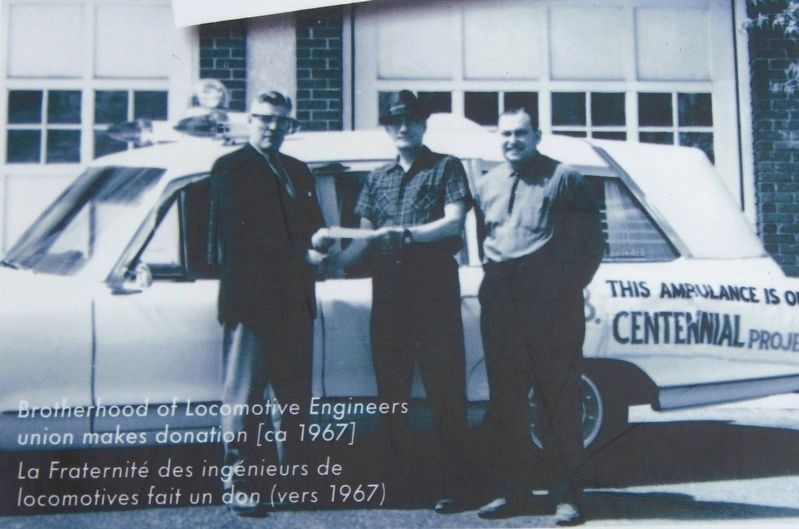
Excerpt: Established in 1813, Jasper House was first a fur trade outpost of the North West Company, and later Hudson's Bay Company, on the York Factory Express trade route to what was then(Submitted on September 29, 2026, by Cosmos Mariner of Cape Canaveral, Florida.)called “New Caledonia” (now British Columbia) and Fort Vancouver on the lower Columbia River. Jasper House was 35 km north of today's town of Jasper.Jasper-Yellowhead Museum and Archives (999.03.154), Sandy Robinson photograph4. Marker detail: Brotherhood of Locomotive Engineers union makes donation (ca 1967)La Fraternité des ingénieurs de locomotives fait un don (vers 1967)
The railway divisional point at the location of the future townsite was established by the Grand Trunk Pacific Railway in 1911 and originally named Fitzhugh after a Grand Trunk vice president (along the Grand Trunk's “alphabet” line). The Canadian Northern Railway began service to its Jasper Park station in 1912, about 700 m from GTP's Fitzhugh station. The townsite was surveyed in 1913 by H. Matheson. It was renamed Jasper after the former fur trade post.
2. Jasper station (Wikipedia).
Excerpt: By 1913 both the Grand Trunk and the Canadian Northern Railway called on Jasper. By 1923 the CNoR and the GTPR were taken oven by the Canadian government and merged into the Canadian National Railway, which continued to use the old GTPR station until it burned down during the winter of 1924–25. The current station was constructed by the CNR in 1926.(Submitted on September 29, 2026, by Cosmos Mariner of Cape Canaveral, Florida.)
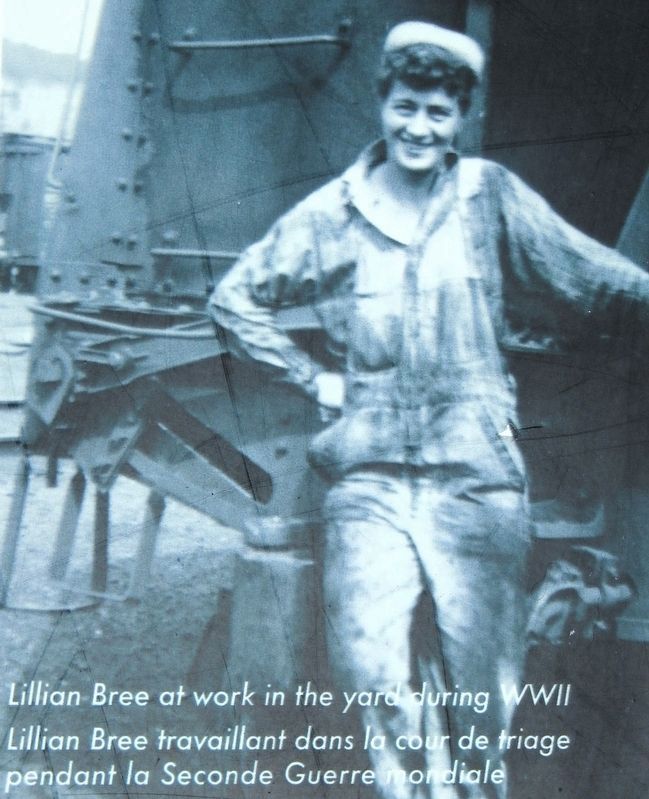
Jasper-Yellowhead Museum and Archives (996.37.40)
5. Marker detail: Lillian Bree at work in the yard during WWII.
Lillian Bree travaillant dans la cour de triage pendant la Seconde Guerre mondiale.
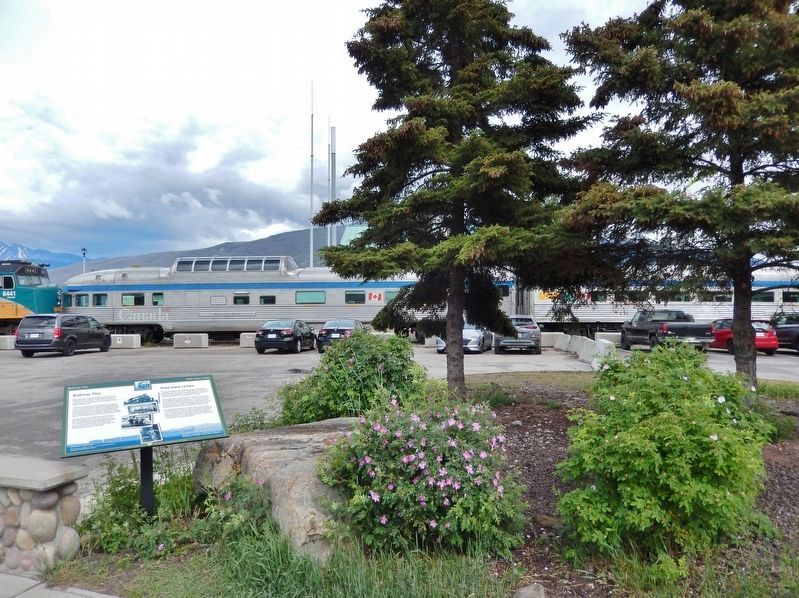
Photographed by Cosmos Mariner, July 5, 2022
6. Railway Ties / Petit train va loin Marker
Looking east from Connaught Drive. The marker is beside the sidewalk in front of the Jasper public parking lot — formerly the rail yard.
Credits. This page was last revised on September 29, 2026. It was originally submitted on September 29, 2026, by Cosmos Mariner of Cape Canaveral, Florida. This page has been viewed 3 times since then. Photos: 1, 2, 3, 4, 5, 6. submitted on September 29, 2026, by Cosmos Mariner of Cape Canaveral, Florida.
