Kershaw in Lancaster County, South Carolina — The American South (South Atlantic)
Bank of Kershaw
Photographed by Ronald Patton
1. Bank of Kershaw Marker
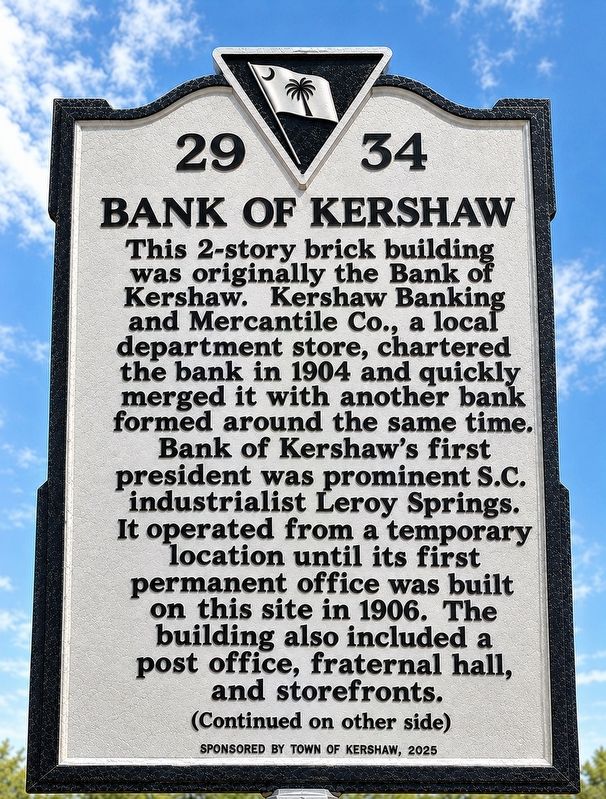
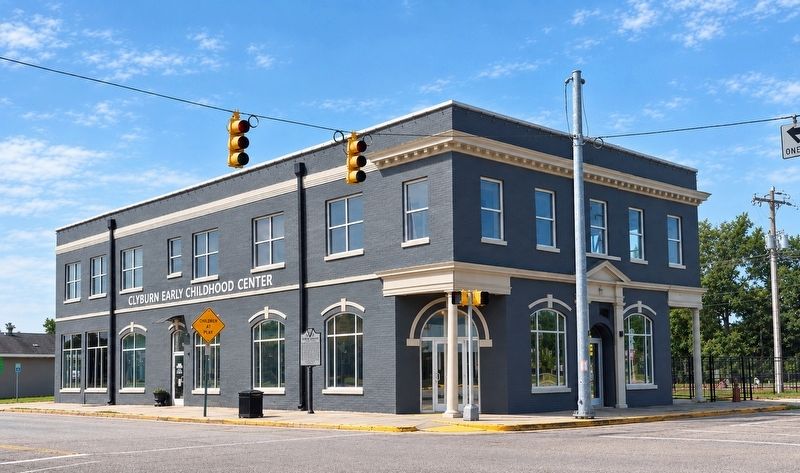
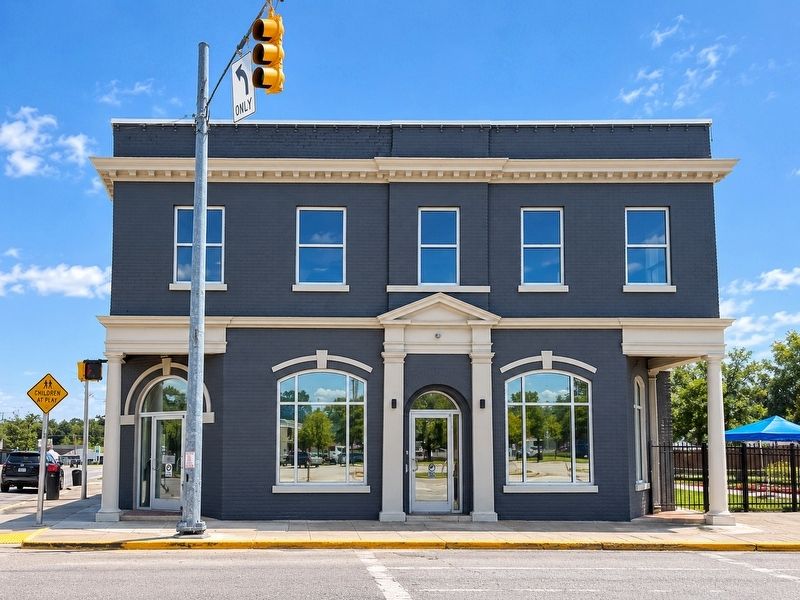
This 2-story brick building was originally the Bank of Kershaw. Kershaw Banking and Mercantile Co., a local department store, chartered the bank in 1904 and quickly merged it with another bank formed around the same time. Bank of Kershaw's first president was prominent S.C. industrialist Leroy Springs. It operated from a temporary location until its first permanent office was built on this site in 1906. The building also included a post office, fraternal hall, and storefronts.
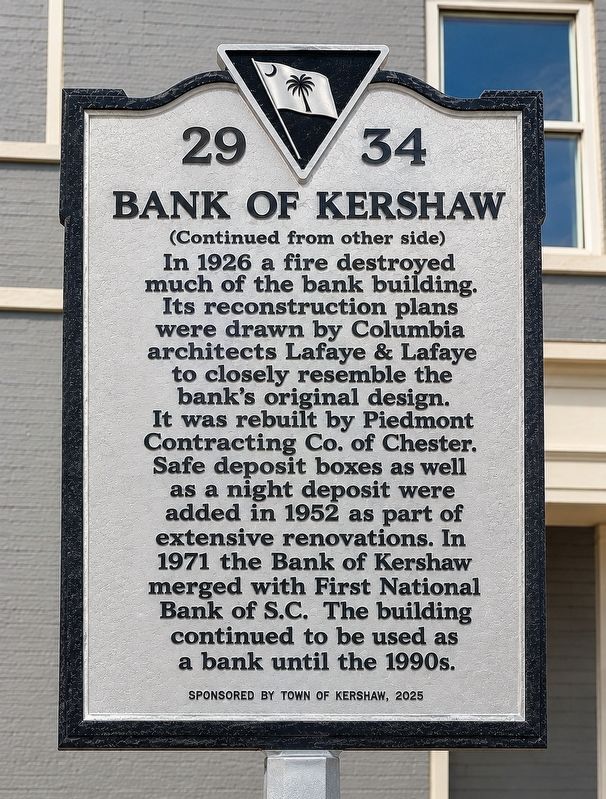
In 1926 a fire destroyed much of the bank building. Its reconstruction plans were drawn by Columbia architects Lafaye & Lafaye to closely resemble the bank's original design. It was rebuilt by Piedmont Contracting Co. of Chester. Safe deposit boxes as well as a night deposit were added in 1952 as part of extensive renovations. In 1971 the Bank of Kershaw merged with First National Bank of S.C. The building continued to be used as a bank until the 1990s.
Erected 2025 by Town of Kershaw. (Marker Number 29-34.)
Topics. This historical marker is listed in this topic list: Industry & Commerce. A significant historical year for this entry is 1904.
Location. 34° 32.871′ N,
this page online

Regionally, this marker is in the Midlands and in the Olde English District. It is also in the American South and specifically in the Deep South. Globally, it is in North America, the Western Hemisphere, the Western World, and the Anglosphere. Historically, it finds itself in what was once the territory of the Mississippian Culture, one of the original Thirteen Colonies, one of the Confederate States of America, and the Antebellum South.
Other nearby markers. At least 8 other markers are within 6 miles of this marker, measured as the crow flies: Kershaw (within shouting distance of this marker); Welsh's Station / Kershaw Depot (within shouting distance of this marker); Kershaw's First Library (within shouting distance of this marker);
Photographed by Ronald Patton, September 1, 2026
2. Bank of Kershaw Marker
Regarding Bank of Kershaw. The bank was organized in March 1904 with $50,000 in capital. Its first president was prominent South Carolina businessman and industrialist Leroy Springs. John T. Stevens was vice-president, and T. B. Clyburn was cashier.
The connection to Leroy Springs is especially significant. Springs was a major Lancaster County businessman who was involved in banking, cotton mills, railroads and other enterprises. He had already organized the Kershaw Mercantile & Banking Company in 1888, so the 1904 Bank of Kershaw grew out of an established local business network.
The permanent bank building was constructed in 1906. The building wasn’t just a bank—it also contained a post office, fraternal hall and storefronts, making it an important commercial and community building in downtown Kershaw.
Photographed by Ronald Patton
3. Bank of Kershaw Marker
A major fire struck Kershaw on June 1, 1926. The bank building was badly damaged/gutted, along with the railroad freight station, freight warehouse and other downtown businesses. Remarkably, bank employees managed to get almost all of the bank’s records into the inner safe before the fire reached the building.
The building was rebuilt after the fire. Columbia architects Lafaye & Lafaye prepared plans intended to closely reproduce the original appearance, and Piedmont Contracting Co. of Chester carried out the reconstruction.
By 1931, the bank had become a substantial local financial institution. A contemporary newspaper account reported that it had increased its capital stock to $100,000, had paid shareholders $146,000 in dividends, and had accumulated $96,000 in surplus and profits.
1952 brought another major renovation, including the installation of safe-deposit boxes and a night-deposit facility.
In 1971 the Bank of Kershaw merged with First National Bank of South Carolina. Federal banking records at the time described the Bank of Kershaw as having approximately $7.6 million in deposits and serving a primary area of about
Photographed by Ronald Patton
4. Bank of Kershaw Marker
The historic building continued to function as a bank into the 1990s, making its banking history span roughly nine decades.
Credits. This page was last revised on October 2, 2026. It was originally submitted on September 30, 2026, by Ronald Patton of Lancaster, South Carolina. This page has been viewed 10 times since then. Photos: 1, 2, 3, 4. submitted on September 30, 2026, by Ronald Patton of Lancaster, South Carolina. • Devry Becker Jones was the editor who published this page.
Editor’s want-list for this marker. Source for the information in Regarding Bank of Kershaw. • Can you help?
