Mayview in Colton in Whitman County, Washington — The American West (Northwest)
A Constant Search for Food

Photographed by Barry Swackhamer, June 15, 2026
1. A Constant Search for Food Marker
"we can kill no game in these plains"
Finding food for 33 people was a constant challenge for the Lewis and Clark Expedition. During fall 1805 and spring 1806 when the explorers passed through this region, they had a difficult time finding game. On a good day the hunters might bring in some ducks, geese, or grouse, but sightings of deer, elk, and other big game were rare.
Fortunately, the Nimiipuu, ('the people") or Nez Perce and other tribes were willing to provide food to the Expedition as gifts and in trade. Native people had an abundance of food to share with the explorers, including meats from fish, deer, elk, horses, dogs and other animals, and various berries and roots.
How Much is that Doggie?
For hundreds of years dogs were beasts of burden and companions to Snake River tribes. Native people did not eat dogs and often were astonished by the Expedition's appetite for them. The explorers purchased as many as 40 dogs a day if willing sellers could be found. Patrick Gass wrote, "Most of our people having been accustomed to meat, do not relish the fish, but prefer dog meat; which, when cooked , tastes very well."
this page online
"we came to a fishing Camp ...where we bought considerable quantity of Sammon, and 8 or 10 fat dogs to eat ... Camped at a fishing Camp of Indias on the 'S Side where we bought 2 or 4 more dogs and Some Sammon &c."
Joseph Whitehouse
Finding Food
"here we dined, and for the first time for three weeks past I had a good diner of Blue wing Teal."
William Clark, October 14, 1805
"Some of the men went out and killed three geese Several ducks."
Joseph Whitehouse, October 15, 1805
"eat the last of our dried meat; and are altogether without other previsions, as our stock of dogs is exhausted, and we can kill no game in these plains."
Patrick Gass, May 4, 1806
"we had ... a dog ...but this was a scanty allowance for thirty odd hungry men."
Patrick Gass, May 4, 1806
Wawáwii
The placename "Wawáwii" may relate to the early use of this area by Nimiipuu, (Nez Perce), Palus (Palouse), and other tribes as a gathering place. Loosely translated, "Wawáwii" may mean "council ground" or "place of talking" in some local native dialects. Another translation comes from the Nimiipuu
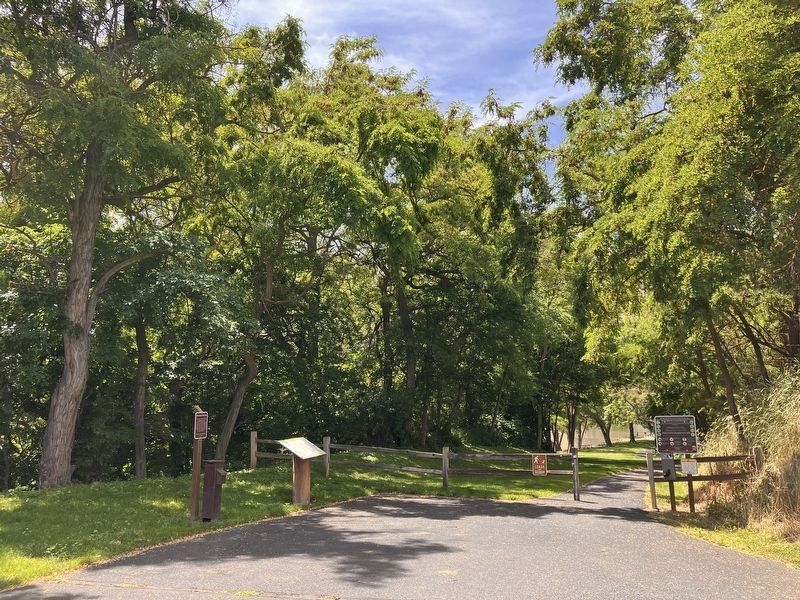
Photographed by Barry Swackhamer, June 15, 2026
2. A Constant Search for Food Marker
Erected by Washington Lewis & Clark Expedition Bicentennial Commission.
Topics. This historical marker is listed in these topic lists: Animals • Exploration.
Location. 46° 38.18′ N, 117° 22.499′ W. Marker is in Colton, Washington, in Whitman County. It is in Mayview. It can be reached from Wawawai Grade Road near Wawawai Road. The markers is located in Wawawai County Park. Touch for map. Marker is in this post office area: Colton WA 99113, United States of America. Touch for directions.

Regionally, this marker is in the Palouse and in Greater Spokane. It is also in the American Mountain West and in the Lewis & Clark Corridor. Globally, it is in North America, on the Pacific Rim, in the Western Hemisphere, in the Western World, and in the Anglosphere.
Other nearby markers. At least 5 other markers are within 14 miles of this marker, measured as the crow flies: Wild Snake River (approx. 7.3 miles away); History of the Greystone Church (approx. 11½ miles away); Ancient Crossroads (approx. 12.8 miles away); "the Soil is extreamly fertile" (approx. 14.1 miles away); Lewis and Clark Expedition (approx. 14.1 miles away).
Regarding A Constant Search for Food. This marker is located in Wawawai County Park
Additional keywords. Food
Credits. This page was last revised on September 30, 2026. It was originally submitted on September 30, 2026, by Barry Swackhamer of Brentwood, California. This page has been viewed 4 times since then. Photos: 1, 2. submitted on September 30, 2026, by Barry Swackhamer of Brentwood, California.
