Jasper, Alberta — Canada’s Prairie Region (North America)
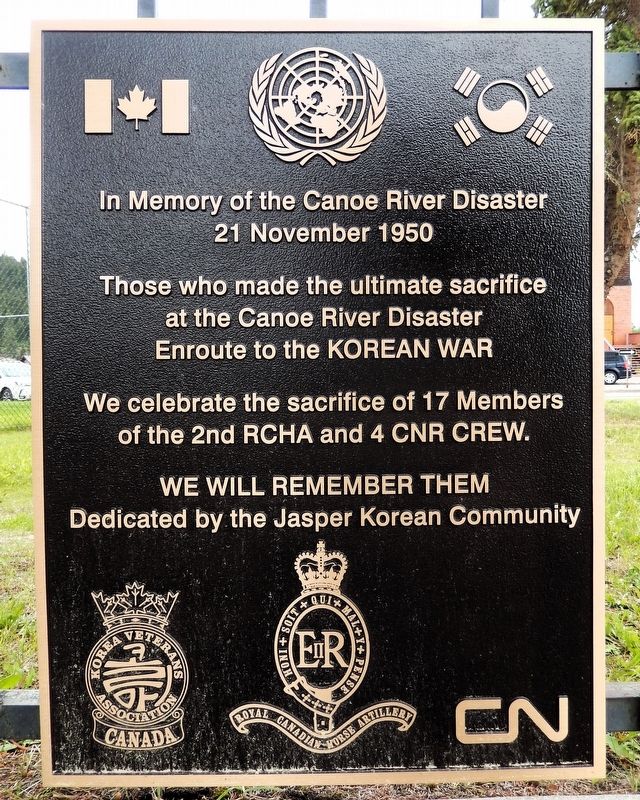
In Memory of the Canoe River Disaster
21 November 1950
Photographed by Cosmos Mariner, July 5, 2022
1. In Memory of the Canoe River Disaster Marker
at the Canoe River Disaster
enroute to the Korean War
We celebrate the sacrifice of 17 members
of the 2nd RCHA and 4 CNR crew.
We will remember them
Dedicated by the Jasper Korean Community
Korea Veterans Association of Canada
Royal Canadian Horse Artillery
Canadian National Railway
Erected by The Jasper Korean Community.
Topics. This memorial is listed in these topic lists: Disasters • Railroads & Streetcars • War, Korean. A significant historical date for this entry is November 21, 1950.
Location. 52° 52.751′ N, 118° 4.929′ W. Memorial is in Jasper, Alberta. It is at the intersection of Geikie Street and Pyramid Lake Road, on the left when traveling north on Geikie Street. The marker is near the northeast corner of Commemoration Park. Touch for map. Memorial is at or near this postal address: 301 Pyramid Lake Road, Jasper AB T0E 0A8, Canada. Touch for directions.

Regionally, this memorial is in the Canadian Rockies. It is also in the Prairies. Globally, it is in North America, the Rocky Mountains, the Western Hemisphere, the Western World, and the Anglosphere. Historically,
this page online
Other nearby markers. At least 8 other markers are within walking distance of this marker: Korean War (here, next to this marker); In Honoured Memory of Those Who Paid the Supreme Sacrifice (here, next to this marker); Jasper School District No. 3063/District scolaire 3063 de Jasper (about 180 meters away, measured in a direct line); The First Recorded North West Mounted Police Patrol in this Valley (about 210 meters away); First People / Les premiers habitants (about 240 meters away); Memories of Home / Souvenirs d'un lieu de résidence / Weekiwawoo isitapatamook (approx. 0.2 kilometers away); The First Homesteaders / Les premiers homesteaders / Nistum Oota Ka Ki Weekichik (approx. 0.2 kilometers away); A Lasting Legacy / Un legs durable / Aniskoonamakewin (approx. 0.2 kilometers away). Touch for a list and map of all markers in Jasper.
Also see . . .
1. Canoe River train crash (Wikipedia).
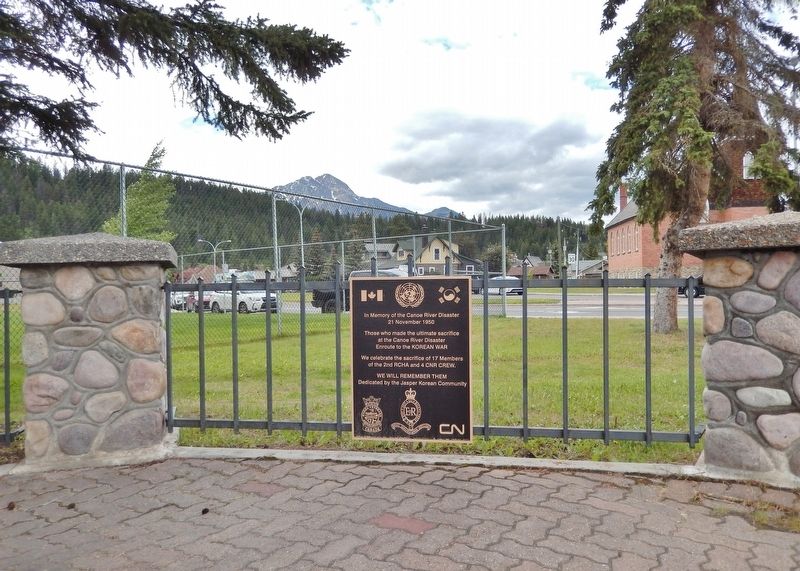
Excerpt: The Canoe River train crash occurred on November 21, 1950, near Valemount in eastern British Columbia, Canada, when a westbound troop train and the(Submitted on October 3, 2026, by Cosmos Mariner of Cape Canaveral, Florida.)eastbound Canadian National Railway (CNR) Continental Limited collided head-on. The collision killed 21 people: 17 Canadian soldiers en route to the Korean War and the two-man locomotive crew of each train.Photographed by Cosmos Mariner, July 5, 20222. In Memory of the Canoe River Disaster MarkerLooking north from the northeast corner of Commemoration Park. Pyramid Lake Road is in the background.
The post-crash investigation found that the order given to the troop train differed from the intended message. Crucial words were missing, causing the troop train to proceed on its way rather than halt on a siding, resulting in the collision. A telegraph operator, Alfred John “Jack” Atherton, was charged with manslaughter; the Crown alleged that he was negligent in passing an incomplete message. His family hired his Member of Parliament, John Diefenbaker, as defence counsel. Diefenbaker joined the British Columbia bar to take the case, and obtained Atherton's acquittal.
After the accident, the CNR installed block signals on the stretch of track on which the crash occurred. The railway later realigned its main line in that area, eliminating a sharp curve that had prevented crews from seeing oncoming trains. Diefenbaker's successful defence of Atherton became an asset in his political rise. A number of monuments honour the dead.
2. Diefenbaker and the Canoe River Wreck (Colin Churcher's Railway Pages).
(By Bob Meldrum) : Excerpt: On November 21, 1950, at 10:35 in the morning, there was a terrible accident on the Canadian National main line 312 miles west of Edmonton. A 17-car westbound troop tram carrying 340 soldiers crossed a long trestle over a 500-foot mountain gorge. Just east of the hamlet called Canoe River, British Columbia, the troop train entered a long sweeping uphill curve. At the same time, an eastbound transcontinental express banked into the same curve.(Submitted on October 3, 2026, by Cosmos Mariner of Cape Canaveral, Florida.)
In the ensuing crash, the engine of the army train was tossed up and back onto the coaches immediately behind it. The wooden coaches filled with soldiers buckled like cordwood. Twenty-one men died in the wreck including four whose remains were never found. Seventy were injured including many who were hurt by the scalding steam.
On May 9, 1951, a manslaughter trial opened in Prince George, British Columbia. There, a 22-year-old CNR telegrapher named Alfred Atherton was accused of causing the wreck because he had allegedly sent an incomplete message to the westbound train. John Diefenbaker (who went on to be the thirteenth Canadian prime minister) was Atherton's lawyer.
Credits. This page was last revised on October 3, 2026. It was originally submitted on September 30, 2026, by Cosmos Mariner of Cape Canaveral, Florida. This page has been viewed 6 times since then. Photos: 1, 2. submitted on October 3, 2026, by Cosmos Mariner of Cape Canaveral, Florida.
