Olathe in Johnson County, Kansas — The American Midwest (Upper Plains)
The Four Chaplains
Photographed by Jason Voigt, September 21, 2026
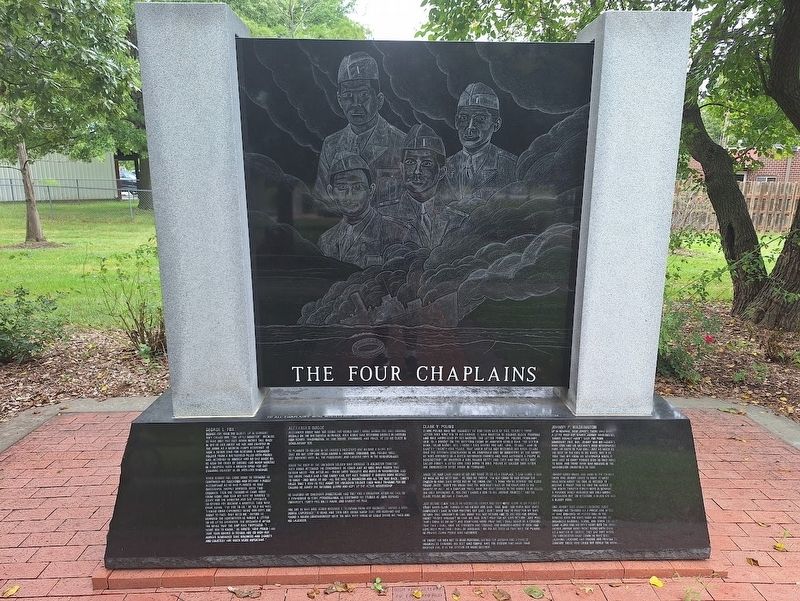
1. The Four Chaplains Marker
Front, top of base:
To all chaplains who ministered to those men and women who stood in harms way as sentinels of our freedom
Front, on base:
George L. Fox
George Fox was the oldest. Up in Vermont they called him "the Little Minister" because he was only five feet seven inches tall. Back in 1917 he lied about his age and enlisted in the army as a medical corps assistant. He won a Silver Star for rescuing a wounded soldier from a battlefield filled with poison gas. Although he himself had no gas mask on, he won the Croix de Guerre -- and many months in a hospital with a broken spine for outstanding bravery in an artillery barrage.
When George Fox came home to Vermont he continued his education and became a public accountant as he had planned. He was successful, happily married, with two children. Then one evening he came home from work and told his wife he wanted to study for the ministry and she approved. So George Fox became a minister. Then war came again. "I've got to go," he told his wife. "I know from experience what our boys are about to face. They need me." Before he boarded the Dorchester he wrote a letter
this page online
Alexander Goode
Alexander Goode was too young for World War I while George Fox was winning medals on the battlefield in France. Alex Good was receiving medals in Eastern High School, Washington, DC, for tennis, swimming, and track. He led his class in scholarship too.
He planned to follow in his father's footsteps and become a rabbi. But that did not keep him from having a laughing, shouting, hail-fell-well met boyhood with all the protestant and catholic boys in the neighborhood.
When the body of the Unknown Soldier was brought to Arlington Cemetery, Alex Goode attended the ceremonies. He could just as well have ridden that fifteen miles -- for after all -- there were trolleys and buses in Washington, and the Goode family hada fine family car, but Alex thought it showed more respect to walk-- and walk he did--all the way to Arlington and all the way back…thirty miles. That's
Photographed by Jason Voigt, September 21, 2026
2. The Four Chaplains Marker
reverse side
He married his childhood sweetheart and they had a daughter. After his call to a synagogue in York, Pennsylvania, he continued his studies at John Hopkins University, forty-five miles away, and earned his Ph.D.
One day in 1943 Mrs. Goode received a telegram from her husband…"Having a wonderful experience." it read, and then Mrs. Goode knew that her husband had found a warm companionship with the men with whom he could share his faith and his laughter.
Clark V. Poling
Clark Poling was the youngest of our four men of God. Clark's first letter was written to his father. It was written in square block printing and was addressed by his mother. The letter found Dr. Poling, February 1918, in a dugout on the western front of another world war. The letter read, "Dear daddy: Gee, I wish I was where you are. Love, Clark" And in exactly twenty-five years, that eager little boy received his wish. Clark was the seventh generation in an unbroken line of ministers of the gospel. He was ordained in a Dutch
Photographed by Jason Voigt, September 21, 2026
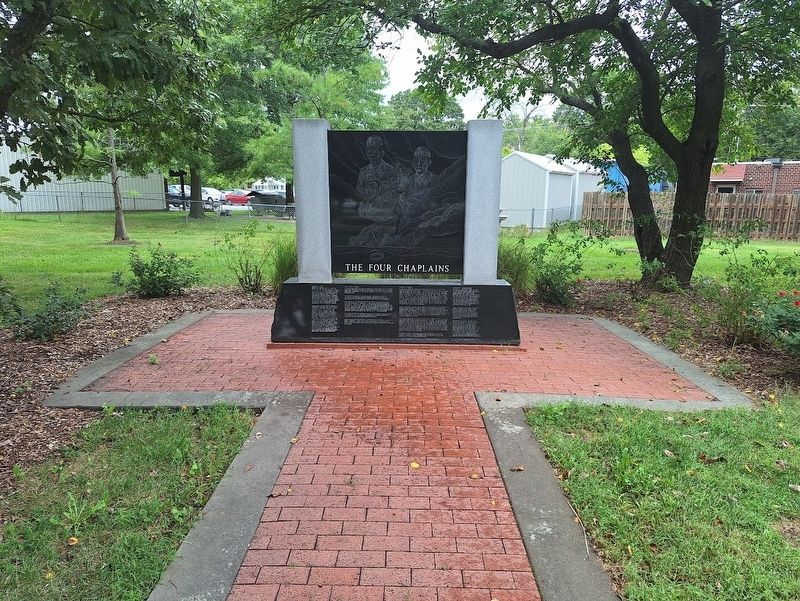
3. The Four Chaplains Marker
Located at Veterans Memorial Park.
When the war came along he did not want to go as a chaplain. "I can carry a gun as well as the next guy," he told his father. "I'm not going to hide behind the church in some safe office out of the firing line." "I think you're scared" the elder Poling joked. "Don't you know that the mortality rate of the chaplains is the highest of all? As a chaplain you'll have the best chance in the world to be killed. The only difference is, you can't carry a gun to kill anyone yourself." And so Clark Poling became a chaplain.
Just before Clark sailed he visited his father and they were alone in Dr. Poling's study when Clark turned to his father and said, "Dad, dad, you know how much confidence I have in your prayers. But dad, I don't want you to pray for my safe return. That wouldn’t be fair. Many will not return and to ask God for special family favors wouldn't be fair. No, Dad, don't pray for my safe return - just pray that I shall do my duty and something more. Pray that I shall never be a coward. Pray that I shall have the strength and courage and understanding of men. And especially pray that I shall be adequate." Dr. Poling tells us that was the prayer he prayed. Clark Poling was adequate.
He taught his men not to bear personal hatred for German and Japanese soldiers or civilians. His text was simple. Hate the system that made your brother evil. It is the system we must destroy.
Johnny P. Washington
Up in Newark, New Jersey, there was once a little Irish boy named Johnny Washington. Things usually aren't easy for poor immigrant folk. But, Johnny and his father's Irish grin and his mother's Irish newspapers. Sure, he liked to play ball, just as much as the rest of the kids in his block. But if he took time off from his newspaper route it was just so many pennies less to take home to mom. And there were nine mouths in the Washington household to feed.
Johnny loved music and sang in the church choir and Johnny loved to fight. It must have been about the time he decided to become a priest that he was the leader of the South Twelfth Street Boys in Newark. A position which required not only moral persuasion but, on occasion, a black eye and a bloody nose.
And Johnny was always laughing, right through his training as a priest and after he was ordained he played ball in the streets with the boys from his parish. He organized baseball teams, and when the war came along and his boys went into the army, Father Johnny went right along with them as a matter of course. They say that when the Dorchester went down he was still laughing and singing and praying to comfort shoe who could not reach the lifeboats.
Reverse:
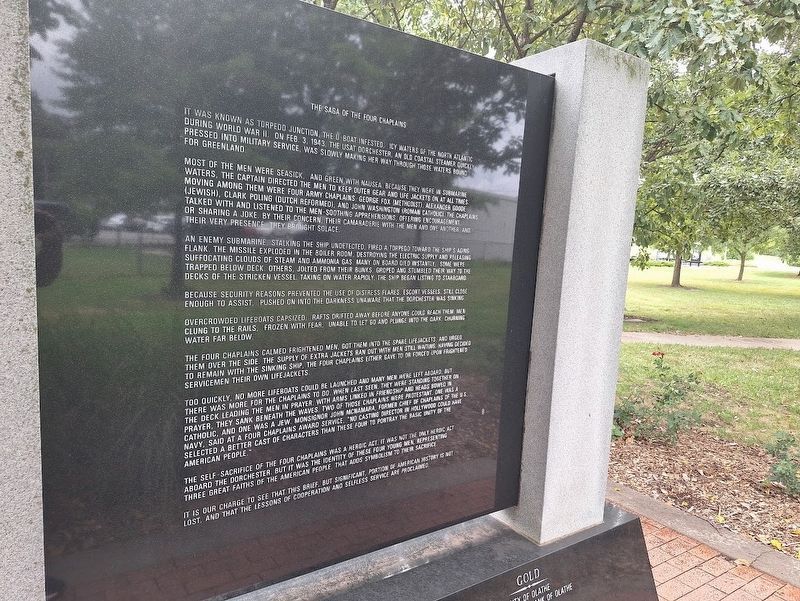
The Saga of the Four Chaplains
It was known as Torpedo Junction, the U-Boat infested, icy waters of the North Atlantic during World War II. On Feb. 3, 1943, the USAT Dorchester, an old coastal steamer quickly pressed into military service, was slowly making her way through those waters bound for Greenland.
Most of the men were seasick, and green with nausea. Because they were in submarine waters, the captain directed the men to keep outer gear and life jackets on at all times moving among them were four army chaplains: George Fox (Methodist), Alexander Goode (Jewish), Clark Poling (Dutch Reformed), and John Washington (Roman Catholic). The chaplains talked with and listened to the men - soothing apprehensions, offering encouragement or sharing a joke. By their concern, their camaraderie with the men and one another, and their very presence. They brought solace.
An enemy submarine, stalking the ship undetected, fired a torpedo toward the ship's aging flank. The missile exploded in the boiler room, destroying the electric supply and releasing suffocating clouds of steam and ammonia gas. Many on board died instantly. Some were trapped below deck. Others, jolted from their bunks, groped and stumbled their way to the decks of the stricken vessel. Taking on water rapidly, the ship began listing to starboard.
Because security reasons prevented the use of distress flares, escort vessels, still close enough to assist, pushed on into the darkness unaware that the Dorchester was sinking.
Overcrowded lifeboats capsized; rafts drifted away before anyone could reach them. Men clung to the rails. Frozen with fear, unable to let go and plunge into the dark, churning water far below.
The four chaplains calmed frightened men, got them into the spare life jackets, and urged them over the side. The supply of extra jackets ran out with men still waiting. Having decided to remain with the sinking ship, the four chaplains either gave to or forced upon frightened servicemen their own lifejackets.
Too quickly, no more lifeboats could be launched and many men were left aboard, but there was more for the chaplains to do. When last seen, they were standing together on the deck leading the men in prayer. With arms linked in friendship and heads bowed in prayer, they sank beneath the waves. Two of those chaplains were Protestant, one was a Catholic, and one was a Jew. Monsignor John McNamara, former chief of chaplains of the U.S. Navy, said at a Four Chaplains award service, "No casting director in Hollywood could have selected a better cast of characters than these four to portray the basic unity of the American people."
The self-sacrifice of the four chaplains was a heroic act. It was not the only heroic act aboard the Dorchester. But it was the identity of these four young men. Representing three great faiths of the American people, that adds symbolism to their sacrifice.
It is our charge to see that this brief, but significant, portion of American history is not lost, and that the lessons of cooperation and selfless service are proclaimed.
Topics and series. This memorial is listed in these topic lists: Religion & Religious Structures • War, World II. In addition, it is included in the The Four Chaplains series list. A significant historical month for this entry is February 1918.
Location. 38° 52.114′ N, 94° 49.023′ W. Memorial is in Olathe, Kansas, in Johnson County. It can be reached from the intersection of South Harrison Street and East Old 56 Highway (Kansas Route 7). Memorial is located at Veterans Memorial Park. Touch for map. Memorial is at or near this postal address: 1025 S Harrison St, Olathe KS 66061, United States of America. Touch for directions.

Regionally, this memorial is in Eastern Kansas and specifically in Greater Kansas City. It is also in the American Midwest, in the Corn Belt, on the prairies, on the Southern Plains, and on the Santa Fe Trail Corridor. Globally, it is in North America, the Western Hemisphere, the Western World, and the Anglosphere. Historically, it finds itself in what was once the Louisiana Purchase.
Other nearby markers. At least 8 other markers are within one mile of this marker, measured as the crow flies: Revolutionary War Patriots (within shouting distance of this marker); Stanley T. Adams (within shouting distance of this marker); Gold Star Families Memorial Monument (within shouting distance of this marker); POW-MIA (within shouting distance of this marker); Children of the Trails (approx. 0.9 miles away); Santa Fe Trail (approx. one mile away); Bicentennial Time Capsule (approx. one mile away); R.R. Osborne Plaza (approx. 1.1 miles away). Touch for a list and map of all markers in Olathe.
Credits. This page was last revised on October 2, 2026. It was originally submitted on October 1, 2026, by Jason Voigt of Glen Carbon, Illinois. This page has been viewed 7 times since then. Photos: 1. submitted on October 1, 2026, by Jason Voigt of Glen Carbon, Illinois. 2, 3. submitted on October 2, 2026, by Jason Voigt of Glen Carbon, Illinois.
