Keystone in Pennington County, South Dakota — The American Midwest (Upper Plains)
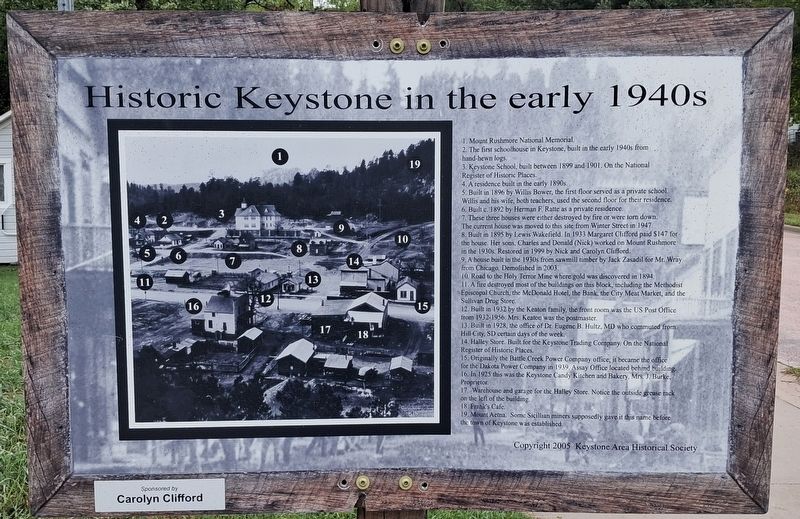
Historic Keystone in the early 1940s
Photographed by William Fischer, Jr., September 21, 2026
1. Historic Keystone in the early 1940s Marker
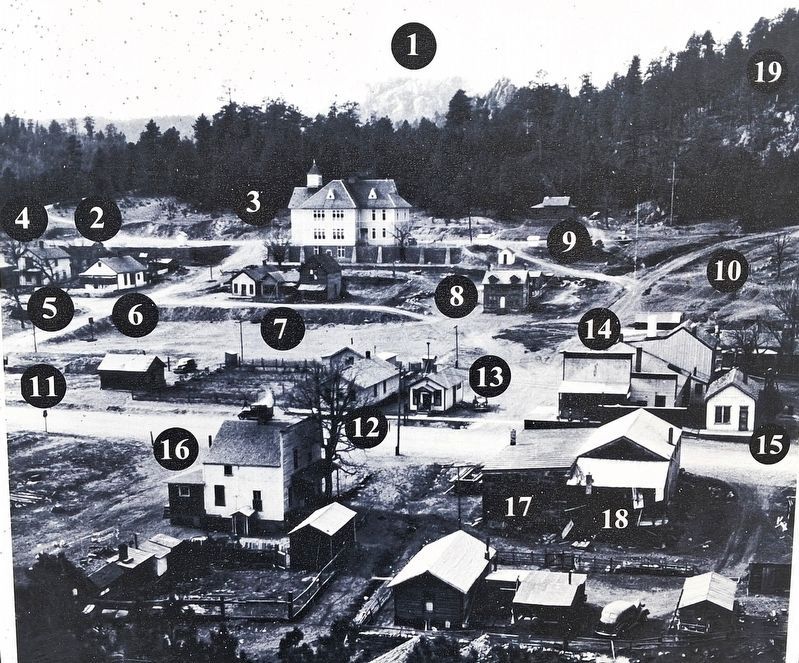
1. Mount Rushmore National Memorial.
2. The first schoolhouse in Keystone, built in the early 1[8]40s from hand-hewn logs.
3. Keystone School, built between 1899 and 1901. On the National Register of Historic Places.
4. A residence built in the early 1890s.
5. Built in 1896 by Willis Bower, the first floor served as a private school. Willis and his wife, both teachers, used the second floor for their residence.
6. Built c. 1892 by Herman F. Ratte as a private residence.
7. These three houses were either destroyed by fire or were torn down.
The current house was moved to this site from Winter Street in 1947.
8. Built in 1895 by Lewis Wakefield. In 1933 Margaret Clifford paid $147 for the house. Her sons, Charles and Donald (Nick) worked on Mount Rushmore in the 1930s. Restored in 1999 by Nick and Carolyn Clifford.
9. A house built in the 1930s from sawmill timber by Jack Zasadil for Mr. Wray from Chicago. Demolished in 2003.
10. Road to the Holy Terror Mine where gold was discovered in 1894.
11. A fire destroyed most of the buildings on this block, including the Methodist Episcopal Church, the McDonald
this page online
12. Built in 1932 by the Keaton family, the front room was the US Post Office from 1932-1956. Mrs. Keaton was the postmaster.
13. Built in 1928, the office of Dr. Eugene B. Hultz, MD who commuted from Hill City, SD certain days of the week.
14. Halley Store. Built for the Keystone Trading Company. On the National Register of Historic Places.
15. Originally the Battle Creek Power Company office, it became the office for the Dakota Power Company in 1939. Assay Office located behind building.
16. In 1925 this was the Keystone Candy Kitchen and Bakery, Mrs. J. Burke, Proprietor.
17. Warehouse and garage for the Halley Store. Notice the outside grease rack on the left of the building.
18. Frank's Cafe.
19. Mount Aetna. Some Sicillian [sic] miners supposedly gave it this name before the town of Keystone was established.
Erected 2005 by Keystone Area Historical Society. (Marker Number 16.)
Topics. This historical marker is listed in this topic list: Settlements & Settlers.
Location. 43° 53.767′ N, 103° 25.189′ W.
Photographed by William Fischer, Jr., September 17, 2026
2. Historic Keystone in the early 1940s Marker
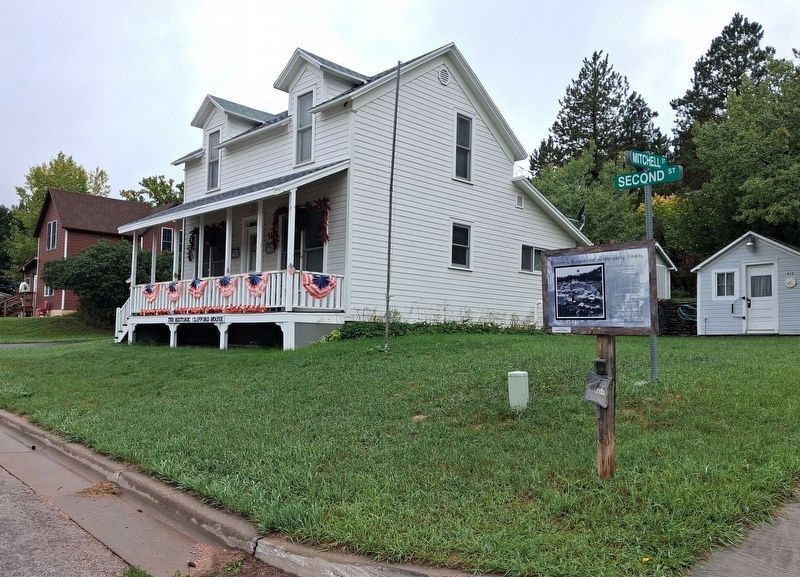
Clifford House (#8 on marker) in background

Regionally, this marker is in West River, in the Badlands, and in Greater Rapid City. It is also in the American Black Hills, in the Lewis & Clark Corridor, on the prairies, and on the Northern Plains. Globally, it is in North America, the Western Hemisphere, the Western World, and the Anglosphere. Historically, it finds itself in what was once Rupert’s Land and also the Louisiana Purchase.
Other nearby markers. At least 8 other markers are within walking distance of this marker: U.S. 4th Cavalry Bivouac (a few steps from this marker); Halley's Store Icehouse (within shouting distance of this marker); Keystone Battle Creek Cultural Center (within shouting distance of this marker); First School (within shouting distance of this marker); Keystone Trading Company/Halley's Store (within shouting distance of
Photographed by Unknown, circa 1940s
3. Historic Keystone in the early 1940s Marker Photo
Also see . . . Historic Keystone Walking Tour. (Submitted on October 2, 2026, by William Fischer, Jr. of Reynoldsburg, Ohio.)
Credits. This page was last revised on October 2, 2026. It was originally submitted on October 2, 2026, by William Fischer, Jr. of Reynoldsburg, Ohio. This page has been viewed 6 times since then. Photos: 1, 2, 3. submitted on October 2, 2026, by William Fischer, Jr. of Reynoldsburg, Ohio.
