North Walsham in Norfolk, England, United Kingdom — Northwestern Europe (the British Isles)
The Pastons in North Walsham
Photographed by Ray Gurganus, April 23, 2026
1. The Pastons in North Walsham Marker
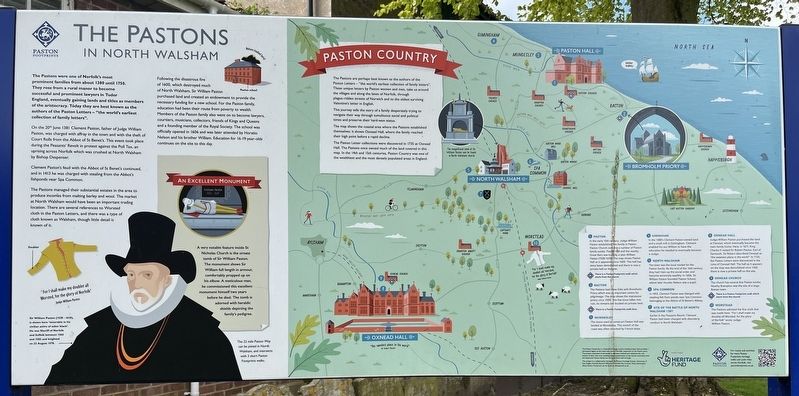
The Pastons were one of Norfolk's most prominent families from about 1380 until 1750. They rose from a rural manor to become successful and prominent lawyers in Tudor England, eventually gaining lands and titles as members of the aristocracy. Today they are best known as the authors of the Paston Letters - "the world's earliest collection of family letters".
On the 20th June 1381 Clement Paston, father of Judge William Paston, was charged with affray in the town and with the theft of Court Rolls from the Abbot of St Benet's. This event took place during the Peasants' Revolt in protest against the Poll Tax, an uprising across Norfolk which was crushed at North Walsham by Bishop Despenser.
Clement Paston's feud with the Abbot of St Benet's continued, and in 1413 he was charged with stealing from the Abbot's fishponds near Spa Common.
The Pastons managed their substantial estates in the area to produce incomes from malting barley and wool. The market at North Walsham would have been an important trading location. There are several references to Worsted cloth in the Paston Letters, and there was a type of cloth known
this page online
Sir William Paston (1528-1610), is shown here 'venerable in his civilian attire of sober black'. He was Sheriff of Norfolk and Suffolk between 1565 1582 and knighted on 22 August 1578.
Following the disastrous fire of 1600, which destroyed much of North Walsham, Sir William Paston purchased land and created an endowment to provide the necessary funding for a new school. For the Paston family, education had been their route from poverty to wealth. Members of the Paston family also went on to become lawyers, courtiers, musicians, collectors, friends of Kings and Queens and a founding member of the Royal Society. The school was officially opened in 1606 and was later attended by Horatio Nelson and his brother William. Education for 16-19-year-olds continues on the site to this day.
An Excellent Monument
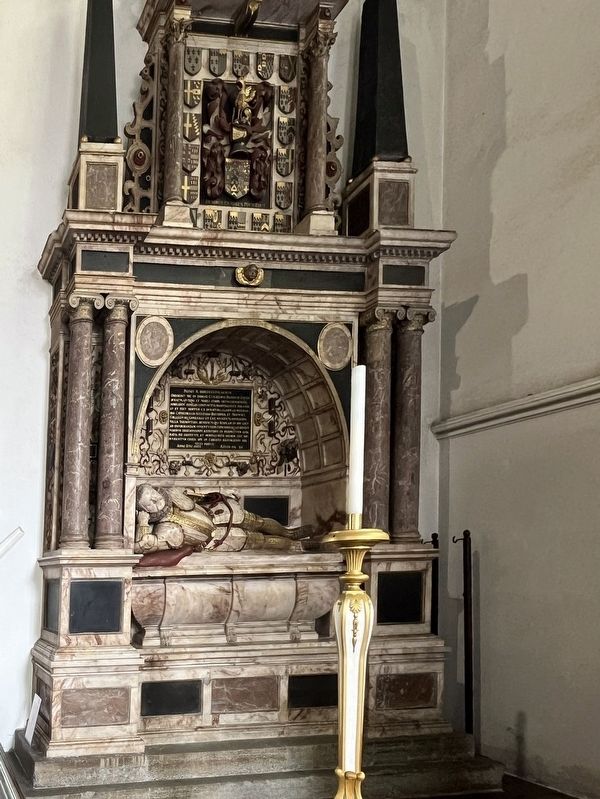
A very notable feature inside St Nicholas Church is the ornate tomb of Sir William Paston. The monument shows Sir William full length in armour, comfortably propped up on his elbow. A meticulous man, he commissioned this excellent monument himself two years before he died. The tomb
Photographed by Ray Gurganus, April 23, 2026
2. William Paston Monument, St Nicholas Church
Paston Country
The Pastons are perhaps best known as the authors of the Paston Letters - "the world's earliest collection of family letters". These unique letters by Paston women and men, take us around the villages and along the lanes of Norfolk, through plague-ridden streets of Norwich and to the oldest surviving Valentine's letter in English.
This journey tells the story of a family desperately trying to navigate their way through tumultuous social and political times and preserve their hard-won status.
The map shows the coastal area where the Pastons established themselves: it shows Oxnead Hall, where the family reached their high point before a rapid decline.
The Paston Letter collections were discovered in 1735 at Oxnead Hall. The Pastons once owned much of the land covered in this map. In the 14th and 15th centuries, Paston Country was one of the wealthiest and the most densely populated areas in England.
Map Captions
1. Paston
In the early 15th century, Judge William Paston established the family in Paston. Paston Church contains a number of
Photographed by Ray Gurganus, April 23, 2026
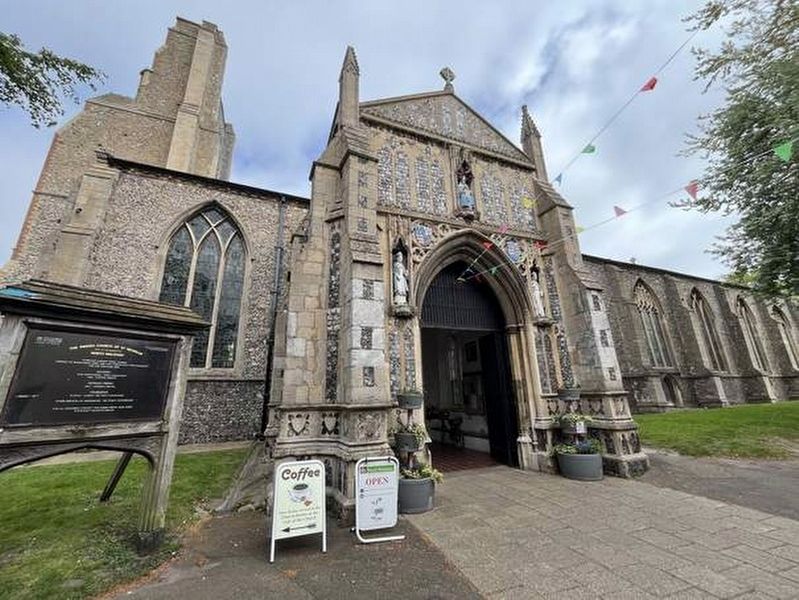
3. St Nicholas Church
2. Bacton
The Pastons had close links with Bromholm Priory which was an important centre for pilgrimage. The map shows the impressive priory circa 1500. This has since fallen into ruin, its remains are located on private land.
3. Mundesley
The stone used to construct Paston Hall was landed at Mundesley. This stretch of the coast was often attacked by French ships.
4. Gimingham
In the 1380's Clement Paston owned land and a small mill in Gimingham. Clement enabled his son William to have the education he needed to eventually become a Judge.
5. North Walsham
The town was the local market for the Paston family. By the end of the 16th century they had risen up the social order and become extremely wealthy. In 1606, Sir William Paston founded Paston School, where later Horatio Nelson was a pupil.
6. Spa Common
In 1413, Clement Paston was charged with stealing fish from ponds near Spa Common belonging to the Abbot of St Benet's Abbey.
7. Site of the Battle of North Walsham 1381
Earlier in the Peasants Revolt, Clement Paston had been charged with disorderly conduct in North Walsham.
8. Oxnead Hall
Judge William Paston purchased the land at Oxnead, which eventually became the main family home. Here, in 1671, King Charles II visited Sir Robert Paston, Earl of Yarmouth. Sir Robert described Oxnead as "the sweetest place in the world". In 1735, the Paston Letters were discovered in the ruins of Oxnead Hall. The hall as it appears on the map was demolished circa 1760, there is now a private hall on this site.
9. Oxnead Church
The church has several fine Paston tombs. Nearby Brampton was the site of a large Roman town.
10. Worstead
The Pastons admired the fine cloth that was made here. "For I shall make my doublet all Worsted, for the glory of Norfolk" wrote Judge William Paston.
Topics. This historical marker is listed in this topic list: Notable Places.
Location. 52° 49.291′ N, 1° 23.196′ E. Marker is in North Walsham, England, in Norfolk. On the grounds of St Nicholas Church. Touch for map. Marker is in this post office area: North Walsham, England NR28 9BP, United Kingdom. Touch for directions.

Regionally, this marker is in East Anglia. Globally, it is on the Atlantic Ocean, in the North Atlantic Region, in Europe, in Atlantic Europe, on one of the British Isles, in the Western World, and in the Anglosphere. Historically, it finds itself in what was once the Roman Empire.
Other nearby markers. At least 8 other markers are within 23 kilometers of this marker, measured as the crow flies: The town with two stations (approx. 0.4 kilometers away); Bronze Ballet, 1940 (approx. 13.7 kilometers away); Elm Hill (approx. 21.9 kilometers away); Pull's Ferry (approx. 21.9 kilometers away); Pull's Ferry House (approx. 21.9 kilometers away); Wrights Court (approx. 21.9 kilometers away); Edith Cavell (approx. 22 kilometers away); Augustine Steward House (approx. 22 kilometers away).
Also see . . . Paston Letters (Wikipedia). Overview:
The Paston Letters are a collection of correspondence between members of the Paston family of Norfolk gentry and others connected with them in England between the years 1422 and 1509. The collection also includes state papers and other important documents.(Submitted on October 5, 2026.)
The letters are a noted primary source for information about life in England during the Wars of the Roses and the early Tudor period. They are also of interest to linguists and historians of the English language, being written during the Great Vowel Shift, and documenting the transition from Late Middle English to Early Modern English.
Credits. This page was last revised on October 5, 2026. It was originally submitted on October 2, 2026, by Ray Gurganus of Washington, District of Columbia. This page has been viewed 4 times since then. Photos: 1, 2, 3. submitted on October 2, 2026, by Ray Gurganus of Washington, District of Columbia. • Andrew Ruppenstein was the editor who published this page.
Editor’s want-list for this marker. photo of the marker within its surroundings • Can you help?
