North Scituate in Providence County, Rhode Island — The American Northeast (New England)
Old Congregational Church
Scituate Heritage Trail
| — | Historic Scituate, Rhode Island | — |
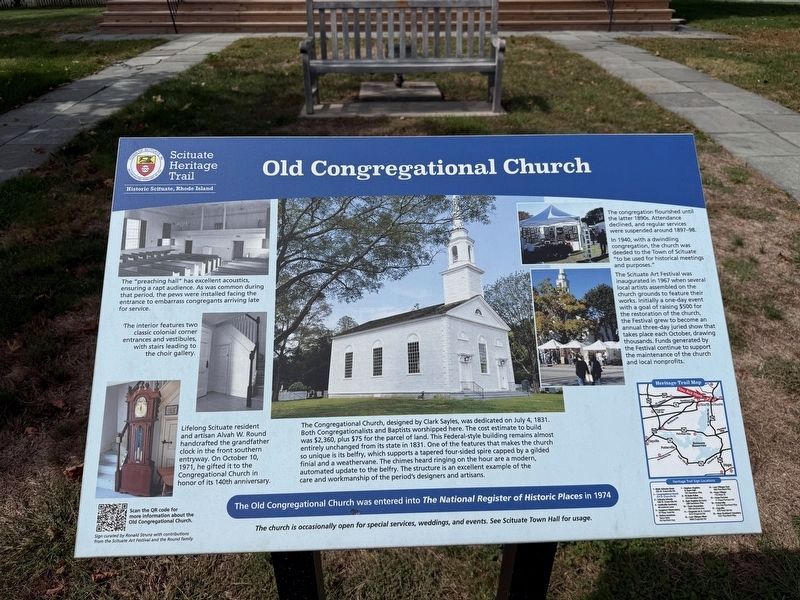
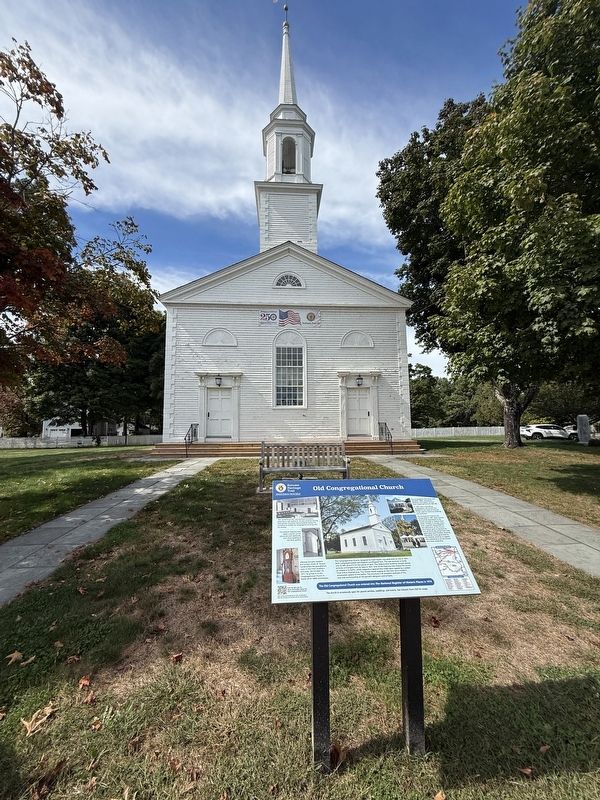
The Congregational Church, designed by Clark Sayles, was dedicated on July 4, 1831. Both Congregationalists and Baptists worshipped here. The cost estimate to build was $2,360, plus $75 for the parcel of land. This Federal-style building remains almost entirely unchanged from its state in 1831. One of the features that makes the church so unique is its belfry, which supports a tapered four-sided spire capped by a gilded finial and a weathervane. The chimes heard ringing on the hour are a modern automated update to the belfry. The structure is an excellent example of the care and workmanship of the period's designers and artisans.
The "preaching hall" has excellent acoustics, ensuring a rapt audience. As was common during that period, the pews were installed facing the entrance to embarrass congregants arriving late for service.
The interior features two classic colonial corner entrance and vestibules, with stairs leading to the choir gallery.
Lifelong Scituate resident and artisan Alvah W. Round handcrafted the grandfather clock in the front southern entryway. On October 10, 1971, he gifted it to the Congregational
this page online
The congregation flourished until the latter 1890s. Attendance declined, and regular services were suspended around 1897-98.
In 1940, with a dwindling congregation, the church was deeded to the Town of Scituate "to be used for historical meetings and purposes."
The Scituate Art Festival was inaugurated in 1967 when several local artists assembled on the church grounds to feature their works. Initially a one-day event with a goal of raising $500 for the restoration of the church, the Festival grew to become an annual three-day juried show that takes place each October, drawing thousands. Funds generated the Festival continue to support the maintenance of the church and local nonprofits.
The church is occasionally open for special services, weddings, and events. See Scituate Town Hall for usage.
Erected by Town of Scituate, Rhode Island.
Topics. This historical marker is listed in these topic lists: Architecture • Religion & Religious Structures. A significant historical date for this entry is July 4, 1831.
Location. 41° 50.062′ N,

Regionally, this marker is in the Quiet Corner and in Greater Providence. It is also in the American Northeast, in New England, and on the Eastern Seaboard. Globally, it is in the North Atlantic Region, North America, the Western Hemisphere, the Western World, and the Anglosphere. Historically, it finds itself in what was once one of the original Thirteen Colonies.
Other nearby markers. At least 8 other markers are within walking distance of this marker: The Village of North Scituate / Scituate, Rhode Island (a few steps from this marker); Korea Memorial (within shouting distance of this marker); Owen Soldiers' Monument (within shouting distance of this marker); Scituate Honor Roll (within shouting distance of this marker); Vietnam Veterans Memorial (within shouting distance of this marker); Revolutionary War Memorial (within shouting distance of this marker); a different marker also named Scituate Honor Roll (within shouting distance of this marker); The Richmond Mill Bell (within shouting distance of this marker). Touch for a list and map of all markers in Scituate.
Also see . . . National Register of Historic Places nomination form for the church.
This form was prepared by Richard B. Harrington, a consultant for the Rhode Island Historical Preservation Commission on February 15, 1973. The statement of historical significance beings on page 3:
(Submitted on October 3, 2026, by Devry Becker Jones of Washington, District of Columbia.)
North Scituate's Old Congregational Church--placed on the simply-landscaped but conspicuous site, with a Civil War memorial on the south and World War memorials to the north--remains an important adornment of its small community. It is very fortunate that it does remain there, for at one time there was areal danger that the structure would be dismantled and re-erected elsewhere in Rhode Island. This building is a fine, intact example of the small-town New England church of the early XIX Century, conceived and erected simply and economically, but with conscious taste, reflected proudly if naively a relationship with earlier or grander products of classical and academic architecture and displaying plainly the careful though and excellent workmanship of local designers and artisans.
Credits. This page was last revised on October 3, 2026. It was originally submitted on October 3, 2026, by Devry Becker Jones of Washington, District of Columbia. This page has been viewed 4 times since then. Photos: 1, 2. submitted on October 3, 2026, by Devry Becker Jones of Washington, District of Columbia.
