Tower Hamlets in Greater London, England, United Kingdom — Northwestern Europe (the British Isles)
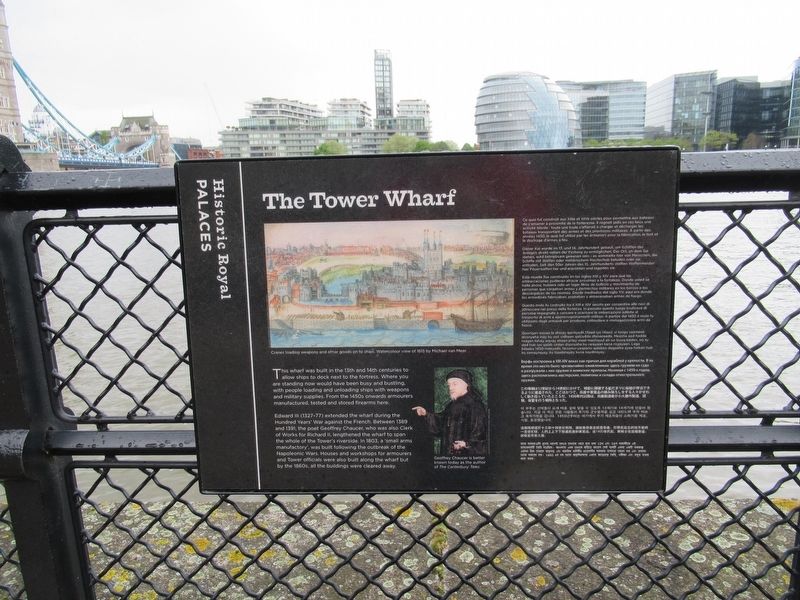
The Tower Wharf
Photographed by Michael Herrick, April 27, 2018
1. The Tower Wharf Marker
This wharf was built in the 13th and 14th centuries to allow ships to dock next to the fortress. Where you are standing now would have been busy and bustling with people loading and unloading ships with weapons and military supplies. From the 1450s onwards armourers manufactured, tested and stored firearms here.
Edward III (1327-77) extended the wharf during the Hundred Years' War against the French. Between 1389 and 1391, the poet Geoffrey Chaucer, who was also Clerk of Works for Richard II, lengthened the wharf to span the whole of the Tower's riverside. In 1803, a 'small arms manufactory', was built following the outbreak of the Napoleonic Wars. Houses and workshops for armourers and Tower officials were also built along the wharf but by the 1860s, all the buildings were cleared away.
Topics. This historical marker is listed in this topic list: Forts and Castles. A significant historical year for this entry is 1389.
Location. Marker has been permanently removed. It was located near 51° 30.445′ N, 0° 4.655′ W. Marker was in Tower Hamlets, England, in Greater London. It could be reached from the intersection of Tower
this page online
We have been informed that this marker is no longer there and will not be replaced. This page is an archival view of what was.
Regionally, this marker was in London and in the Greater South East. Globally, it was on the Atlantic Ocean, in the North Atlantic Region, in Europe, in Atlantic Europe, on one of the British Isles, in the Western World, and in the Anglosphere. Historically, it found itself in what was once the Roman Empire.

Other nearby markers. At least 8 other markers are within walking distance of this location: St Thomas’s Tower (within shouting distance of this marker); Traitors' Gate (within shouting distance of this marker); The Tower Under Attack (within shouting distance of this marker); The Western Entrance (within shouting distance of this marker); a different marker also named St Thomas's Tower (within shouting distance of this marker); Guarding the Tower (within shouting distance of this marker);
Photographed by Michael Herrick, April 27, 2018
2. The Tower Wharf Marker
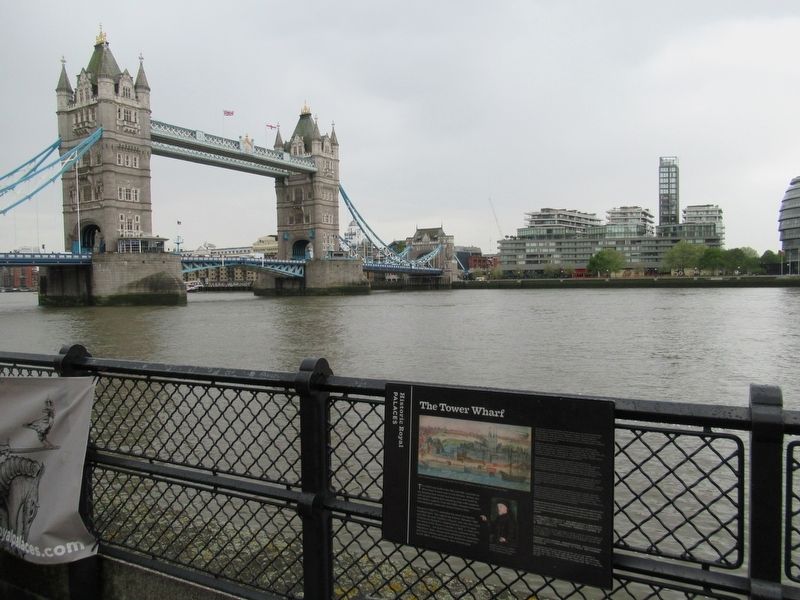
Behind the marker is the River Thames and Tower Bridge.
Other markers no longer nearby. The Queen’s Stairs (was within shouting distance of this marker but has been permanently removed); The Bell Tower (was within shouting distance of this marker but has been replaced with another marker now near it); Saluting Battery (was within shouting distance of this marker but has been permanently removed); The Byward Postern (was within shouting distance of this marker but has been replaced with another marker now near it); The Tower of London foreshore (was within shouting distance of this marker but has been permanently removed); Western entrance (was within shouting distance of this marker but has been replaced with another marker now near it).
Also see . . .
1. Tower of London. (Submitted on May 14, 2018, by Michael Herrick of Southbury, Connecticut.)
2. Tower of London on Wikipedia. (Submitted on May 14, 2018, by Michael Herrick of Southbury, Connecticut.)
Credits. This page was last revised on October 6, 2026. It was originally submitted on May 14, 2018, by Michael Herrick of Southbury, Connecticut. This page has been viewed 2,645 times since then and 137 times this year. Last updated on October 3, 2026, by Ian Lefkowitz of New York, New York. Photos: 1, 2. submitted on May 14, 2018, by Michael Herrick of Southbury, Connecticut. • Devry Becker Jones was the editor who published this page.
