Tower Hamlets in Greater London, England, United Kingdom — Northwestern Europe (the British Isles)
The coronation procession
Photographed by Michael Herrick, April 27, 2018
1. The coronation procession Marker

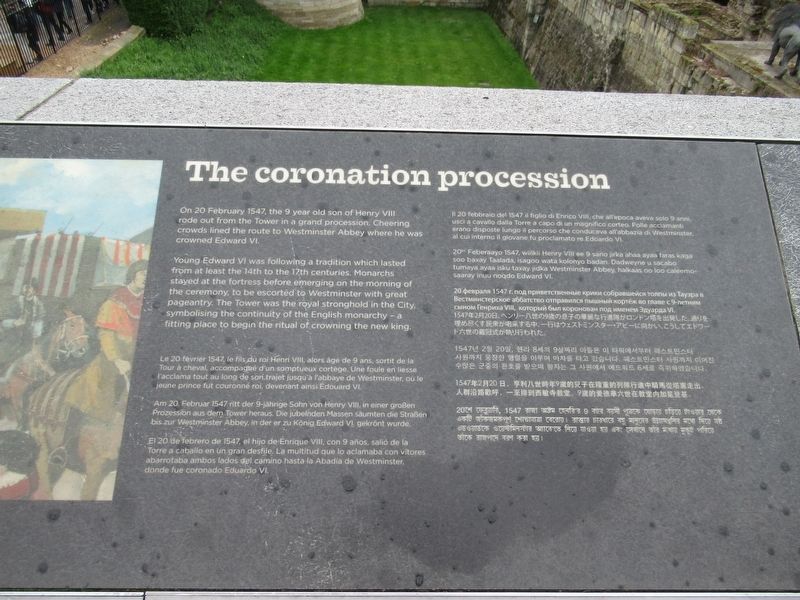
On 20 February 1547, the 9 year old son of Henry VIII rode out from the Tower in a grand procession. Cheering crowds lined the route to Westminster Abbey where he was crowned Edward VI.
Young Edward VI was following a tradition which lasted from at least the 14th to the 17th centuries. Monarchs stayed at the fortress before emerging on the morning of the ceremony, to be escorted to Westminster with great pageantry. The Tower was the royal stronghold in the City symbolising the continuity of the English monarchy — a fitting place to begin the ritual of crowning the new king.
this page online
( the text is also presented in six additional languages)
Topics. This historical marker is listed in this topic list: Forts and Castles. A significant historical date for this entry is February 20, 1547.
Location. Marker has been permanently removed. It was located near 51° 30.501′ N, 0° 4.698′ W. Marker was in Tower Hamlets, England, in Greater London. It could be reached from the intersection of Tower Hill and Trinity Square, on the left when traveling west. Located on the Tower of London Plaza. Touch for map. Marker was in this post office area: Tower Hamlets, England EC3N 4DH, United Kingdom.
We have been informed that
Photographed by Michael Herrick, April 27, 2018
2. The coronation procession Marker
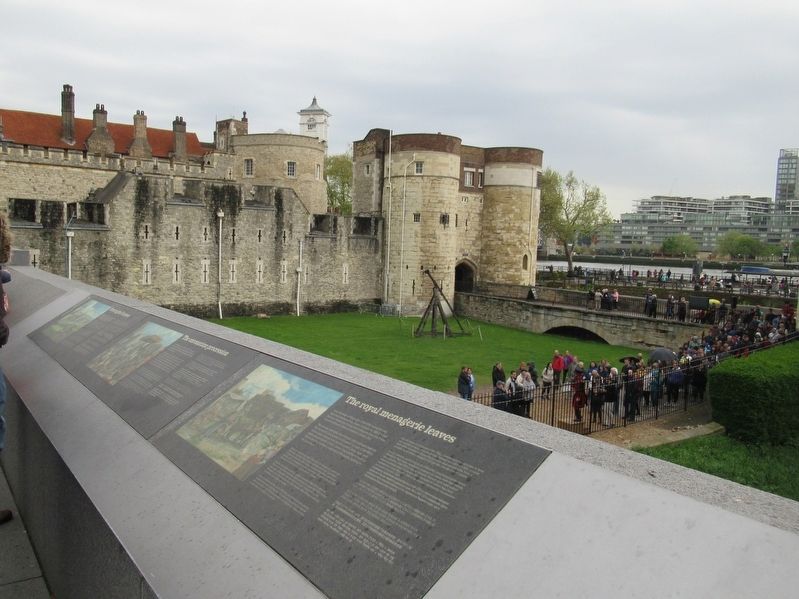
The marker is at the center. Beyond the marker are walls and fortifications of the Tower of London.
Regionally, this marker was in London and in the Greater South East. Globally, it was on the Atlantic Ocean, in the North Atlantic Region, in Europe, in Atlantic Europe, on one of the British Isles, in the Western World, and in the Anglosphere. Historically, it found itself in what was once the Roman Empire.

Other nearby markers. At least 8 other markers are within walking distance of this location: Historic Royal Palaces (a few steps from this marker); The Wharfinger’s Cottage (within shouting distance of this marker); The Tower's Community (within shouting distance of this marker); Wharfinger Cottage (within shouting distance of this marker); William the Conqueror (within shouting distance of this marker); King Charles II (within shouting distance of this marker); The Tower Under Attack (within shouting distance of this marker); The Western Entrance (within shouting distance of this marker). Touch for a list and map of all markers in Tower Hamlets.
Other markers no longer nearby. The royal menagerie leaves (was here, next to this marker but has been permanently removed); Entering the fortress (was here, next to this marker but has been permanently removed); Tea on Tower Hill (was here, next to this marker but has been permanently removed); A place of execution (was here, next to this marker but has been permanently removed); The fortress extends (was here, next to this marker but has been permanently removed); The Byward Postern (was within shouting distance of this marker but has been replaced with another marker now near it); Western entrance (was within shouting distance of this marker but has been replaced with another marker now near it).
Also see . . .
1. Tower of London. (Submitted on May 13, 2018, by Michael Herrick of Southbury, Connecticut.)
2. Tower of London on Wikipedia. (Submitted on May 13, 2018, by Michael Herrick of Southbury, Connecticut.)
Credits. This page was last revised on October 6, 2026. It was originally submitted on May 13, 2018, by Michael Herrick of Southbury, Connecticut. This page has been viewed 272 times since then and 16 times this year. Last updated on October 3, 2026, by Ian Lefkowitz of New York, New York. Photos: 1, 2. submitted on May 13, 2018, by Michael Herrick of Southbury, Connecticut. • Devry Becker Jones was the editor who published this page.
Editor’s want-list for this marker. Text from the marker in all languages. • Can you help?
