Kensington in Kensington and Chelsea in Greater London, England, United Kingdom — Northwestern Europe (the British Isles)
Sir Edward Burne-Jones
1833–1898
Photographed by Ian Lefkowitz, September 11, 2026
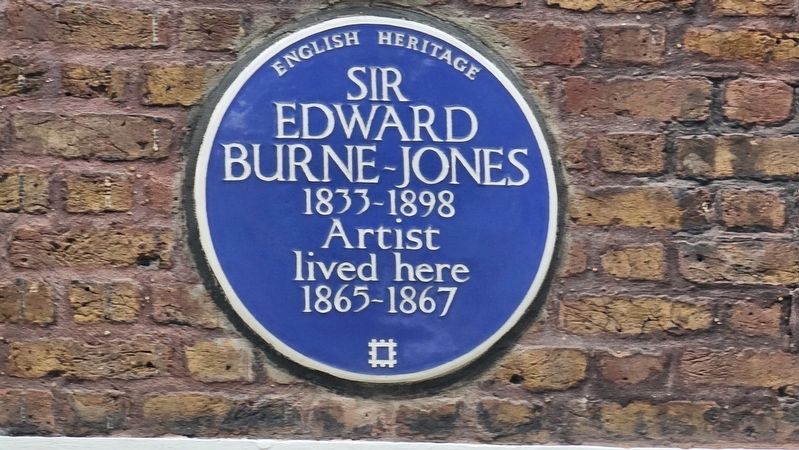
1. Sir Edward Burne-Jones Marker
Edward
Burne-Jones
1833–1898
Artist
lived here
1865–1867
Erected 1998 by English Heritage.
Topics. This historical marker is listed in this topic list: Arts, Letters, Music. A significant historical year for this entry is 1865.
Location. 51° 30.055′ N, 0° 11.413′ W. Marker is in Kensington and Chelsea, England, in Greater London. It is in Kensington. It can be reached from Kensington Square west of Young Street, on the right when traveling west. Touch for map. Marker is at or near this postal address: 41 Kensington Square, Kensington and Chelsea, England W8 5HP, United Kingdom. Touch for directions.

Regionally, this marker is in London and in the Greater South East. Globally, it is on the Atlantic Ocean, in the North Atlantic Region, in Europe, in Atlantic Europe, on one of the British Isles, in the Western World, and in the Anglosphere. Historically, it finds itself in what was once the Roman Empire.
Other nearby markers. At least 8 other markers are within walking distance of this marker: Sir John Simon (a few steps from this marker); W. M. Thackeray (within shouting distance of this marker); Mrs Patrick Campbell
this page online
Also see . . .
1. Burne-Jones, Sir Edward (1833-1898) (English Heritage). (Submitted on October 4, 2026, by Ian Lefkowitz of New York, New York.)
2. Edward Burne-Jones (Britannica).
Edward Burne-Jones (born August 28, 1833, Birmingham, England—died June 17, 1898, London) was one of the leading painters and designers of late 19th-century England, whose romantic paintings using medieval imagery were among the last manifestations of the Pre-Raphaelite style. More long-lasting is his influence as a pioneer of the revival of the ideal of the “artist-craftsman,” so influential to the development of 20th-century industrial design.(Submitted on October 4, 2026, by Ian Lefkowitz of New York, New York.)
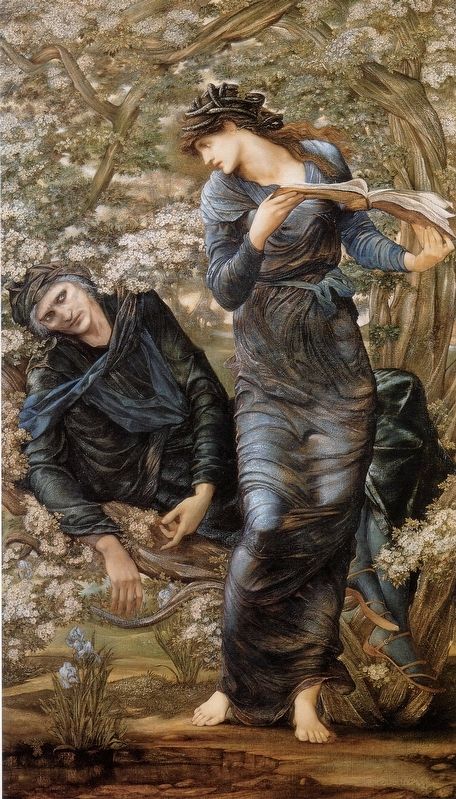
Edward Burne-Jones - Scanned from Wildman, Stephen: Edward Burne-Jones: Victorian Artist-Dreamer
2. The Beguiling of Merlin, by Sir Edward Burne-Jones
Credits. This page was last revised on October 4, 2026. It was originally submitted on October 4, 2026, by Ian Lefkowitz of New York, New York. This page has been viewed 8 times since then. Photos: 1, 2. submitted on October 4, 2026, by Ian Lefkowitz of New York, New York. • Andrew Ruppenstein was the editor who published this page.
