Kensington in Kensington and Chelsea in Greater London, England, United Kingdom — Northwestern Europe (the British Isles)
John Stuart Mill
1806–1873
Simon Harriyott from Uckfield, England, January 16, 2013
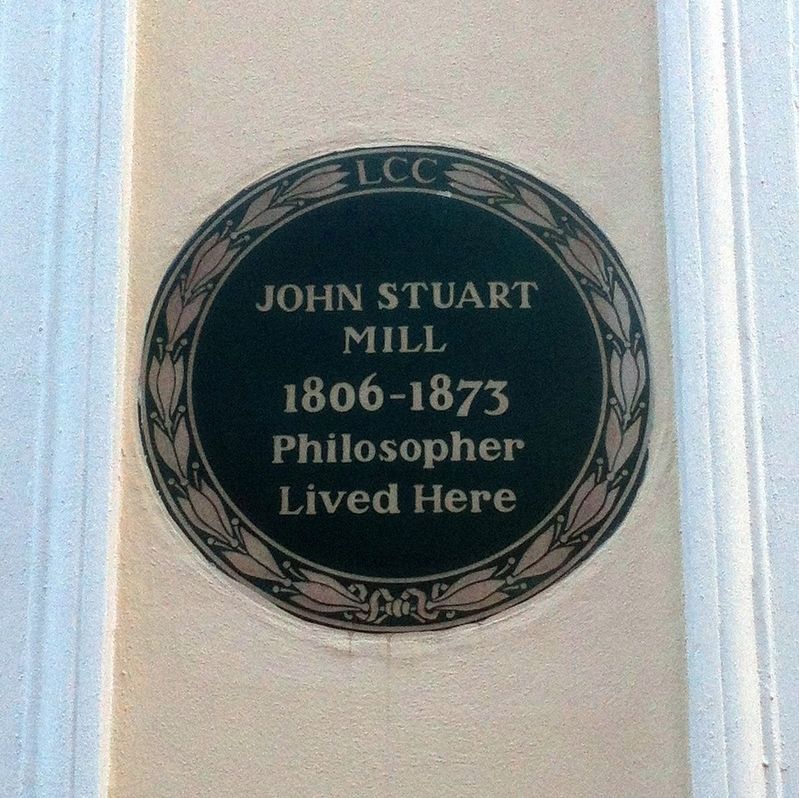
1. John Stuart Mill Marker
John Stuart Mill
1806–1873
Philosopher
Lived Here
Erected 1907 by London County Council.
Topics. This historical marker is listed in this topic list: Arts, Letters, Music. A significant historical year for this entry is 1837.
Location. 51° 30.01′ N, 0° 11.391′ W. Marker is in Kensington and Chelsea, England, in Greater London. It is in Kensington. It can be reached from Kensington Square west of Thackeray Street, on the right when traveling east. Touch for map. Marker is at or near this postal address: 18 Kensington Square, Kensington and Chelsea, England W8 5SF, United Kingdom. Touch for directions.

Regionally, this marker is in London and in the Greater South East. Globally, it is on the Atlantic Ocean, in the North Atlantic Region, in Europe, in Atlantic Europe, on one of the British Isles, in the Western World, and in the Anglosphere. Historically, it finds itself in what was once the Roman Empire.
Other nearby markers. At least 8 other markers are within walking distance of this marker: Hubert Parry (here, next to this marker); Joan Sims (within shouting distance of this marker); Sir Edward Burne-Jones
this page online
Also see . . . Mill, John Stuart (1806-1873) (English Heritage).
Mill moved to 18 Kensington Square with his mother, Harriet (1782–1854), and eight younger brothers and sisters in 1837, following the death of his father, the philosopher James Mill. Here, John Stuart Mill continued to tutor his siblings according to the demanding curriculum prescribed by his father, and it was at Kensington Square that he wrote two of his most important works, A System of Logic (1843) and Principles of Political Economy (1848), the overarching themes of which were social progress and the relation of the individual to society.(Submitted on October 4, 2026, by Ian Lefkowitz of New York, New York.)
Additional keywords. green plaque
Photographed by Ian Lefkowitz, September 11, 2026
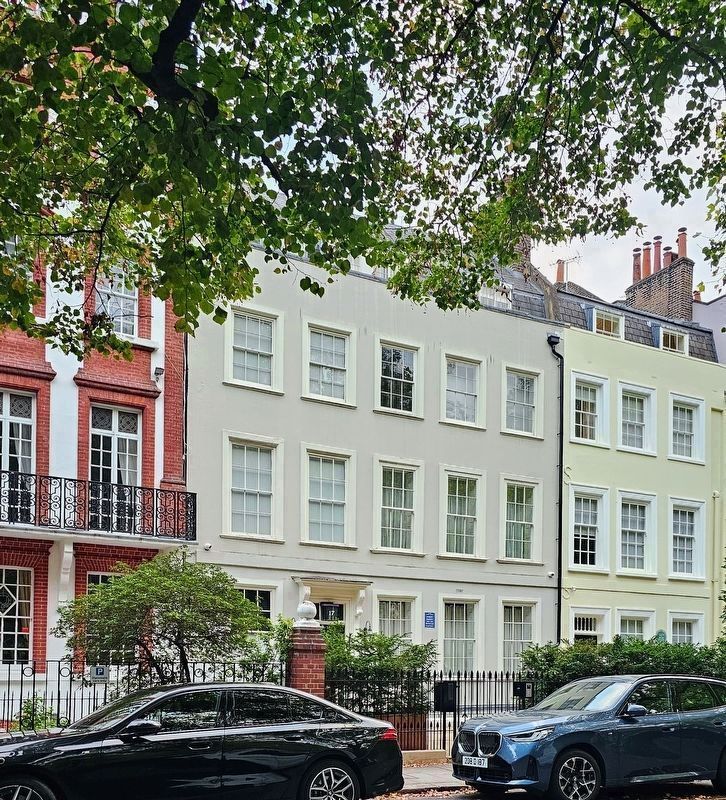
2. John Stuart Mill Marker
The marker is located above 18 Kensington Square (the rightmost home in this photograph).
Credits. This page was last revised on October 4, 2026. It was originally submitted on October 4, 2026, by Ian Lefkowitz of New York, New York. This page has been viewed 10 times since then. Photos: 1, 2. submitted on October 4, 2026, by Ian Lefkowitz of New York, New York. • Andrew Ruppenstein was the editor who published this page.
