Feuerbach in Stuttgart, Baden-Württemberg, Germany — Central Europe
Wilhelm Geiger
(1869–1940)
Photographed by James Hulse, September 10, 2026
1. Wilhelm Geiger Marker

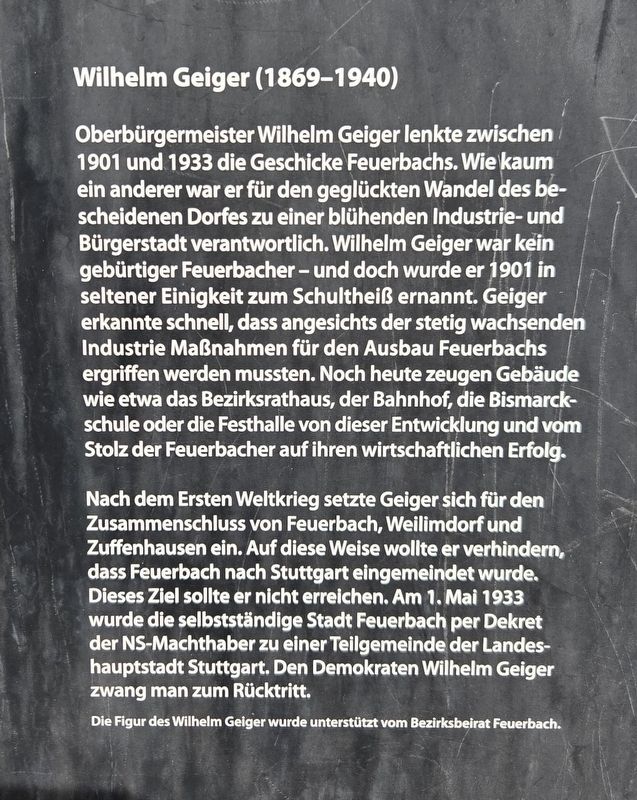
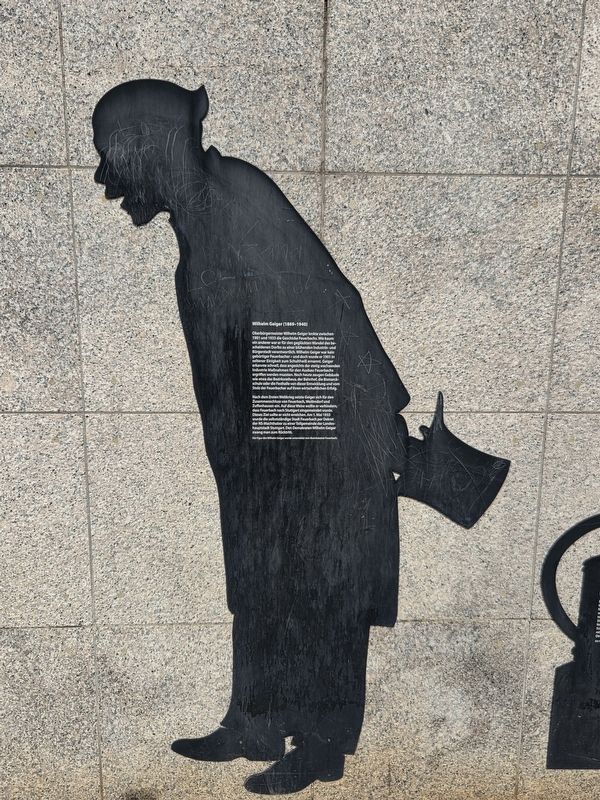
Nach dem Ersten Weltkrieg setzte Geiger sich für den Zusammenschluss von Feuerbach, Weilimdorf und Zuffenhausen ein. Auf diese Weise wollte er verhindern, dass Feuerbach nach Stuttgart eingemeindet wurde. Dieses Ziel sollte er nicht erreichen. Am 1. Mai 1933 wurde die selbstständige Stadt Feuerbach per Dekret der NS-Machthaber zu einer Teilgemeinde der Landeshauptstadt Stuttgart. Den Demokraten Wilhelm Geiger zwang man zum Rücktritt.
Die Figur des Wilhelm Geiger wurde unterstützt vom Bezirksbeirat Feuerbach.
Lord
this page online
Buildings such as the district town hall, railway station, Bismarck School and Festival Hall still bear witness to this development and to the pride Feuerbach’s residents took in their economic success. After the First World War, Geiger advocated the merger of Feuerbach, Weilimdorf and Zuffenhausen. In this way, he hoped to prevent Feuerbach from being incorporated into Stuttgart. He did not achieve this goal. On May 1, 1933, the Nazi authorities decreed that the independent town of Feuerbach would become part of the state capital, Stuttgart. Wilhelm Geiger, a democrat, was forced to resign.
The Wilhelm Geiger figure was supported by the Feuerbach District Advisory Council.
Topics. This
Photographed by James Hulse
2. Wilhelm Geiger Marker
Location. 48° 48.71′ N, 9° 9.55′ E. Marker is in Stuttgart, Baden-Württemberg. It is in Feuerbach. It is at the intersection of Wilhelm-Geiger-Platz and Grazer Str. on Wilhelm-Geiger-Platz. Touch for map. Marker is at or near this postal address: Wilhelm-Geiger-Platz 10, Stuttgart BW 70469, Germany. Touch for directions.

Regionally, this marker is in German Swabia. Globally, it is in Europe, the European Union, Atlantic Europe, Central Europe, the Schengen Area, Western Europe, and the Western World. Historically, it finds itself in what was once the Roman Empire, the Holy Roman Empire, and the former West Germany.
Other nearby markers. At least 8 other markers are within walking distance of this marker: Die gute Schneiderkanne! / The Good Schneider Watering Can! (here, next to this marker); Robert Bosch in Feuerbach (here, next to this marker); Auguste Happold (here, next to this marker); Schule in Feuerbach / Schools in Feuerbach (here, next to this marker); Der Talkrabb / The Valley Crow (here, next
Photographed by James Hulse, September 10, 2026
3. Wilhelm Geiger Marker
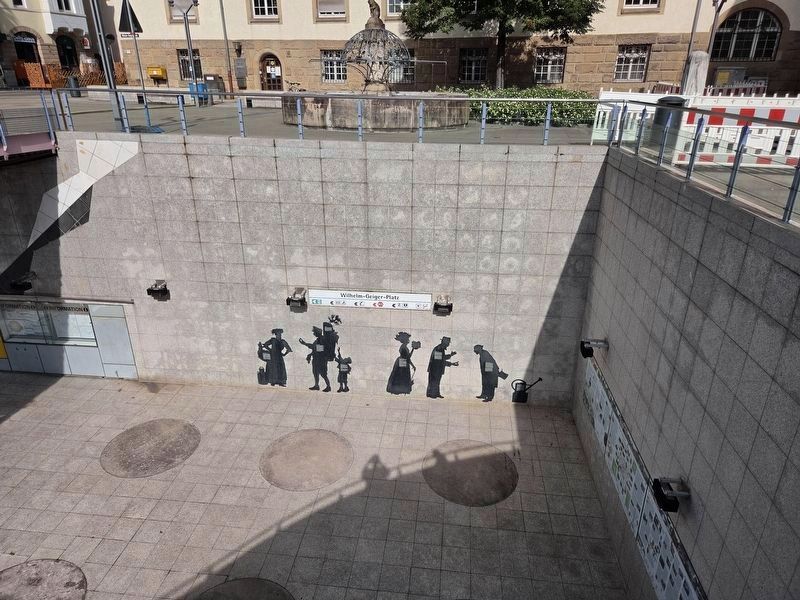
The markers are located on the lower level at the subway station.
Credits. This page was last revised on October 6, 2026. It was originally submitted on October 6, 2026, by James Hulse of Medina, Texas. This page has been viewed 3 times since then. Photos: 1, 2, 3. submitted on October 6, 2026, by James Hulse of Medina, Texas.
