Beattyville in Lee County, Kentucky — The American South (East South Central)
Appalachian Spring - Beattyville
⎯⎯⎯
William Hamilton Stepp
| — | America 250 | — |
Photographed by Dedra Brandenburg
1. Appalachian Spring - Beattyville Side
Appalachian Spring - Beattyville
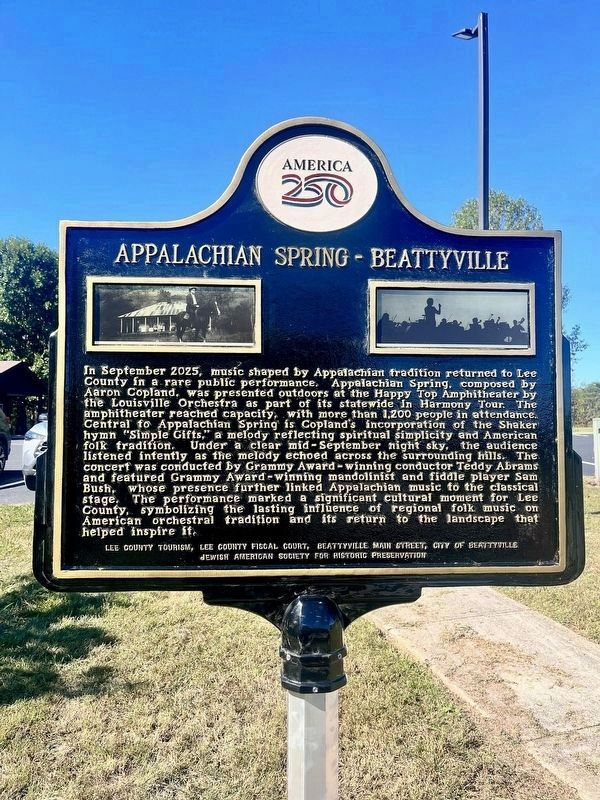
In September 2025, music shaped by Appalachian tradition returned to Lee County in a rare public performance. Appalachian Spring, composed by Aaron Copland, was presented outdoors at the Happy Top Amphitheater by the Louisville Orchestra as part of its statewide In Harmony Tour. The amphitheater reached capacity, with more than 1,200 people in attendance. Under a clear mid-September night sky, the audience listened in silence as Copland’s composition—rooted in American folk traditions—echoed through the surrounding hills. The concert was conducted by Grammy Award–winning conductor Teddy Abrams and featured Grammy Award–winning mandolinist Sam Bush, whose presence further linked Appalachian music to the classical stage. The performance marked a significant cultural moment for Lee County, symbolizing the lasting influence of regional folk music on American orchestral tradition and its return to the landscape that helped inspire it.
(Reverse Side)
William Hamilton Stepp
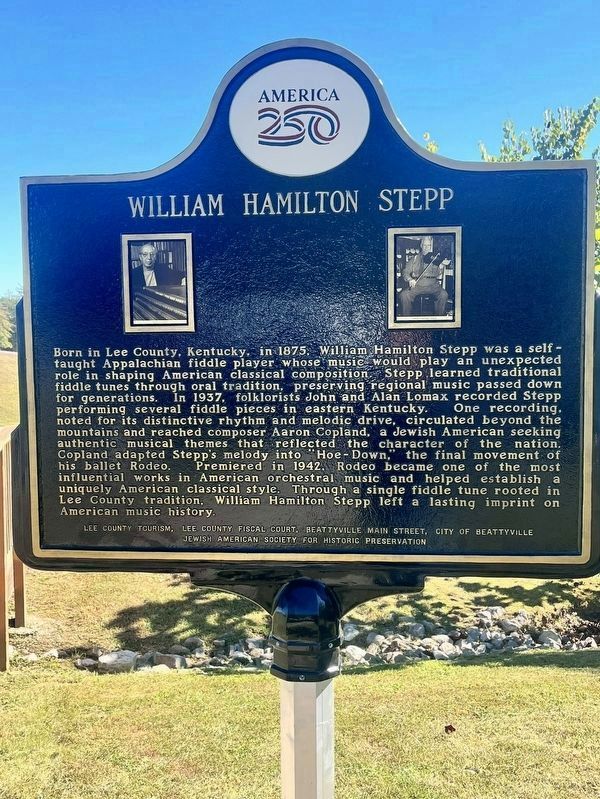
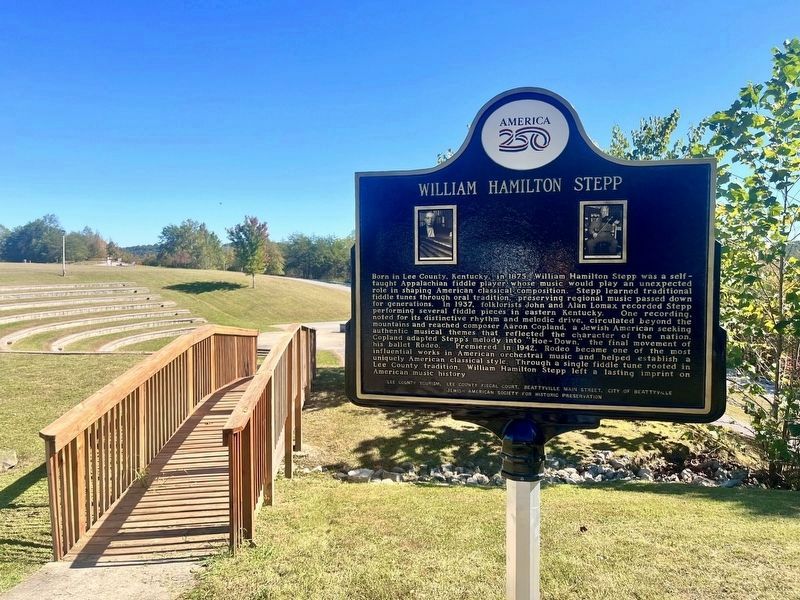
Born in Lee County, Kentucky in 1875, William Hamilton Stepp was a self-taught Appalachian fiddle player whose music
this page online
Erected 2026 by Jewish American Society for Historic Preservation, Lee County Tourism, Lee County Fiscal Court, Beattyville Main Street, city of Beattyville.
Topics. This historical marker is listed in these topic lists: Arts, Letters, Music
Photographed by Dedra Brandenburg
2. William Hamilton Stepp Side
Location. 37° 34.574′ N, 83° 43.238′ W. Marker is in Beattyville, Kentucky, in Lee County. It can be reached from Happy Top Road south of W Main Street. Happy Top Community Park at the entrance to the amphitheater. Touch for map. Marker is at or near this postal address: 500 Happy Top Rd, Beattyville KY 41311, United States of America. Touch for directions.

Regionally, this marker is in Eastern Kentucky and in the Cumberland Plateau. It is also in the American South, specifically in the Upper South, in Appalachia, and specifically in Southern Appalachia. Globally, it is in North America, the Western Hemisphere, the Western World, and the Anglosphere. Historically, it finds itself in what was once the territory of the Mississippian Culture and also the Antebellum South.
Other nearby markers. At least 8 other markers are within 8 miles of this marker, measured as the crow flies: County Named, 1870 (approx. 0.6 miles away); Kentucky River Forms Here (approx. 0.6 miles away); Lee County War Memorial (approx. 0.8 miles away); Lee County Veterans Wall (approx.
Photographed by Dedra Brandenburg
3. William Hamilton Stepp Side
Also see . . .
1. Appalachian Spring.
Appalachian Spring is an American ballet created by the choreographer Martha Graham and the composer Aaron Copland, later arranged as an orchestral work. Commissioned by Elizabeth Sprague Coolidge, Copland composed the ballet music for Graham; the original choreography was by Graham, with costumes by Edythe Gilfond and sets by Isamu Noguchi. The ballet was well received at the 1944 premiere, earning Copland the Pulitzer Prize for Music during its 1945 United States tour. The orchestral suite composed in 1945 was played that year by many symphony orchestras; the suite is among Copland's best-known works, and the ballet remains essential in the Martha Graham Dance Company repertoire.(Submitted on October 6, 2026, by Jerry Klinger of Boynton Beach, Florida.)
2. Appalachian Spring Suite. (Submitted on October 6, 2026, by Jerry Klinger of Boynton Beach, Florida.)
3. The Man Behind The Music.
Brooklyn, New York was a bustling place at the turn of the last century, filled with people of many nationalities. Many were immigrants; some were customers of Copland's Department Store on Washington Avenue. Described by Aaron Copland as "a kind of neighborhood Macy's," the store was operated by Sarah and Harris Copland, Russian-born, Jewish immigrants. They lived above and to the side of the store with their five children. Everyone in the family worked at the store. "Copland's" was the center of their lives.(Submitted on October 6, 2026, by Jerry Klinger of Boynton Beach, Florida.)
4. William Hamilton Stepp.
Stepp's version of the song was used as a major component of Aaron Copland's song "Hoe-Down" from the ballet Rodeo. "Hoe-Down" has in turn been covered by various artists, including Emerson, Lake and Palmer on their 1972 album Trilogy. It has also received use in television and film, including the American TV ad campaign "Beef. It's What's For Dinner".(Submitted on October 6, 2026, by Jerry Klinger of Boynton Beach, Florida.)
5. How one a poor Appalachian fiddler named William Hamilton Stepp changed American classical music for. (Submitted on October 6, 2026, by Jerry Klinger of Boynton Beach, Florida.)
6. Bill Stepp, Aaron Copland, and “Bonaparte’s Retreat”.
One of the best-known pieces from the archive is a distinctive version of the fiddle tune “Bonaparte’s Retreat,” recorded by Alan and Elizabeth Lomax in Salyersville, Kentucky, in 1937. According to the American Folklife Center’s founding director, Alan Jabbour, “Bonaparte’s Retreat” is probably Irish in origin, and was used for ballads about Napoleon’s defeat and exile. Samuel Bayard further tells us it was used as a military march during the Civil War. By the Lomaxes’ time it was a common slow dance tune, but the musician they recorded that day in Salyersville, William Hamilton Stepp, played it very differently from other renditions. In particular, he almost doubled the tempo of the tune, transforming it from a 4/4 march to a reel or hoedown. He also altered the rhythm enough to make the melody sound different from typical performances.(Submitted on October 6, 2026, by Jerry Klinger of Boynton Beach, Florida.)
Credits. This page was last revised on October 6, 2026. It was originally submitted on October 6, 2026, by Jerry Klinger of Boynton Beach, Florida. This page has been viewed 12 times since then. Photos: 1, 2, 3. submitted on October 6, 2026, by Jerry Klinger of Boynton Beach, Florida. • James Hulse was the editor who published this page.
